-
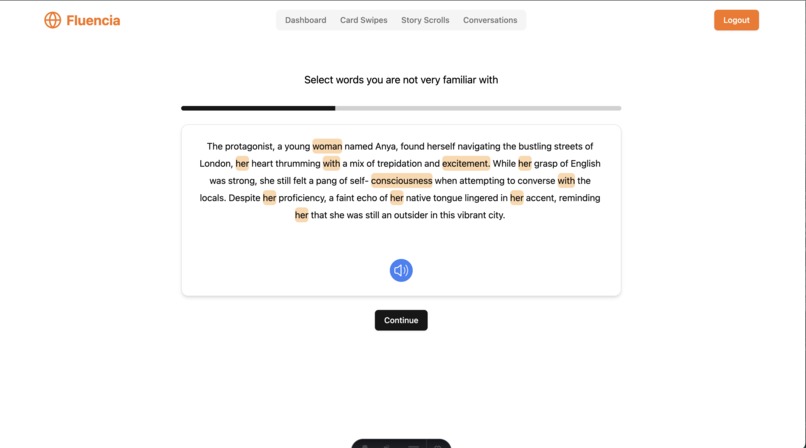
Onboarding Process
-
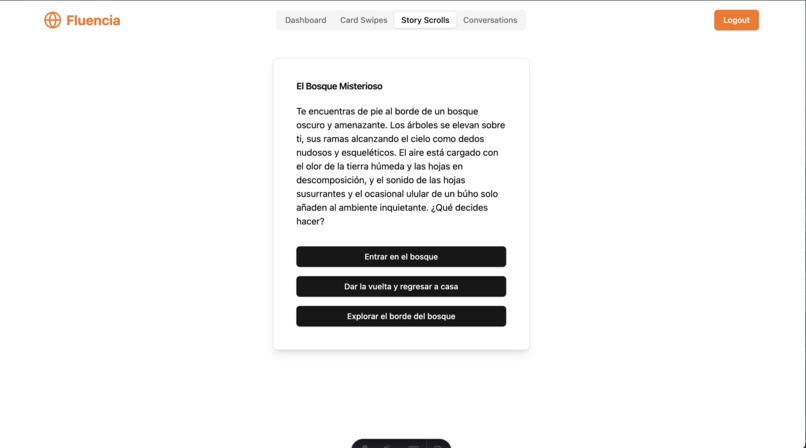
Choose Your Own Adventure
-
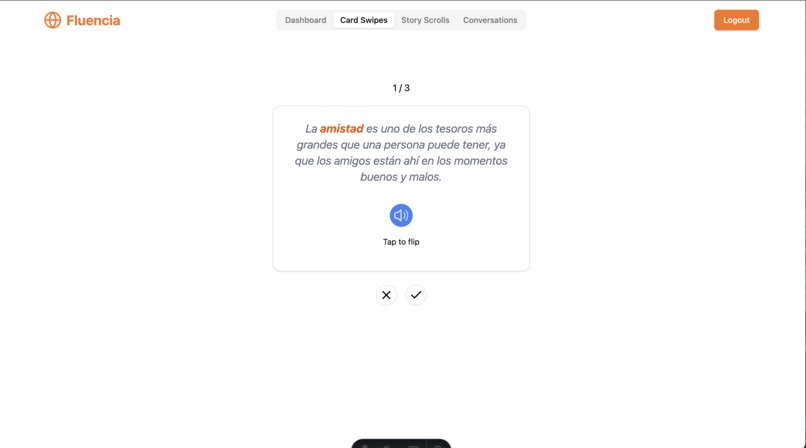
Flash Card Swipes
-
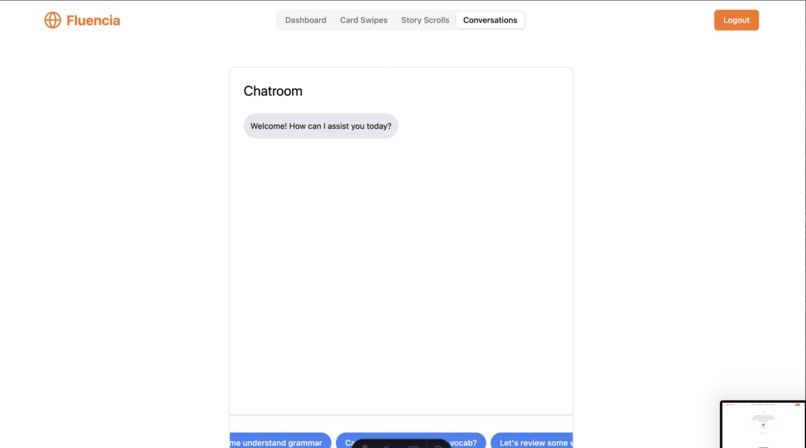
AI Chat Partner
-
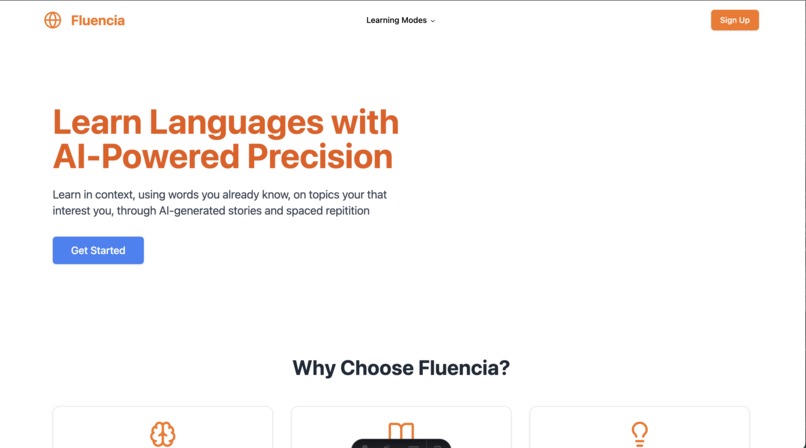
Home Page
-
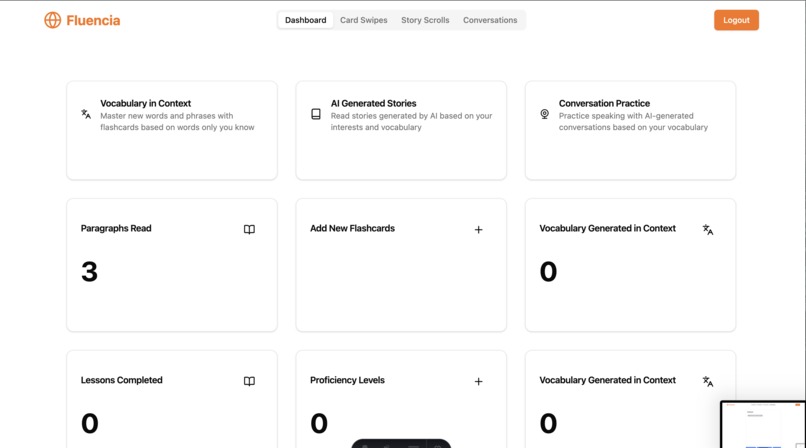
Dashboard


Inspiration
Our inspiration for Fluencia came from the experiences of two of our team members' families. Both sets of parents are Hispanic and immigrated to America in search of better opportunities but faced a significant challenge: the language barrier. Their struggle to learn English inspired us to create an app that not only teaches languages but also simplifies the process, making it more accessible and less overwhelming, especially for immigrants adapting to a new culture.
What it does
The website requires users to create an account and complete an onboarding quiz that assesses their language proficiency, from beginner to expert. This quiz also tracks known and unfamiliar words, which are then utilized across all learning tools. Then through the power of Google's Gemini AI, we provide three powerful tools to help users learn their desired language.
Tech
- Golang backend Deployed to AWS using Docker containers with a Firebase for database and user management
- Astro+React frontend deployed to Vercel. TailwindCSS and Shadcn used for styling and UI.
Features
Card Swipe The first is a Card Swipe tool, where users are presented with AI-generated sentences featuring a word they may not know. By swiping left or right, the AI adapts, learning which words the user knows and using a spaced repetition algorithm to ensure mastery of both vocabulary and context.
Story Scroll The second tool, Story Scroll, immerses users in an interactive, AI-generated, choose your own adventure story created in the target language. The story primarily uses words the user already knows, while strategically introducing new vocabulary to gradually challenge and expand their skills. This unique approach keeps users deeply engaged, much like a video game, but with the added advantage of limitless storylines and scenarios generated by AI. The dynamic nature of the content ensures that no two stories are alike, allowing users to explore endless narrative possibilities while steadily improving their language abilities in an entertaining way.
AI Chat Partner Lastly, the AI Chat Partner offers users the opportunity to engage in real-time, dynamic conversations with an AI in the language they are learning. This tool simulates natural language interactions, allowing users to practice speaking, writing, and comprehending the language in a practical, conversational context. The AI adjusts its responses based on the user’s proficiency, incorporating both familiar words and new vocabulary to keep the conversation challenging yet approachable. By engaging in these personalized conversations, users can practice grammar, sentence structure, and fluency in a way that mimics real-life communication, helping them build confidence and competence in the language.
Dashboard Users also have access to a detailed dashboard where they can track their language learning progress through clear and concise metrics. This includes statistics on the number of paragraphs they’ve read, lessons completed, proficiency levels achieved, and vocabulary learned both in context and through flashcards.
How we built it
Being a web-based platform, we utilize a wide variety of both back-end and front-end technologies. The back-end is built with GoLang and integrates Firebase as the database, deployed through a combination of Docker and AWS for scalability and reliability. On the front-end, we employed Tailwind CSS, Astro, React, elevenlabs, and Shadcn to create a seamless and responsive user interface. The front-end is deployed via Vercel, ensuring fast, reliable performance across devices.
Challenges we ran into
For many of our team members, this project was the first time working with several of these technologies. The learning curve was steep, especially with Golang, a programming language that none of us had experience with prior to this project. Adapting to Golang's unique syntax and concepts while, at the same time, building and deploying a full-scale backend was definitely one of the most challenging parts of the development process. On the front-end, the biggest challenge was ensuring the interface was accessible to all users, regardless of their technological skill level, which required thoughtful design and usability considerations throughout development. We also had to figure out the complex task of onboarding users, which involved designing a system to build a personalized vocabulary list that could be used throughout the rest of the application. This required careful planning and integration with our AI tools to ensure a fun learning experience. Additionally, as we scaled up development, we maxed out six Gemini API keys, highlighting just how much data and AI processing power went into creating the interactive and adaptive features of the app.
Accomplishments that we're proud of
We are really proud that all of us stepped out of our comfort zone to build and deploy an ambitious product using technologies we didn't really know. Initially, we were worried that the project was too complex for the hackathon, but we successfully completed it nonetheless. It was remarkable how much we learned and implemented new technologies in such a short time, pushing ourselves beyond what we thought possible.


Log in or sign up for Devpost to join the conversation.