-
-
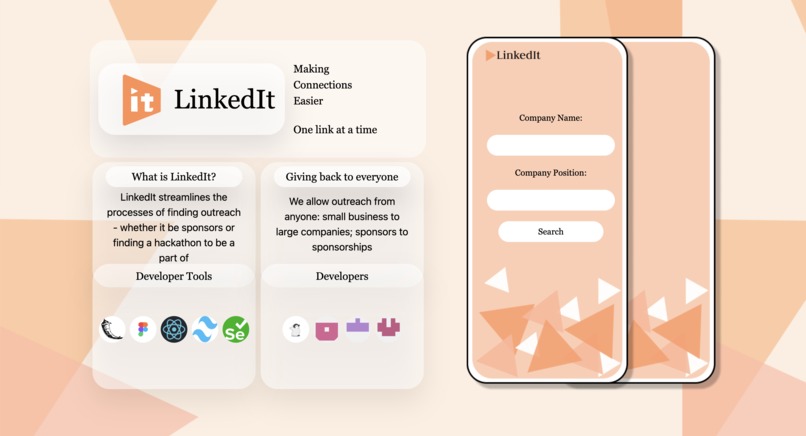
Landing Page
-
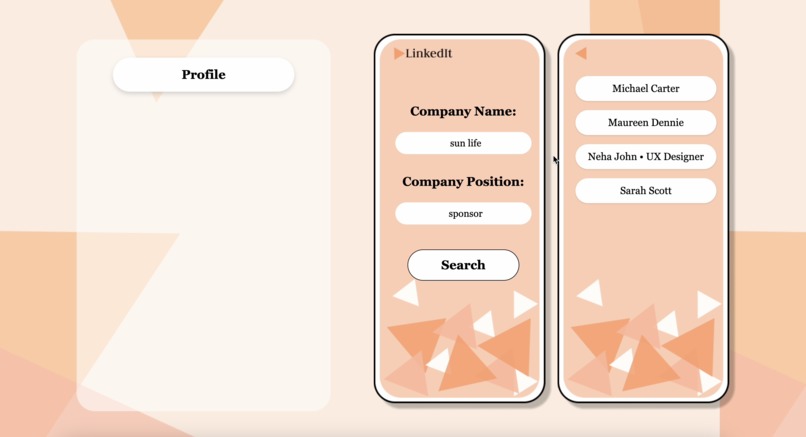
User Profiles
-
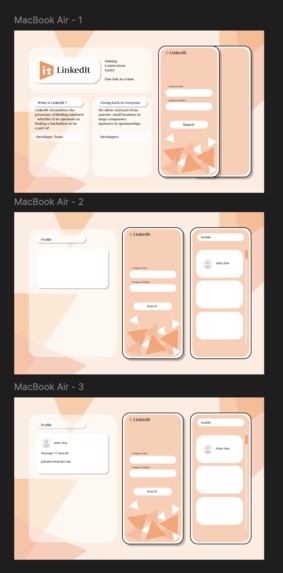
Figma Prototype


Inspiration
After experiencing the toils that sponsorship teams must go through to find and contact sponsors, we wanted to find a way to make this process more efficient. This process includes searching LinkedIn company pages and filtering for positions, then scrolling through multiple profiles in pursuit of a personal email to contact. While firsthand experience with searching sponsors was our main identified problem, we realized this search for connections was generally arduous for most individuals. Thus, to streamline this LinkedIn problem, we created LinkedIt.
What it does
LinkedIt is a program that allows users to input two simple search terms, returning profiles from LinkedIn that match. This includes the profile name as well as the contact's headline, and most importantly, a quick access to their email. We reduce the time it takes for users to input fields themselves multiple times, and the scrolling for LinkedIn profiles.
How we built it
We began with project planning. We walked through the steps required to cover all bases of this project. This included breaking down the project into two parts: front-end and back-end.
Front-end:
- Visualizing UI with Figma
- Implementing elements in VSCode with React (JS), HTML, CSS with Tailwind CSS for streamlined styling.
Back-end
- Coding up an API using Selenium
- Imbedding it within the front-end
- Utilizing Flask to allow front-end access to the back-end API
Finally, when these two elements were completed, we integrated them together. This included making sure inputs were run through the API, and returned API outputs were shown as UI elements on the website.
Challenges we ran into
Overall, our team faced two challenges: one in back-end and one in front-end. Front-end faced some challenges when it came to integrating the multiple different components that came with our Figma UI visualization. There were a few times where div and flex were issues - where components would not set properly. Our greatest issue was creating dynamic movement with our components, where our animation was jerky and too sudden.
We also found out early on about the difficulties that came with implementing the LinkedIn API with our program: it didn't fulfill our goals. We were unable to access key features that we wanted to implement through this API. Thus, we coded our own API to allow these accesses to happen. This included using Selenium, merging our back-end to our front-end code using Flask, as well as making sure our calls from the API was working and appearing on the UI. Each step of the back-end development was a consistently re-iterated upon, and went through multiple trials and tests.
Accomplishments that we're proud of
Our proudest achievement was getting through this project. Like mentioned in our challenges, this whole project was a learning experience filled with hardship. From the difficulties of designing a website using JS, CSS, and HTML, to coding a new API, to merging the two components together. Being able to work through this project to completion is definitely a highlight, and something we are super proud of.
What we learned
The biggest lesson that we learned was how to overcome difficult obstacles. In both our front-end and back-end, we've experienced many problems that were technically challenging and were constantly breaking on us. However, we learned to break down these problems into smaller problems, handling them all separately, finding the issues, and resolving them. Communication and collaboration played a key role in this.
What's next for LinkedIt
To make sure this process of connection is the most streamlined, a viable next step for LinkedIt would be to challenge ourselves to implement a way for users to email their contacts directly on our website. This means integrating a database into our project, as well as implementing security to protect the privacy of our users.
To provide benefits to those who are contacted, we would also like to implement a method where active connectors, like those who are often sponsoring events, will be shown to users more often. Showing to users who active connectors are can include highlighting searched up profiles or autofilling the search box. This is especially important to larger companies, where appealing to youth through sponsored events, can lead to higher interest and retain rate in companies and the outshining of competitors.



Log in or sign up for Devpost to join the conversation.