-
-
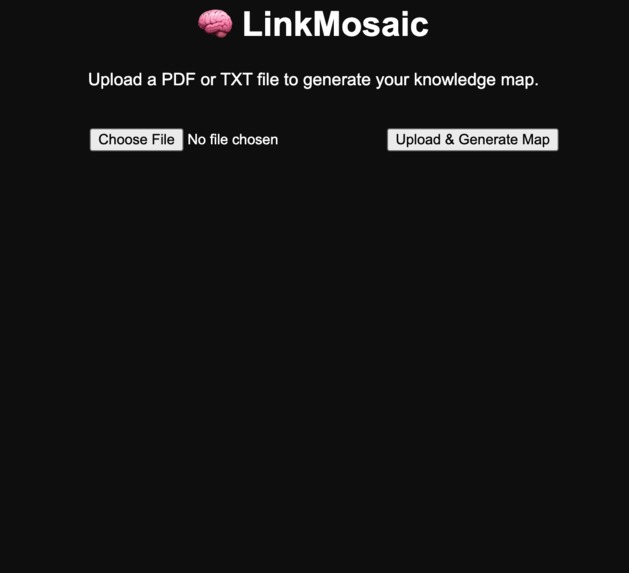
UI for LinkMosaic

Inspiration
Every day, we read thousands of words — articles, research papers, reports — but rarely see how ideas connect. We wanted to build a tool that could automatically visualize the relationships between concepts inside a document, transforming plain text into a structured map of understanding. That’s how LinkMosaic was born — to turn unstructured information into meaningful connections using AI and cloud automation.
What it does
LinkMosaic lets users upload a PDF or text file and automatically:
- Extracts the content from the document.
- Clusters related concepts and summarizes key points.
- Generates a JSON-based knowledge map showing how ideas connect.
- Uploads and displays this map visually through a simple web interface. It’s a fast, serverless way to convert any document into an interactive network of insights.
How we built it
Backend: AWS Lambda functions written in Python 3.11, orchestrated to process uploads and build maps. Storage: Amazon S3 buckets store uploaded files and generated knowledge maps. Integration: Amazon API Gateway connects the frontend to the backend securely via presigned URLs. Frontend: A lightweight HTML/JS interface (hosted on GitHub Pages) lets users upload documents and view the final map.
Pipeline:
- UploadSigner generates secure upload URLs
- Orchestrator coordinates processing
- MapBuilder outputs a final JSON map to S3
Everything runs serverlessly — no dedicated servers or databases required.
Challenges we ran into
Dependency packaging on AWS Lambda: Some Python libraries (like pdfminer and PyPDF2) required custom bundling to work correctly in the Lambda environment.
IAM permissions: S3 bucket access and cross-Lambda invocation policies were tricky to configure properly.
API Gateway integration: Adjusting the orchestrator to handle both S3 triggers and HTTP requests took extensive debugging.
Time management: Balancing multiple moving parts — Lambda functions, front end, and API routes — was challenging under hackathon deadlines.
Accomplishments that we're proud of
- Integrated multiple AWS services: Lambda, S3, API Gateway, into one cohesive system.
- Built a secure, scalable architecture with real-world use potential (document summarization, research tools, educational applications).
- Learned how to debug complex serverless workflows across multiple AWS layers.
What we learned
- How to design event-driven architectures on AWS.
- Best practices for packaging Python dependencies for Lambda.
- How to use presigned URLs for secure file uploads.
- How modularizing cloud functions improves scalability and debugging.
- That even small automation steps can drastically improve how we process and visualize information.
What's next for LinkMosaic
🌐 Add interactive visualizations (D3.js or React Graph) for map viewing. 🧩 Integrate LLMs via AWS Bedrock or OpenAI for deeper semantic analysis. 🔍 Support multi-document clustering to build cross-source knowledge graphs. 👥 Add user accounts for personalized maps and document histories. 🧠 Expand the pipeline with intelligent summarization and citation mapping.


Log in or sign up for Devpost to join the conversation.