-
-
-
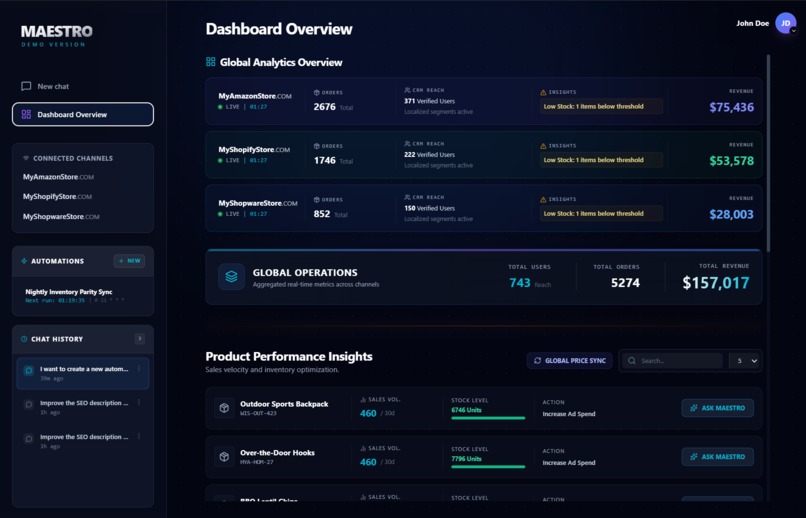
Dashboard


Inspiration
The inspiration for Maestro Ops comes directly from real-world pain.
When you run a small business with one shop and a handful of products, everything feels manageable. You update products manually, adjust prices, and keep stock under control without too much effort.
But as the business grows, reality hits hard.
Suddenly, you have:
- Hundreds of products Multiple e-commerce platforms (Shopify, Shopware, Magento, etc.)
- Possibly an ERP system that must stay in sync
- Different languages, prices, and stock levels per channel
At that point, even simple tasks—like updating a product description or syncing stock—become complex, slow, and error-prone. Teams need developers, translators, SEO specialists, and endless meetings just to keep systems aligned.
I’ve lived this problem daily as a developer working with ERPs, B2B platforms, and multiple e-commerce systems.
Maestro Ops was born from the idea that this complexity shouldn’t exist anymore. What if you could simply talk to your business systems?
What it does
Maestro Ops is an AI-powered operations layer that lets users manage their business through natural language.
Instead of clicking through dashboards, writing scripts, or coordinating multiple teams, users can simply say things like:
- “Improve the SEO description for product SKU 123 in German and French”
- “Sync stock levels across all shops every night at 9”
- “Show me my best and worst performing products this month”
- “Which customers haven’t ordered in 60 days, and what should I do?”
Maestro understands the intent, reasons over connected systems, and turns conversation into real actions.
If you can say it, Maestro will do it.
How we built it
The project is structured as a realistic but demo-friendly architecture:
Frontend
- Chat-based interface
- Dashboard views: Global Analytics Overview Product Performance Insights Customer Performance Insights
“Ask Maestro” actions that open contextual AI conversations
Data Layer (Demo Mode)
- Mock product, order, and customer data
- Multiple simulated “channels” (Shop, ERP, Email, etc.)
- Structured TypeScript modules acting as stand-ins for real APIs
AI Layer
- Gemini interprets user intent
- Reasons over structured business data
- Generates insights, suggestions, and actions
- Demonstrates how real MCPs / connectors would work in production
Although the demo uses mocked data, the architecture mirrors how Maestro would connect to real systems via APIs or MCP-style connectors.
Challenges we ran into
1- Simulating Reality Without Real APIs AI Studio cannot directly connect to external systems, so I had to design the project in a way that:
- Feels realistic
- Still demonstrates true business logic
- Clearly shows how it would scale to real integrations
2- Avoiding Over-Complexity There are many possible features (ERP sync, marketing automation, forecasting, staffing insights). One of the hardest parts was deciding what not to build—and focusing on a clear, strong core.
3- Designing for Non-Technical Users The biggest challenge wasn’t technical—it was UX thinking: How do you make advanced operations accessible to someone who doesn’t know what an ERP or API is?
The answer was conversation-first design.
Accomplishments that we're proud of
Designed a conversation-first operations platform We built Maestro Ops around natural language as the primary interface, proving that complex business operations (products, analytics, synchronization) can be controlled simply by talking—without exposing users to technical complexity.
Created a realistic multi-system architecture without real APIs Despite AI Studio limitations, we successfully simulated real-world systems (shops, ERP, customers, orders) using structured data and a clean modular design that mirrors how real integrations would work in production.
Leveraged Gemini’s long-context reasoning for business insights By structuring product, order, and customer data thoughtfully, we demonstrated how Gemini can reason across large datasets and provide meaningful, actionable insights—not just single-shot answers.
Built an actionable analytics experience, not just dashboards Instead of static charts, Maestro guides users toward decisions (e.g., underperforming products, inactive customers) and offers AI-driven next steps through contextual “Ask Maestro” actions.
Delivered a scalable foundation, not a throwaway demo The system is designed to grow—from mock data to real MCP/API integrations, from simple queries to scheduled automations—without needing to redesign the core architecture.
Kept the product focused and understandable under tight time constraints With limited time, we intentionally prioritized clarity, usability, and a strong core idea over feature overload—resulting in a product judges can immediately understand and evaluate.
What we learned
AI becomes truly powerful when paired with structured domain data Context is more important than clever prompts Natural language is the best “UI” for complex systems Building for clarity beats building for completeness Most importantly, I learned that AI can level the playing field—giving small businesses access to capabilities that were previously reserved for large enterprises.
What's next for MaaestroOps
Maestro Ops is designed as a foundation, not a one-off demo. The next steps focus on turning this concept into a production-ready platform while keeping the core promise intact: conversation as the control layer for business operations.
Real System Integrations (MCP / API Connectors) The first priority is replacing mock data with real integrations: -E-commerce platforms (Shopify, Shopware, Magento) -ERP systems -Email and marketing tools These integrations will follow a modular MCP-style approach so new systems can be added without changing the core logic.
Scheduled Automations & Background Tasks Maestro will move beyond reactive commands into proactive operations: -Scheduled stock synchronization -Automated price updates -Recurring analytics and health checks -“Run every day at 9am” style natural-language automations This turns Maestro into a system that works even when the user is offline.
Predictive & Proactive Insights Using historical data and long-context reasoning, Maestro will: -Predict stock shortages and overstock risks -Identify products that should be promoted or retired -Detect inactive customers and suggest retention actions -Surface problems before users ask for them
Multi-User & Team Collaboration Future versions will support: -Multiple users per company -Role-based permissions (admin, operations, marketing) -Task assignment and visibility (inspired by tools like monday.com, but AI-driven)
This allows Maestro to act as a shared operational brain for teams.
- From Demo to Real Product After validating the concept through this hackathon: -Move to real customer pilots -Gradually replace mock data with live systems -Explore commercial deployment for small and mid-size businesses
The goal is not to replace people—but to remove friction, meetings, and manual work from everyday operations.
Final Vision Maestro Ops aims to become the universal AI operations layer that sits above existing tools so businesses don’t need to learn new systems, only how to ask the right questions.
If you can say it, Maestro will do it.
Built With
- aistudio
- mpc
- react


Log in or sign up for Devpost to join the conversation.