-
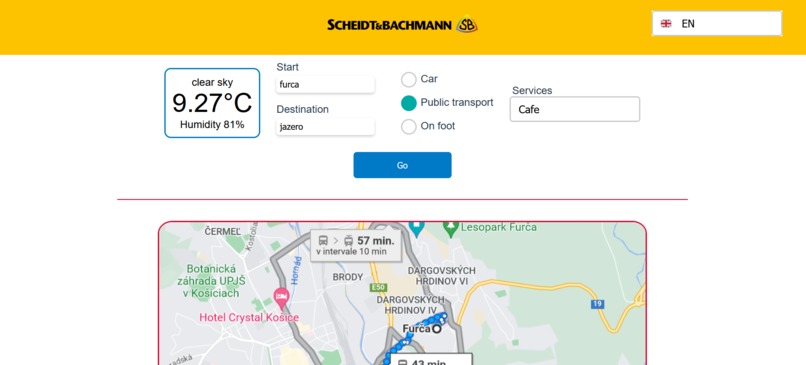
Landing page

Inspiration
Our project, Mapka, was inspired by the need for a more comprehensive and integrated mapping solution for everyday users. We recognized that people often require information about weather conditions, public transport schedules, and optimal routes for their journeys. By combining these elements into one seamless web application, we aim to simplify the process and enhance the user experience.
What it does
Mapka is an all-in-one mapping solution that integrates real-time data from weather, public transport, and routes to provide users with the most relevant and accurate information for their journeys. Users can access this information through a user-friendly web application, making it easy to plan their trips, adapt to changing conditions, and find the best routes.
How we built it
Mapka is built using the Vue.js framework for the frontend and Django for the backend. We have collected data from various sources, including weather APIs, public transport schedules, and route information. The data is then processed and merged in the Django backend to be displayed on the Vue.js frontend. The route calculation will be done using Dijkstra's algorithm, but it is not yet implemented due to a lack of data.
Challenges we ran into
During the development of Mapka, we faced challenges in collecting and merging data from various sources, as well as determining the most efficient way to process and display this information. Additionally, implementing Dijkstra's algorithm for route calculation proved to be a challenge, as we currently do not have enough data to ensure accurate results. Accomplishments that we're proud of
We are proud of our ability to create a seamless web application that integrates multiple data sources, providing users with a comprehensive and user-friendly mapping solution. Furthermore, we have laid the groundwork for implementing Dijkstra's algorithm, which will significantly improve the accuracy and efficiency of route calculation once we have sufficient data.
What we learned
Throughout the development of Mapka, we learned the importance of efficient data processing and integration, as well as the challenges associated with implementing complex algorithms like Dijkstra's. Additionally, we gained experience working with the Vue.js and Django frameworks, which proved invaluable for building a robust and scalable application.
What's next for Mapka
The next steps for Mapka include obtaining more data to enable the implementation of Dijkstra's algorithm for accurate route calculation. We also plan to expand the application's features to include real-time traffic updates, personalized route recommendations, and integration with popular navigation systems. Furthermore, we will work on refining the user interface and experience, ensuring that Mapka remains a valuable tool for travelers and commuters alike.




Log in or sign up for Devpost to join the conversation.