-
-
Logo
-

Landing Page
-
Video Screenshot
-
Dashboard
-
Teammate Matching
-
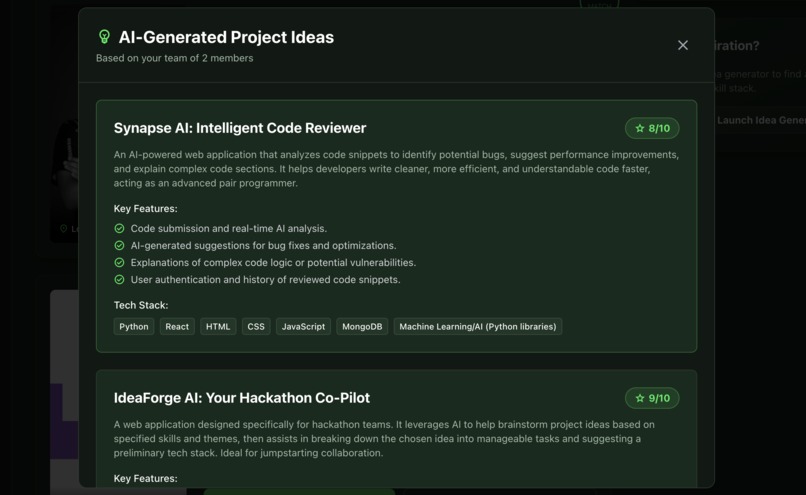
Idea Generator
-
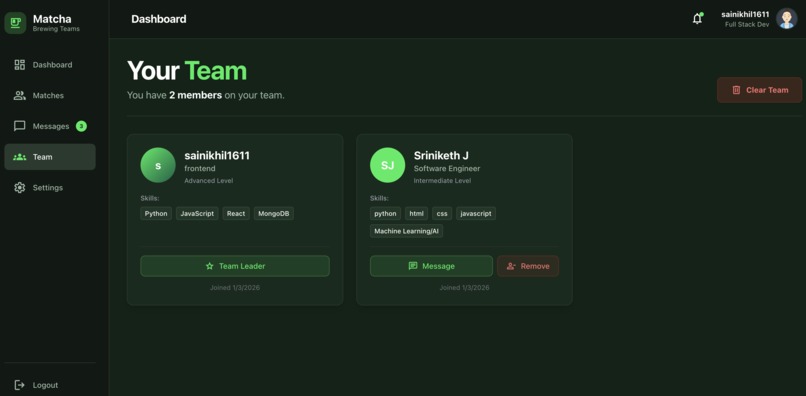
Team Page
-
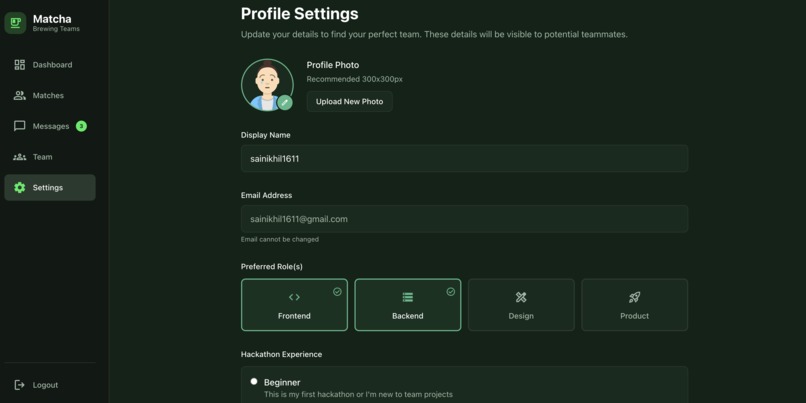
Profile Page
-
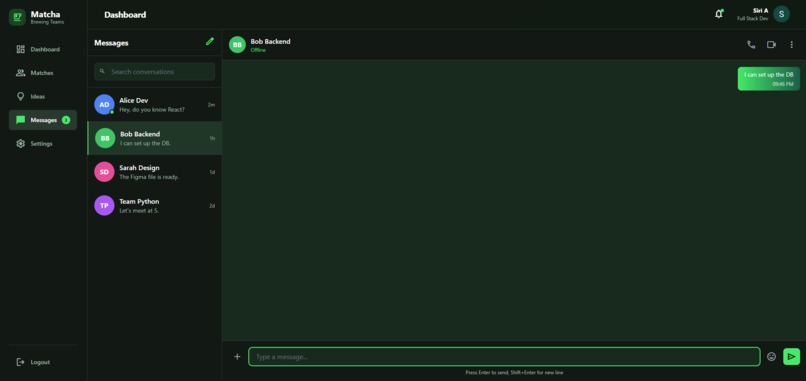
Message Page


Inspiration
The inspiration for Matcha came from a recurring problem at hackathons: team formation is often chaotic, inefficient, and rushed. Despite having platforms like Devpost to showcase projects, participants are still left to manually search through hundreds of profiles, message strangers on Discord, or settle for suboptimal teams due to time pressure.
From our own hackathon experiences, we noticed that the strongest projects consistently come from teams with complementary skills, balanced experience levels, and shared intent. However, there is no intelligent system that helps participants discover those teammates quickly. Matcha is an AI-powered hackathon teammate matching platform that was created to transform hackathon team formation into a structured, data-driven process, making it easier for participants to find the right collaborators and start building faster.
What it does
Matcha is an AI-powered hackathon teammate matching platform that helps participants form high-impact teams in minutes instead of hours.
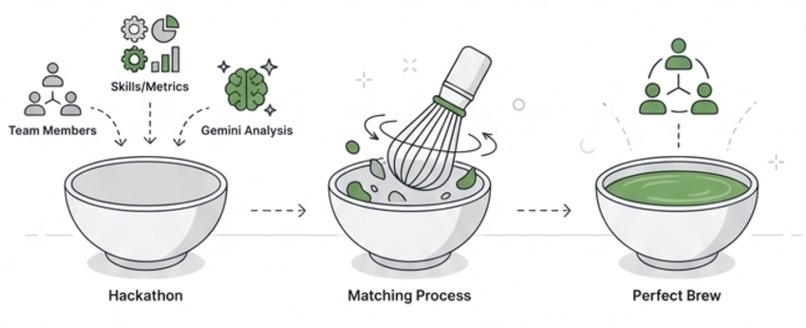
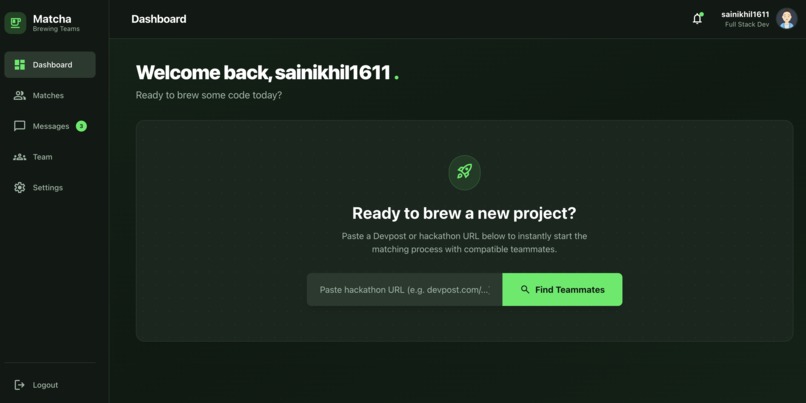
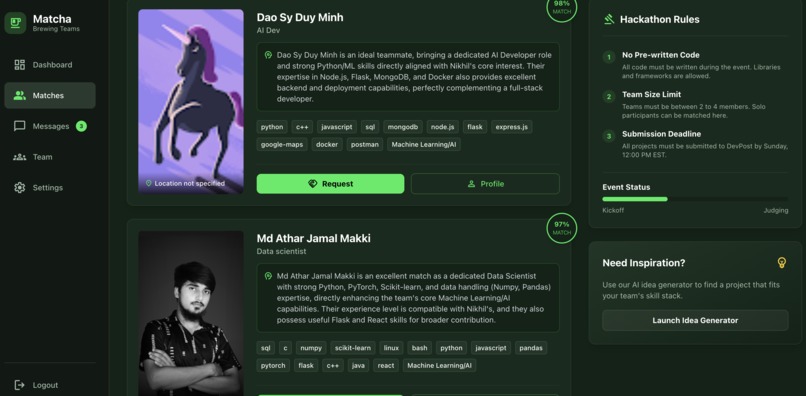
Users paste a Devpost or hackathon link into Matcha, which automatically analyzes the event and loads all participants. Matcha then recommends the most compatible teammates using a hybrid matching system that combines algorithmic pre-filtering with Google Gemini API reasoning. Once matched, users can chat with potential teammates directly in the app, eliminating the need to exchange contact information across multiple platforms. The platform also tracks users' hackathon history, creating a portfolio of all projects, teams, and achievements in one centralized dashboard.
Matcha also includes an AI-powered idea generator that helps matched teams quickly converge on project ideas aligned with hackathon tracks and their combined skill set. Instead of generic brainstorming, Gemini proposes feasible, demo-ready ideas with scope, feasibility, and skill coverage scores, helping teams make informed decisions early.
How we built it
Matcha is a full-stack application built with a dual-backend architecture, allowing different services to specialize in scraping, AI reasoning, authentication, and idea generation.
The frontend is a React application built with Vite and TailwindCSS, providing a fast, responsive interface for browsing matches, reviewing ideas, and managing profiles.
The backend consists of two services: A Flask (Python) backend responsible for Devpost scraping, participant processing, and teammate matching. It uses Selenium to handle dynamically loaded participant pages, BeautifulSoup4 for structured HTML parsing, MongoDB Atlas for persistent storage, and Google Gemini AI for intelligent match evaluation. An Express (Node.js) backend that handles authentication, user profile management with JWTs, and AI-powered idea generation using Gemini.
One key technical challenge was scraping Devpost participant lists reliably. Devpost loads participants dynamically as the user scrolls, meaning traditional HTTP-based scraping only captures the initial set. We solved this by combining Selenium browser automation to mimic user scrolling with BeautifulSoup for clean data extraction, ensuring complete participant coverage even for large hackathons.
Challenges we ran into
The biggest challenge was handling large-scale hackathons efficiently. With events featuring 1000+ participants, running full Gemini AI analysis on every potential match was computationally expensive and slow. The team overcame this by developing a two-stage hybrid matching system. First, a lightweight pre-filtering algorithm scores all participants based on complementary skills, shared interests, and prior project experience. This reduces the candidate pool to the top 50 matches. Gemini AI is then applied only to this reduced set, where it holistically evaluates factors such as experience balance, technical stack compatibility, and overall team fit, generating ranked matches with detailed reasoning. This approach reduces AI processing by approximately 95% while preserving match quality.
Another challenge was integrating two separate backend systems (Flask and Express) to work seamlessly together. Each backend needed distinct environment configurations and port assignments while maintaining consistent API communication with the frontend. The team solved this by creating comprehensive documentation and automated startup scripts.
Data scraping from Devpost presented additional difficulties due to dynamic content loading and varying page structures across different hackathon listings. Using Selenium for browser automation and implementing robust error handling resolved these issues.
Accomplishments that we're proud of
We successfully built an end-to-end AI-powered platform that turns hackathon team formation into a structured, intelligent process. The two-stage matching system demonstrates a practical, scalable approach to AI-assisted recommendation, reducing processing time by approximately 95% without sacrificing quality.
We integrated Google Gemini AI in two distinct ways: deep reasoning for teammate matching in the Flask backend, and structured idea generation in the Express backend. The platform handles real-world scraping challenges, supports large participant pools, and presents complex AI decisions through a clean, intuitive UI.
Most importantly, Matcha helps participants move from “I don’t have a team” to “we’re ready to build” in minutes.
What we learned
Building Matcha taught us how to design AI systems that scale responsibly by combining algorithmic filtering with selective AI reasoning.
We gained experience coordinating multi-service backends, handling dynamic web scraping with Selenium, and designing MongoDB schemas for large, semi-structured datasets. We also learned the importance of transparent AI scoring and explainability in user-facing products.
What's next for Matcha
We plan to include real-time match notifications, deeper team analytics that highlight skill gaps, and expanded integration with other hackathon platforms such as MLH and Devpost.
We also plan to enhance idea generation with collaborative refinement tools and expand Matcha into a persistent hackathon portfolio, allowing users to track teams, projects, and outcomes across events.
Long term, Matcha aims to become the standard intelligence layer for hackathons, minimizing the need to switch between multiple tools during a hackathon. Including: helping organizers directly plan the hackathon to participants registering for the hackathon and preparing through forming better teams, building stronger projects, and communicating all in one place.




Log in or sign up for Devpost to join the conversation.