-
-
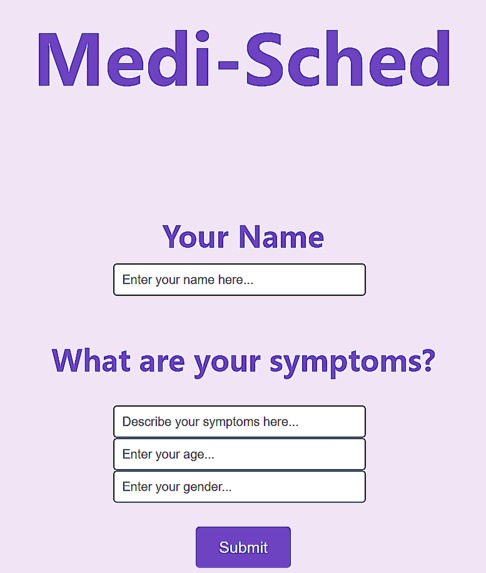
Patient view of service
-
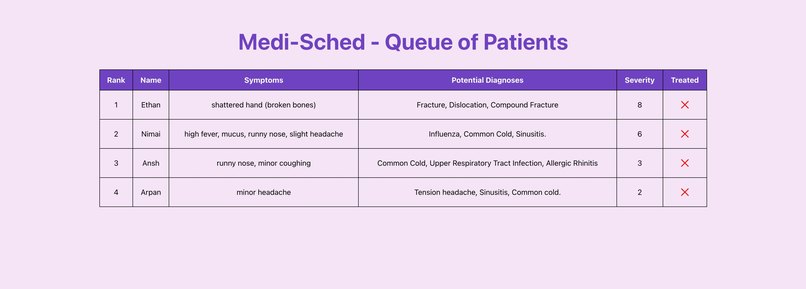
Staff view of service


Inspiration
Medi-Sched was inspired by the increasingly overwhelming conditions faced by emergency rooms worldwide. Nurses are often tasked with making split-second decisions about which patients need immediate care, which can lead to mistakes when ERs are overcrowded. These conditions are prone to human error, especially when a patient's condition isn’t immediately obvious. We realized that there was a critical need for a smarter, more consistent way to triage patients, one that could help nurses make more accurate and data-driven decisions while reducing the mental load on healthcare workers.
What it does
Medi-Sched leverages a proprietary, AI-based algorithm to rank patients based on their symptoms and demographic data, assigning an urgency score from 1 to 10. Our AI doesn’t just consider a patient’s symptoms; it intelligently weights multiple factors, including age, medical history, and time-sensitive conditions, to arrive at the optimal rating. This dynamic score creates a real-time queue that prioritizes patients who need immediate attention, ensuring that critical cases are handled promptly, and the patients are optimally ordered in line. In doing so, Medi-Sched helps nurses manage patient flow more efficiently, reducing the risk of human error and enhancing overall care delivery.
How we built it
Our team collaborated across multiple domains, from healthcare to AI development, to design Medi-Sched as a system that integrates smoothly into existing ER workflows. We began by consulting medical professionals to understand the intricacies of triage and emergency care, then developed an AI algorithm capable of analyzing patient data and symptoms to generate an urgency score. After finalizing the AI-integrated algorithm, we built REST APIs using Flask to manage patient data. These APIs allow users to add patients by entering their name, optional demographic details (age and gender), and symptoms, retrieve the current queue of patients, and remove treated patients from the queue.
On the frontend, we used React to create a highly intuitive and user-friendly interface. This interface allows healthcare workers to input patient information, which is immediately processed by the AI to generate a severity rating. This rating, combined with other factors, determines the patient’s position in the queue based on the urgency of their condition. Our proprietary scheduling algorithm prioritizes patients who may otherwise be overlooked in fast-paced environments.
The patient queue is displayed in real-time on a separate interface for hospital staff, where they can view the urgency scores and manage patient flow. We ensured that Medi-Sched remains simple to use, allowing nurses to quickly assess the severity of patients’ conditions and make data-driven decisions without being overwhelmed by complexity. We used Axios for efficient communication between the frontend and backend, ensuring that patient data and queue updates are synchronized instantly. To further enhance usability, we incorporated smooth animations and visual feedback when patients are added or treated, making the entire process intuitive for healthcare workers.
Throughout development, we prioritized feedback from healthcare professionals, ensuring that the system is optimized for real-world medical environments and effectively supports healthcare workers in high-pressure situations.
Challenges we ran into
One major challenge was incorporating demographic factors, such as age and gender, into the AI’s decision-making process to ensure accurate and personalized urgency ratings. We needed the model to handle a wide range of patient profiles while maintaining high accuracy. Leveraging Hugging Face’s models, we fine-tuned the AI to integrate these factors seamlessly, allowing for more precise predictions across diverse patient populations.
Another technical challenge was optimizing the AI model for real-time performance. Given the dynamic nature of emergency room workflows, it was essential for the system to process patient data and update the queue instantly. We also spent time fine-tuning our chosen model to improve the quality of its responses, adjusting parameters to better handle the nuances of medical terminology and conditions. This tuning allowed the AI to produce more accurate and relevant urgency ratings, further enhancing its ability to prioritize patients effectively.
To ensure the system remained responsive, we used Flask for the backend and Axios for efficient data transmission between the React frontend and the API, enabling near-instant communication between the AI and the user interface. Implementing real-time queue updates and smooth transitions required us to tackle latency issues, all while maintaining a fluid user experience under high demand. These technical hurdles were crucial to delivering a reliable, responsive system that could function effectively in high-pressure, fast-paced ER environments.
Accomplishments that we're proud of
We’re incredibly proud of building a solution that addresses such a critical healthcare issue. Medi-Sched improves patient outcomes by reducing preventable delays in care while easing the mental burden on nurses. Our AI-driven algorithm ensures patient prioritization based on consistent, data-backed insights, improving both the speed and accuracy of triage decisions. Unlike traditional methods, Medi-Sched integrates factors like symptoms, severity, co-morbidities, and time-sensitivity into real-time decision-making, offering more precise and adaptive prioritization.
A key challenge we tackled was addressing the occasional mis-rating of patient severity, often caused by high-frequency ER environments or varying levels of experience among staff. By leveraging AI, we reduce human error and provide consistent, data-informed assessments that allow for more accurate triage decisions.
We’re also proud of how we developed a full-stack solution using Flask, React, and Axios to build efficient communication between the backend and frontend. Our focus on usability ensured that healthcare professionals can quickly input and track patient data, with real-time updates to prioritize the most critical cases.
What we learned
This project has taught us the complexities of triage, and we’ve learned how vital it is to design systems that work seamlessly in high-pressure environments. We also gained valuable insights into how AI can support real-time decision-making in healthcare settings, but only when it is designed with input from both technical teams and healthcare professionals. Understanding how human factors interact with technology was key to ensuring Medi-Sched’s usability and effectiveness.
What's next for Medi-Sched
Next, we plan to continue refining Medi-Sched’s algorithm based on feedback from medical professionals, ensuring that it captures the nuances of patient care even better. Our goal is to pilot the system in a live healthcare setting, where we can gather real-world data to further improve accuracy and user experience. Ultimately, we aim to expand Medi-Sched to integrate with broader hospital systems, streamlining patient flow across multiple departments and improving care delivery on a larger scale.


Log in or sign up for Devpost to join the conversation.