-
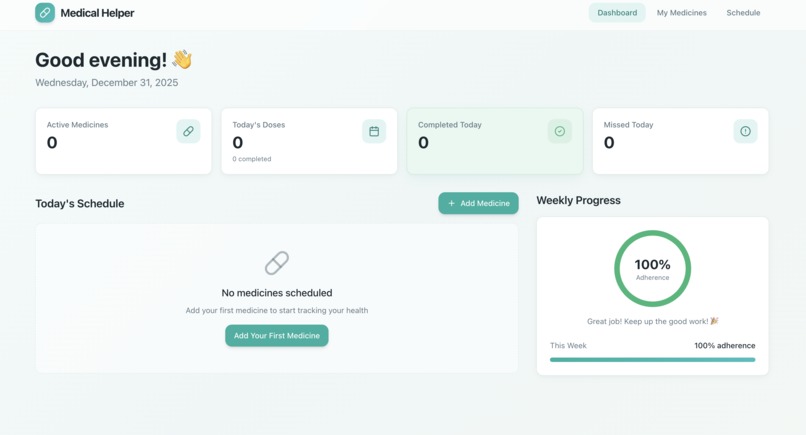
home page

Inspiration
Medicine reminders usually focus on individual alerts, but real treatments are time-bound courses. Missing doses, double-taking, or forgetting how far along you are in a prescription is a common problem—especially for students, elderly users, and people managing multiple medications. We wanted to build something that shows the full picture of treatment adherence, not just today’s notification.
What it does
Medi Trackr helps users track their medicines as structured courses, not isolated reminders.
Visual calendar showing completed, partially completed, and missed days
Course-level progress tracking (e.g. Day 5 of 7)
Daily schedule view for upcoming and completed doses
Clear dashboard stats for active medicines and adherence
Prevents marking doses outside the prescribed course window
Everything is designed to reduce confusion and help users stay consistent with their treatment.
How we built it
We designed Medi Trackr with a clean, medical-friendly UI and a simple but reliable data model.
Course-based medicine schema (start date, end date, dose times)
Calendar logic to compute daily completion state
Dashboard metrics derived directly from calendar state
Component-driven architecture for scalability
Focus on clarity, accessibility, and minimal cognitive load
The emphasis was correctness and usability over unnecessary complexity.
Challenges we ran into
Modeling partial completion (some doses taken, some missed)
Keeping dashboard stats in sync with calendar state
Preventing incorrect interactions outside course dates
Designing a calendar that stays readable with multiple medicines
Balancing simplicity with accurate medical logic required careful trade-offs.
Built With
- tsx


Log in or sign up for Devpost to join the conversation.