-

Logo
-
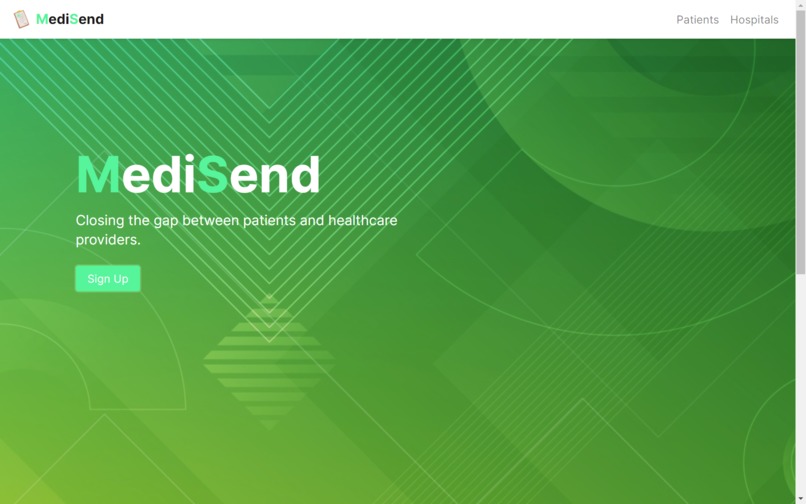
Homepage
-
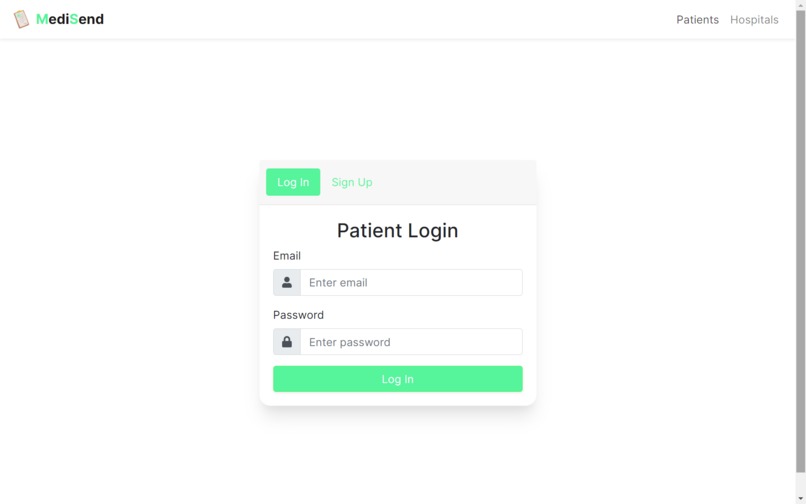
Patient Login


Inspiration
In the COVID-19 pandemic, the transfer of medical records from healthcare providers to patients has become more and more necessary, yet due to the social distancing guidelines put in place, much of this is done in-person (through contact). This puts both physicians and patients at risk, so to lower this risk and keep people safe while making the transfer of medical records more efficient, we created MediSend.
What it does
MediSend allows hospitals and healthcare providers to send messages and upload files to their patients quickly and digitally. Hospitals are able to create their own accounts, and once their account is created, they receive a secure and specific code. This code can be shared with that hospital's patients, who can create accounts and then join this hospital using its code.
Once their patients have signed up and used the proper code, hospitals have access to their inboxes and can send them any medical records or files via the web (PDFs, images, videos, etc.). Patients can then log in to their own accounts and see any messages sent to them. When sending files, hospitals can also send a text message, which can provide a description of the files and even a personal message, which creates an emotional connection between hospitals and patients. Once a patient uses the code for one hospital, they are not restricted to that hospital, however. If they switch hospitals (e.g. because they moved), they can enter a new code and receive messages from a new hospital while still having access to their old medical records from other hospitals.
Our minimal yet friendly user interface allows both hospitals and patients to travel around the website very easily. Thus, we remove the spatial barrier between hospitals and patients by moving this transfer of information to the internet.
How we built it
The frontend of our web application was built with React.js, a JavaScript framework used to design user interfaces, SCSS, and frontend libraries like Tailwind CSS and React Bootstrap. The backend was built with Node.js and Express.js, which were used to connect our front-end to our databases. Our project used both Firebase and MongoDB to store data. Firebase was used for user authentication and file storage, while MongoDB was used to store extra information about hospitals and patients, including hospital codes and names.
Challenges we ran into
The largest issue we had while building our project was successfully connecting our database to the React.js frontend. Our first approach did not use MongoDB at all, which led to many errors. We then decided to switch to MongoDB and connect this database to the frontend using Axios.js, which also led to many errors. Our next approach still used MongoDB but used GraphQL to connect to the database, which once again backfired. Finally, with only a couple of hours left to submit our project, we created our own REST API, which successfully connected the MongoDB database to the frontend. The one thing we gained out of these issues was a broader knowledge of backend development.
Accomplishments that we're proud of
We are most proud of creating a functional backend, as that process was very challenging. We are also proud of successfully using Firebase Cloud Storage to store files that could be transferred from hospitals to patients, as none of us had ever done this before and Firebase was relatively new to us. Just finishing the project was a huge accomplishment, and we learned so much in this experience.
What we learned
We learned a lot about backend development, including using Firebase, MongoDB, REST APIs, GraphQL, axios, and Node.js + Express.js.
What's next for MediSend
In the future, we hope to help real hospitals connect to real patients, especially during these trying times.


Log in or sign up for Devpost to join the conversation.