-
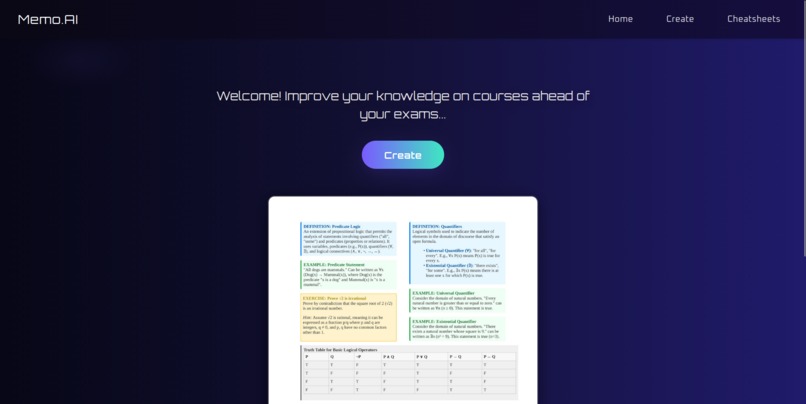
MemoAI Home Page

Inspiration
Like most university students, we’ve all been there, staring at piles of lecture notes the night before an exam, trying to fit everything onto one sheet of paper. Making cheatsheets is helpful, but it’s also tedious and time-consuming. We wanted to build something that makes this process easier and faster: a tool that could turn raw notes and images into clean, organized study sheets automatically.
What it does
Memo.AI takes your study material and instantly transforms it into a printable cheatsheet. You can type or paste your notes, add restrictions or formatting preferences, and the app will generate a well-structured layout with definitions, examples, and summaries. You can download it as a PDF, and even share it with friends who are studying for the same course.
How we built it
We built Memo.AI with a React and Vite frontend, and a FastAPI backend written in Python. The backend uses Google’s Gemini API, Google Cloud Vision API to process the input and generate structured HTML with inline CSS, which we then convert to a PDF using libraries like WeasyPrint. The frontend connects to this API, displaying all created cheatsheets in a simple, responsive dashboard.
Challenges we ran into
Getting consistent, clean HTML from the AI was harder than expected. Sometimes it would over-style or misformat content. We also struggled with PDF rendering at first, since page margins and layout needed to look right for printing. Another challenge was connecting the backend and frontend smoothly while keeping everything fast and responsive.
Accomplishments that we're proud of
We’re proud that we ended up with a working prototype that genuinely saves time for students. It feels really satisfying to paste a chunk of notes and see it turn into a professional-looking, printable sheet in seconds. We also learned a lot about prompt design, layout generation, and integrating AI with real web apps.
What we learned
We learned how much small design details matter. Even things like margin size, font hierarchy, and box colors can affect how readable a study sheet feels. We also gained a better understanding of API integration, state management in React, and the importance of clear communication between frontend and backend.
What's next for MemoAI
We want to make Memo.AI more collaborative, allowing users to browse and share public cheatsheets by course or topic. We also plan to add support for images, formulas, and custom templates. Eventually, we’d like to turn it into a full study companion where AI can quiz you based on your cheatsheet content.


Log in or sign up for Devpost to join the conversation.