-

home screen
-
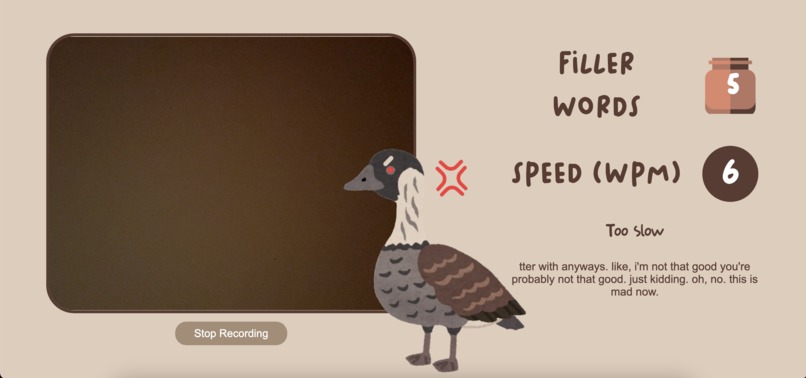
recording page
-
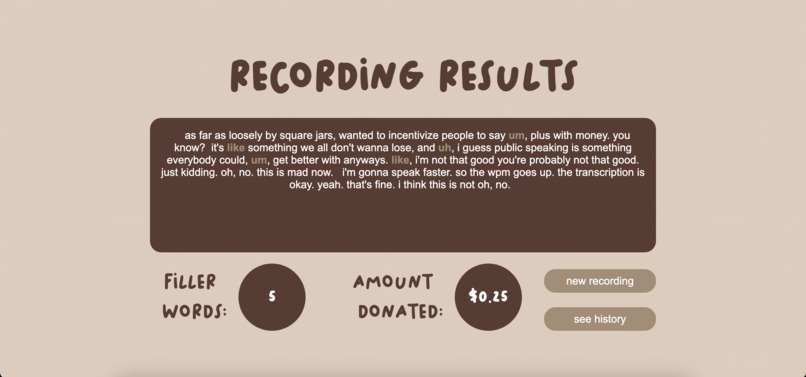
results page


Inspiration behind Umless💡
Growing up, many of our parents used the classic swear jar to curb bad language. Each time someone used a "banned" word, they had to drop a nickel into the jar—an effective motivator since nobody likes losing their money!
Many of us have also struggled with public speaking. When we're speaking under pressure we often forget what to say and subconsiously "fill in" the space using filler words. However, the "ums", "uhs" and "likes" can be distracting and undermine the impact of our message, but it’s tough to notice them in the moment.
By combining these concepts, we created Umless—a digital swear jar that helps you track and reduce filler words while practicing speeches. Every time you use a filler word our software will catch it and donate a nickel to a charity of your choice. Not only will this help recreate the pressure of speaking publicly, but it will bring more awareness of a user's speaking habits and financially motivate them to change. It’s a modern twist on an old idea, designed to improve your speaking skills and hold you accountable in a fun and impactful way.
What it does 🫙
Umless is a powerful web app that reimagines the concept of traditional swear jars. Our platform enables users to record both video and audio of themself, and transcribes text in real time to catch filler words. It then keeps count of the number of no-no words, and donates the appropriate amount of money to charity after each recording. Not only that, but the software records and saves an accurate transcription with filler words highlighted so users can be more aware of instances they use these words. Finally, to further improve public speaking abilities, Umless calculates your speaking pace in real time, and compares the values to professional standards to give you a recommendation on how you can adjust your pace. This all-in-one public speaking tool will enable users to speak more fluently and confidently.
How we built it 🏗️
Umless is a React.js web app built on Django and the Deepgram AI Voice Transcription API. We used the interim results technique to provide live transcription and analysis 3x faster than the native API provides itself. We used MediaDevice's web API to record video and audio, as well as Auth0 for user sign-in
Challenges we ran into ⁉️
The greatest challenge we faced was live transcription. Most APIs automatically filter out filler words, which is counterproductive to our product. Not only did it take large amounts of experimentation to find an API that fits our needs, but we found that the default real-time transcription was either too slow or too inaccurate. To help resolve this, we had to tap into interim results, which will provide preliminary results and adjusts it as necessary before providing a final transcription.
Accomplishments that we're proud of 🏆
1) Creating a functional web application that is able to accurate transcribe and analyze results in hacking time :D
2) UI/UX Design 📐, the home screen, results page, and our animations make for a much more user friendly experience.
What we learned 📚
Half of our team consists of novice hackers, so we gained valuable insights into front-end design, particularly with React. We also learned how to implement APIs, such as Deepgram and Auth0, and how to optimize them to produce more accurate results. The entire team dedicated substantial effort to brainstorming innovative tools for users, gaining valuable experience in user-centric design. We take pride in our rapid progress, successfully developing a functional and meaningful product despite our limited prior exposure to hackathons.
What's next for Umless 🚀
1) More public speaking tools! Particularly, we hope to integrate computer vision with openCV to analyze a user's eye contact, body language, and facial expressions. We also wish to implement more audio analysis tools that helps to identify awkward pauses, monotone speech, or awkward phrasing.
2) Collaborative features, that continues to gamify the experience by allowing users to compete against their friends for the best speeches.


Log in or sign up for Devpost to join the conversation.