-
-
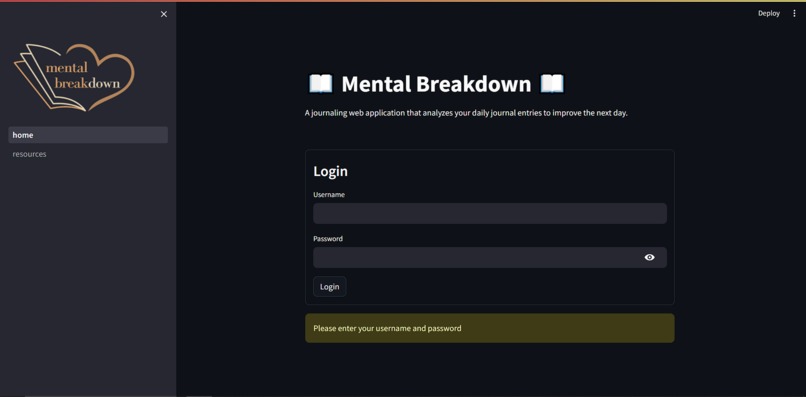
Login
-
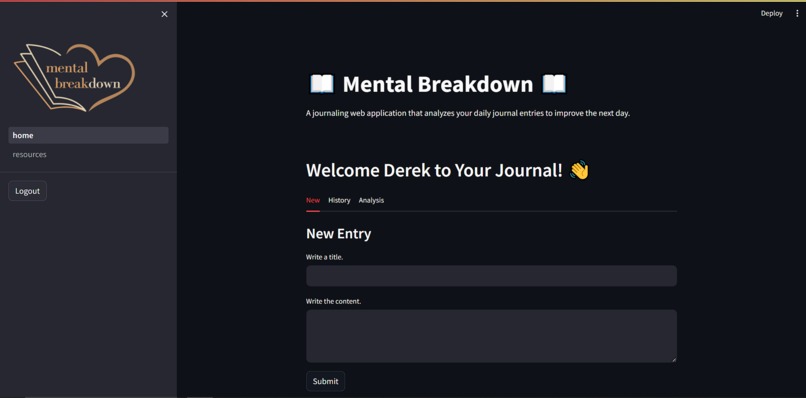
New Journal Entry
-
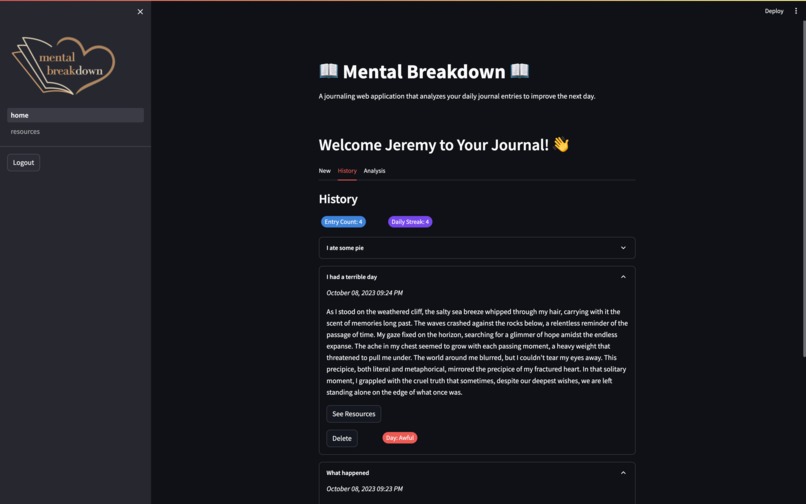
History Page
-
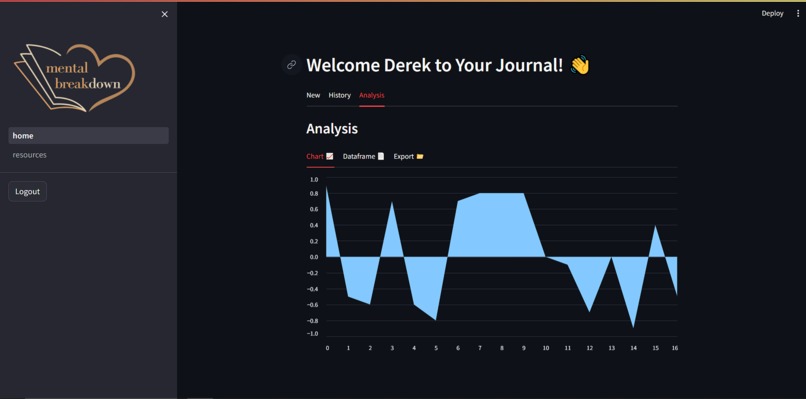
Analysis of Entries Page
-
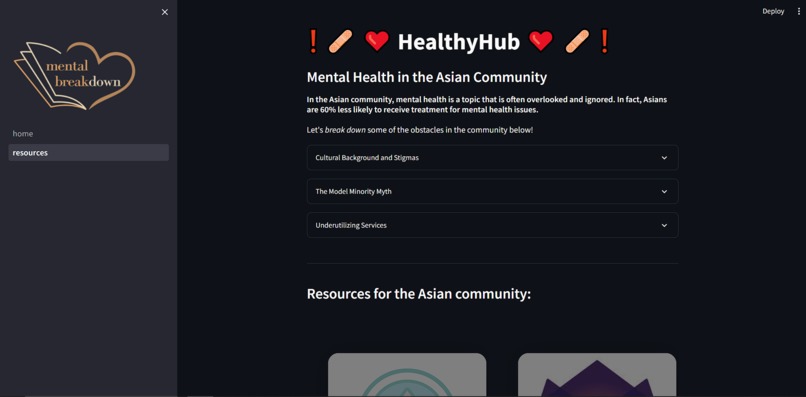
Resources Page


Inspiration
As a whole, mental health is an overlooked and taboo topic amongst Asian families and communities, which creates a perception that mental health is NOT a big issue. In reality that is not the case. Although there are issues, around 60% of Asians are less likely to seek treatment for mental health issues in comparison to their counterparts. Our goal is to open up more avenues for our peers to find the help they need.
What it does
Our application saves and analyzes entries and tracks the assigned status per entry, with an additional page to learn more about Asian Mental Health issues and resources to access organizations, articles, therapists, etc.
How we built it
The team initiated the website's core concept using Python's Streamlit Framework. As the team divided tasks among its members, there was no specific central focus. Some team members concentrated on enhancing site functionality by adding features like a navigation bar, text input fields, a history tab, and a resources page featuring a range of helpful resources within the Asian community. Others focused on backend tasks such as connecting the code to a MongoDB database for storing journal entries and user data. Additionally, efforts were made to incorporate Google Cloud's NLP API to analyze entry sentiment scores, transforming the data into graphical representations.
Challenges we ran into
- Unfamiliar with MongoDB and Google Cloud NLP, making it difficult to integrate into our application
- Most of us were unfamiliar with Streamlit and Python
- Confusing and poor documentation with Streamlit Authentication Components, Google NLP API, etc.
- Difficulty integrating card components in resources due to the Streamlit-extras resource being slightly incorrect
- Saving the session state so Streamlit wouldn’t erase data
Accomplishments that we're proud of
- NLP Graph Tracker
- Learning how to develop a web application despite being unfamiliar with many of the tools Implementing most of the features we set out to include with the ability to develop more
What we learned
- Developing a web application using Streamlit
- Connecting MongoDB to create a database
- HTML markdown language for website design
- Better practice for version control using Github
- Using Google Cloud NLP API
What's next for Mental Breakdown
- Recommendation system: Read entry text and use Generative AI to respond to improve following days
- Deeper analysis of entries: Adding more ways to visualize data, including mood trackers
- Modifying entries: Add feature to modify existing entries in a pop-up window
- Addition of new users: Create new users and sign up feature for the application
- Deployment: Host the website and deploy it to Streamlit Cloud Services


Log in or sign up for Devpost to join the conversation.