-
-
Our Logo
-
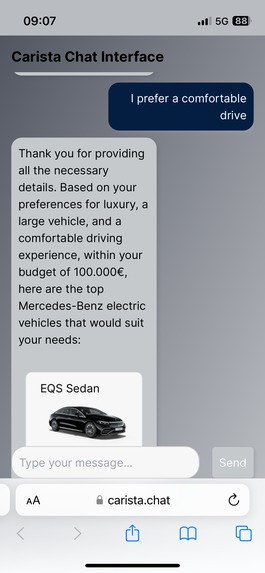
It even works on mobile!
-
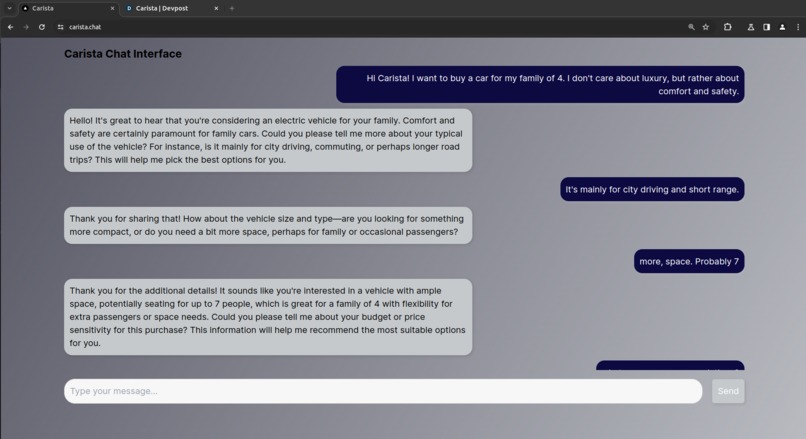
A friendly assistant to find your perfect car.
-
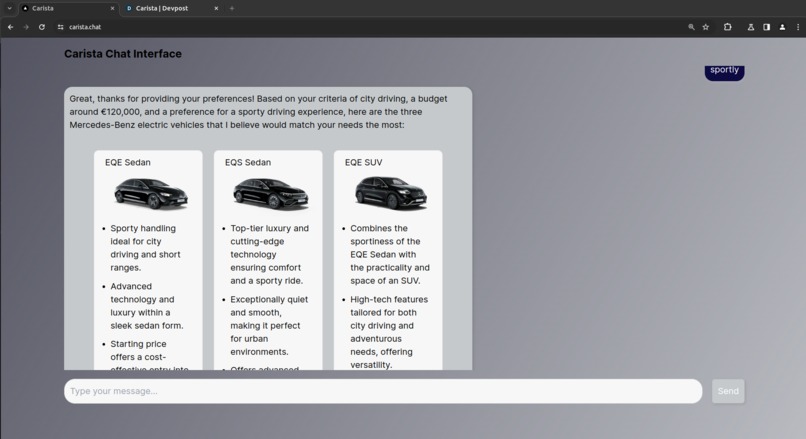
The recommendation is given in simple panels
-
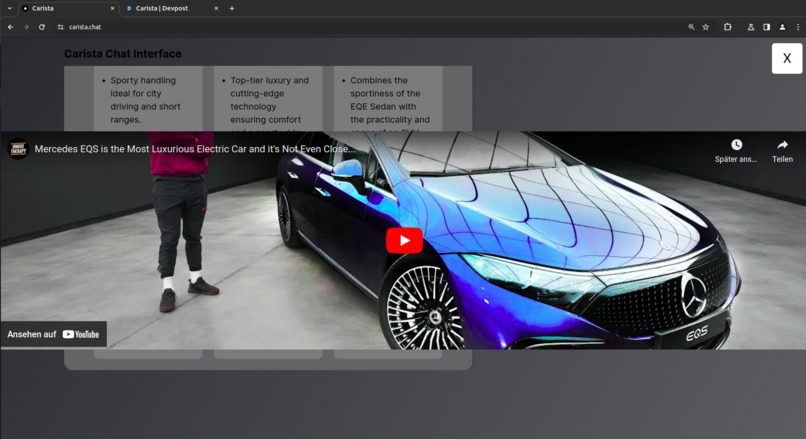
After a recommendation, you can watch a review to increase trustworthiness.
-
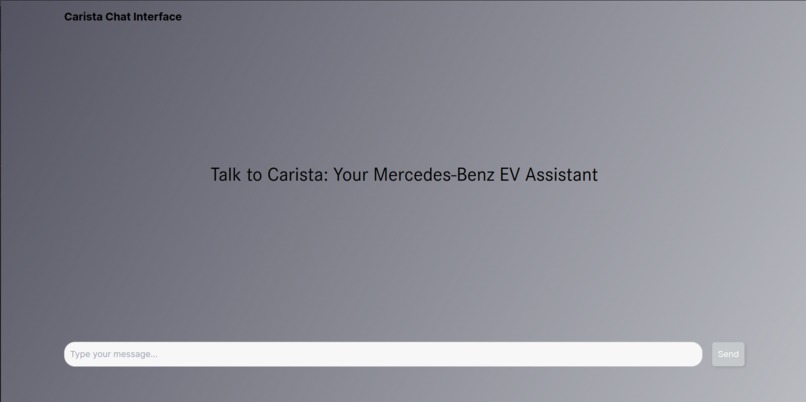
Home Screen.


Inspiration
At the Tum.ai Makeathon, an AI-themed event, our team took on the Mercedes Benz x Salesforce Challenge. We saw an opportunity to transform the typical chatbot experience, drawing from the challenge's goal of integrating artificial intelligence into customer service.
The problem we identified was clear: existing chatbots for product recommendations were uninspiring and often felt like a tedious experience. This gap became especially significant in the context of Mercedes Benz, a brand synonymous with luxury and innovation. As the automotive industry shifts toward online-first sales, we wanted to ensure that the digital customer journey was just as engaging and personalized as visiting a dealership.
We were inspired to create Carista, a chatbot designed to make product recommendations fun and exciting, tailored to each customer’s unique preferences. By focusing on hyperpersonalization, we aimed to revolutionize how customers interact with automotive brands online. With this motivation, we set out to build a solution that could set the standard for a new era of online car sales.
What it does
Carista is an AI-powered chatbot designed to give users hyperpersonalized advice on choosing the perfect Mercedes Benz model. By asking a series of questions about the user's preferences—such as desired vehicle type, budget, performance expectations, and lifestyle needs—Carista customizes the entire car-selection process to ensure an engaging and tailored experience.
The chatbot uses these insights to present a curated list of car models that align with the user's responses. It doesn't just stop at suggesting models; it also provides a personalized explanation for why each model is an excellent fit for the user. This detailed reasoning, rooted in the user's unique inputs, allows Carista to offer recommendations that are both relevant and convincing.
Once the user finds a model they're interested in, Carista facilitates the next steps in the journey. It offers the option to book a test drive or inquire about financing, streamlining the transition from online interaction to real-world experience. This seamless integration with the Mercedes Benz sales process makes Carista a valuable tool for both customers and the brand.

We split our user journey in 3 main parts
How we built it
Carista's architecture is a carefully constructed balance of modern web technologies and AI. The system comprises three core components: the backend, frontend, and the AI-driven language model, all seamlessly integrated to deliver a smooth user experience.
Backend: We used Flask as the primary framework for the backend, allowing us to build a lightweight and efficient server-side application. Hosted on Heroku, the backend serves as the central hub for processing user inputs, interacting with the language model, and handling communication between different parts of the system. Flask's flexibility and simplicity enabled us to set up a robust API structure, ensuring that Carista's responses are quick and reliable.
Frontend: For the frontend, we chose Next.js with Typescript, a framework that combines the best of React with additional features like server-side rendering and static site generation. This approach allows Carista to deliver a highly responsive and interactive user interface. The frontend is deployed on Vercel, offering a scalable and reliable platform for serving Carista to a broad audience. The design is intuitive and user-friendly, ensuring that customers can easily interact with the chatbot to get personalized car recommendations.
AI Integration: Carista's intelligence is powered by GPT-4 Turbo, a state-of-the-art language model that provides the core functionality for hyperpersonalized advice. The backend sends user inputs to GPT-4 Turbo, which then generates tailored responses based on the collected information. This integration allows Carista to adapt to each user's preferences and offer detailed recommendations.
By combining Flask for the backend, Next.js for the frontend, and GPT-4 Turbo for the AI engine, Carista is built to be both scalable and adaptable, ensuring a reliable and engaging experience for users. The deployment on Heroku and Vercel provides the infrastructure needed to support this innovative chatbot, paving the way for a new era of online-first sales in the automotive industry.
Challenges we ran into
Developing Carista presented several significant challenges, from managing the complexities of large language models to dealing with the unexpected issues that always seem to arise during late-night coding sessions. These hurdles not only tested our technical skills but also our resilience as a team.
One of the primary challenges was ensuring that the LLM, GPT-4 Turbo, consistently produced the desired results. Given the variability of AI-generated content, it was crucial to design prompts and workflows that guided the model to generate reliable and accurate responses. This required extensive experimentation and iterative refinement to strike the right balance between flexibility and consistency.
Creating an efficient LLM agent architecture was another challenge. Our goal was to make Carista's recommendations as hyperpersonalized as possible, which required a carefully designed structure for processing user inputs and feeding them to the AI. This task involved a delicate balance of performance and personalization, with a focus on minimizing response times while maximizing relevance.
Additionally, we encountered the usual random bugs that seem to emerge at the most inconvenient times, particularly during the early morning hours. These bugs ranged from minor glitches to more serious issues that took hours to diagnose and resolve. Our team had to stay focused and collaborative, often working through the night to keep the project on track.
Despite these challenges, our team's determination and creativity allowed us to overcome the obstacles and deliver a chatbot that meets our high standards for quality and performance. By addressing these issues head-on and learning from each setback, we transformed the challenges into valuable learning experiences that ultimately strengthened the project.
Accomplishments that we're proud of
One of the accomplishments that fills us with the most pride is the level of teamwork and coordination we achieved during the development of Carista. Our team worked seamlessly, efficiently distributing tasks to leverage each member's strengths. This collaborative spirit allowed us to progress rapidly, tackling complex problems while maintaining a clear focus on our project's goals.
We are also proud of the sophisticated yet streamlined solution we designed to manage the user journey under the hood. By creating a structured flow that efficiently processed user inputs and delivered hyperpersonalized recommendations, we ensured that Carista could offer a smooth and engaging experience. This architectural design demonstrates our ability to balance complexity with ease of use.
Another significant achievement was our ability to exceed the scope of the challenge by integrating personalized customer reviews into the chatbot's interface. This feature allows users interested in a particular car model to view customized reviews that align with their preferences, providing an additional layer of valuable information. It was a bold step that required creativity and innovation, adding a unique aspect to Carista that differentiates it from other product recommendation chatbots.
What's next for Carista
Looking ahead, our vision for Carista extends well beyond the hackathon. We hope to see Mercedes Benz integrate Carista into their official website, leveraging its capabilities to provide a more engaging and personalized car-buying experience for customers. By incorporating our chatbot, Mercedes could offer users a unique tool to help them find the perfect car model based on their preferences, further enhancing the brand's online presence.
Beyond integration, we're excited about exploring different large language models to improve the chatbot's response time and accuracy. This experimentation could lead to a more responsive and efficient Carista, offering users quicker and more tailored recommendations. Additionally, we are considering transforming Carista into a voice-based bot, allowing users to have conversational interactions with the chatbot, similar to speaking with a real human. This would open up new possibilities for customer engagement and make the car-selection process even more interactive.
These ideas represent just the beginning of what Carista could become. By pursuing these next steps, we aim to revolutionize the way customers interact with automotive brands online, bringing a new level of personalization and innovation to the industry. Our team is eager to continue developing Carista and exploring its potential to inspire and reshape the future of online car sales.
Built With
- flask
- heroku
- next.js
- openai
- python
- scikit-learn
- tailwind
- typescript
- vercel

Log in or sign up for Devpost to join the conversation.