-
-
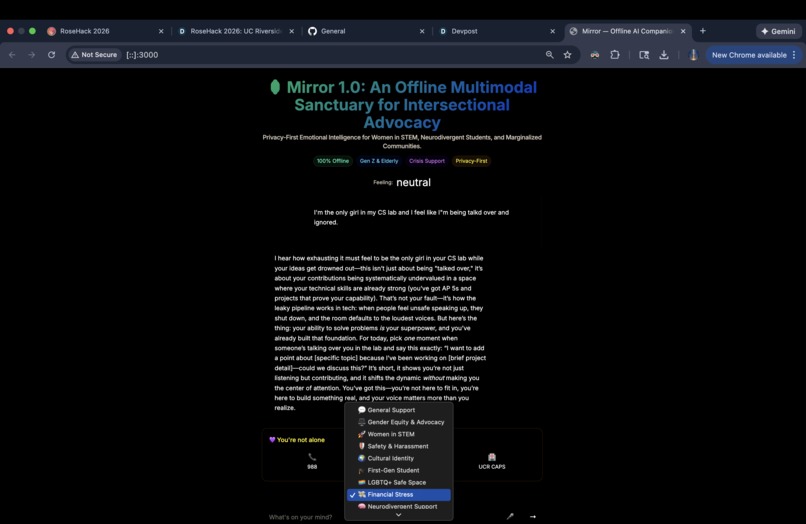
Mirror 1.0 Provides an Empathetic Response, While the Modes Are Shown in the Bar Selection at the Bottom Middle of the Screen

Inspiration
The inspiration for Mirror 1.0 came from seeing the "Empathy Gap" in modern AI. Most mental health tools are cloud-based data-mining traps that fail to understand the specific systemic pressures—like the "leaky pipeline" in tech or cultural imposter syndrome—faced by women and minorities. We wanted to build a sanctuary: a tool that understands your identity and never lets your data leave your device.
What it does
Mirror 1.0 is a local-first companion that listens, reasons, and advocates.
Multimodal Hearing: Uses SenseVoiceSmall to detect prosody (the "silent" pain in a voice) even when the user's words say they are "fine."
Intersectional Reasoning: Powered by Qwen 3 4b Thinking and Ollama , Mirror uses system thinking to provide 8+ specialized advocacy modes, including Women in STEM, Financial Resilience, and Cultural Identity, based off a variety of modes for everyone.
Local Synthesis: Delivers warm, instant empathy via the Kokoro-82M TTS engine, all running on consumer hardware with zero internet required.
How we built it
We engineered a custom multimodal orchestrator that fuses a local ASR pipeline with a high-verbosity reasoning engine.
Backend: FastAPI + Python.
Frontend: Javascript + HTML + CSS
Models: SenseVoiceSmall for prosody, Gemini 3 Flash for logic, and Kokoro for speech.
Memory: A "Digital Heartbeat" system that tracks emotional trends over time to detect rising burnout.
Challenges we ran into
The primary challenge was optimizing Zero-Shot Prosody Detection to work with semantic text reasoning from audio, and dealing with dependency issues to get the TTS (SenseVoiceSmall) to work. We also had to find the right speech to text emotional analysis model. We also fought to keep latency fast enough such that it would be an empathetic mirror that could provide responses fast enough to help the individual using it to benefit from Mirror 1.0 and feel valued.
Accomplishments that we're proud of
We are most proud of achieving 100% Offline Autonomy. Being able to disconnect the Wi-Fi and still receive high-level, intersectional advocacy for a crisis situation is a massive win for user privacy and accessibility. Furthermore, we are proud of our various 10 modes with detailed instructions for each mode to provide empathetic, understanding, sensitive, and warm advice and geniune support for different possible mental struggles or everyday lows.
What we learned
We learned that Privacy is a Social Meaning. Empathy cannot exist without safety. Building a local-first ensemble taught us how to optimize SOTA models for the edge without sacrificing the "Genius-tier" reasoning expected of modern LLMs. Furthermore, we learned how system features (TTS, STT) can amplify the positive sentiment, create a sense of geniuneness, and value to individuals.
What's next for Mirror 1.0
🛠️ 1. Multi-Agent Emotional "Council" Instead of a single Gemini 3 brain, you can implement a Mixture of Experts (MoE) architecture locally.
The Specialist Agents: Create sub-agents specifically trained for different contexts: a "Career Advocate" (leveraging your goal for Big Tech), a "Crisis Counselor," and a "Social Secretary."
The Orchestrator: Use a high-level "Reflector" agent that listens to the user and delegates to the specialist best suited for the current vibe.
📩 2. Emotional Workflow Integration (Gmail/Slack) This is where the bridge is gapped between "feeling" and "doing."
Gmail Advocacy: Mirror could scan incoming emails (locally!) and detect "Aggressive" or "Dismissive" tones from professors or colleagues.
Drafting Support: It can help you draft a "Self-Advocacy" response that is firm but professional, specifically helping women and minorities navigate difficult workplace dynamics.
Calendar Awareness: Mirror could notice you have a "CS 100 midterm" coming up and proactively trigger the Academic Burnout mode a day early.
📱 3. Mobile "Companion" App Vision Language Model (Offline) Live Integration: Use the mobile camera for "Vision-Based Empathy." Mirror could "see" your workspace or the long line at the R'Pantry and offer context-aware support.
Wearable Heartbeat Sync: Integrate with Apple Watch/Fitbit data to detect physiological stress (high heart rate) and proactively start a "Mirror session" before the user even realizes they are anxious.
Built With
- css
- fastapi
- html
- javascript
- offlineai
- ollama
- python
- qwen3
- stt
- tts


Log in or sign up for Devpost to join the conversation.