-
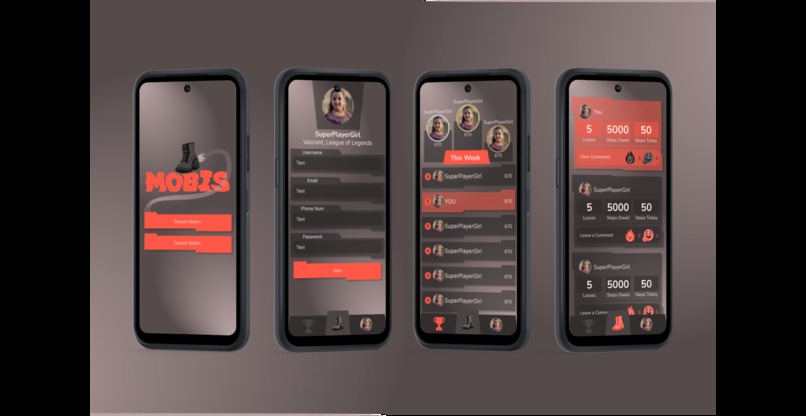
UI Mockups Created in Figma

Inspiration
Gamers after going on a losing streak often get agitated. Running helps you destress but gamers are fixated on continuing their session! We've all been there, spending hour after hour glued to our chairs because we "can't end on a loss". When winning comes first and life comes second, it's easy to forget how important exercise is - it just doesn't make it into our daily routines. But if exercising was motivated by the very games keeping us in our seats, maybe the cycle could be broken?
What it does
(API calls being blocked by cors prevented us from getting our app fully functional) Mobis is a mobile app that sets personalized fitness goals for gamers based on their number of losses in games like Valorant and League of Legends. Every loss over the course of a session adds more steps to the user's step goal - and publishes that data to a public forum for their friends (or foes) to make fun of. Users who complete their step goals are celebrated on a leaderboard, and those who don't are punished with low rankings and potential ridicule from their peers. The idea is to use familiar metrics to encourage an unfamiliar activity: Gamers who rarely exercise may respond well when motivated by consequences they care about.
The application encourages gamers to take breaks and go for a run between gaming sessions. It integrates with various AWS services to handle user sign-up, authentication, and storing user data. The app features a ranking system that ranks users based on their adherence to running routines, and it incorporates social interactions by displaying friends' ranks.
How we built it
React-Native and AWS Serverless Lambda, DynamoDB, IAM, Cognito User and Identity Pools, API Gateway, CloudWatch, Systems Manager. Figma, Adobe Illustrator, and Adobe Generative AI Text-To-Vector for UX/UI
Challenges we ran into
We faced unexpected issues during both the set-up and development parts of building our mobile app. In frontend, our developers attempted to utilize Swift as we wanted to incorporate Apple's HealthKit framework. However, since XCode only runs on Apple devices, we found out through a long and painful attempt of downloading a virtual machine, that virtual machines are not capable of running XCode. This led to a significantly shortened amount of time to switch to React Native and having to start the frontend over from scratch. In backend, our developer faced issues with defining user and role permissions, finding the proper identity verifications for cognito, database management, knowing which services to use, and defining traits for gateway api endpoints.
Accomplishments that we're proud of
This was one member's first hackathon and another's first experience with react native, and giving up seemed like the best option when Saturday came and went without any results to show for frontend. Nevertheless we persisted, working overnight and into Sunday morning doing everything we could to get our app running.
What we learned
Set up your coding environments beforehand!!!! Check to make sure everything works before the hackathon starts!!!!!
What's next for Mobis
World domination and a nice long nap. and fortnite. and then finishing the app!!!


Log in or sign up for Devpost to join the conversation.