-
-
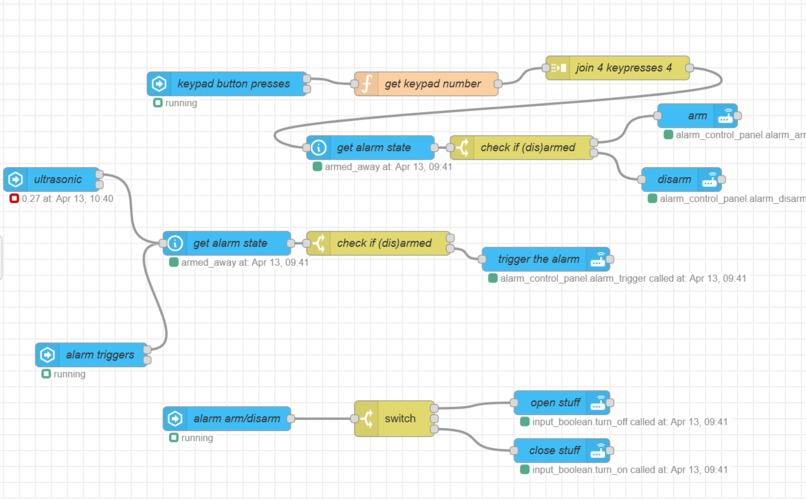
Code
-
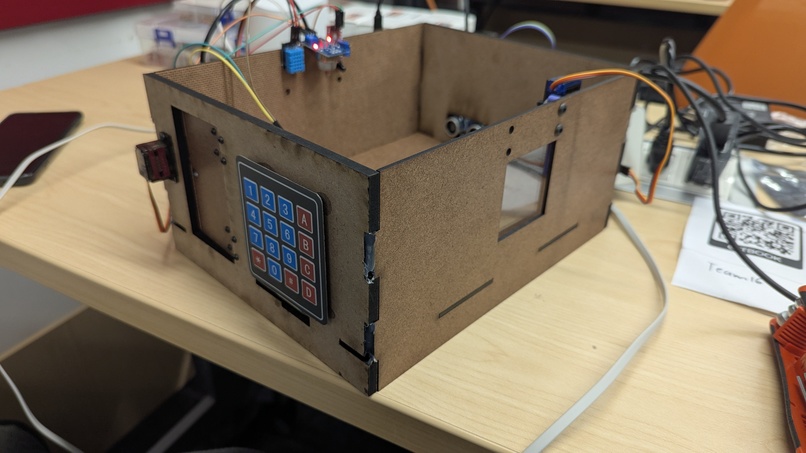
Front Of House
-
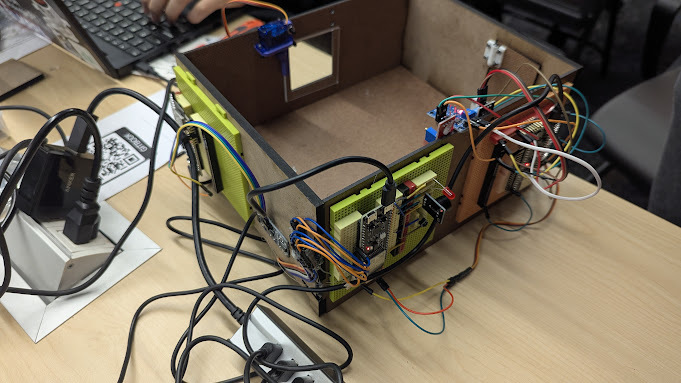
Electronics


Inspiration
Millions of people nationwide & globally are getting scammed by Home Security companies. They have absurd price models for systems you can design yourself.
What it does
Introducing… MOSS: Modular Open Source security. The down-to-earth system focused on the consumer’s personal needs. Through various modules – each powered by its own ESP32 – users can choose what they deem fit for their household at a cheaper price. Through our Google Home integration, all the user has to do is plug it in.
Our current model shows 3 of our many proposed models: The entry System, the Fire Suppression System, and the Expansion Pack. All these modules work together to form a robust home security system at a fraction of the cost.
With our entry system, the user can set a pin to arm their house before they leave. This will lock all doors & windows. It can also be activated via Google Assistant.
Our expansion pack consists of a Servo and an ultrasonic sensor. Along with the entry system, the expansion pack will close the windows and activate the motion sensors when activated. If a break in occurs, an alarm will play, a notification will be sent to your phone, and the police will be called. ADT offers the same protection for $50 a month.
Our hazard prevention system includes an MQ5 gas sensor, flame sensor, water sensor, and a DHT11 temperature & humidity sensor. If increased levels are detected, the user is prompted with a notification to open a window via their device, and can open it remotely.
Since there is smartphone integration, we can use advanced functionality, sending alerts in a variety of scenarios. For example, if you left home and forgot to close a window that you opened.
All these modules can be activated by the various Google Assistant commands. -Hey Google… -Turn (on/off) the window -Turn (on/off) the front door lock -Set home alarm to armed (away/home) -What is the current (Temperature, Humidity)?
How we built it
Mechanically, we used Onshape to design the house. We used calipers, laser cutters and 3D printing to create this design.
Electronically, we have 3 different ESP-32s – each representing a module that a user can buy – with various sensors attached.
With programming, we wanted to use as much preexisting, publicly tested open source software, because of the inherent security risks of automating home security. A single programming oversight could lead to your house being robbed, burned down, flooded, etc.
To ensure our users’ safety and satisfaction, we used ESPhome for local inter-device firmware, and Home Assistant as the gateway to the broader internet.
Home Assistant was run in a VM, allowing portability and idempotency for our users.
For the actual device to device logic, we used NodeRed which is a graphical visualization and editing software for NodeJS. Attached is an image of some of the code.
Challenges we ran into
Mechanically, we had various challenges combining the electronics with the mechanical system.
Electronically, we had many standstills trying to figure out why our project wasn’t working with the main culprit being miswired connections.
Port Forwarding / Tunnelling / Google Assistant Dev Certification: Google Assistant requires a publicly accessible IP address with a valid SSL certificate. The NJIT campus network does not allow “port forwarding”, so we had to come up with a work around to achieve Google Home integration. We are using a Cloudflare tunnel, which gives us both a public FQDN and an SSL certificate to use, while tunneling traffic from outside the NJIT network to our smart home devices. Using the Cloudflare tunnel we were able to complete the Google Home integration setup, activating advanced functionality for our users.
Accomplishments that we're proud of
We are proud of completing this project within the given time frame, using Google Home integration, along with learning how to use various sensors in a wireless setting.
What we learned
We learned the importance of preventing scope creep.
Because of our extensible modular design, we kept coming up with new ideas to implement, and new modules to make. For example, we were going to put up an OLED with status info, and include a series of indicator lights, but we had to condense our project scope to ensure we could complete everything within the hackathon timeframe.
We also learned how to properly laser cut on a Speedy 100.
What's next for MOSS: Modular Open Source Security
For the future, we hope to create new module varieties. These include Facial Recognition, Fingerprint Authentication, and Camera modules. For each module, we hope to make a custom case and PCB that can be installed at various points around the house. Finally, we hope to Integrate this project with Homekit (the Apple Ecosystem).
We can't put a link to try out the software because our authentication system is per person.


Log in or sign up for Devpost to join the conversation.