-
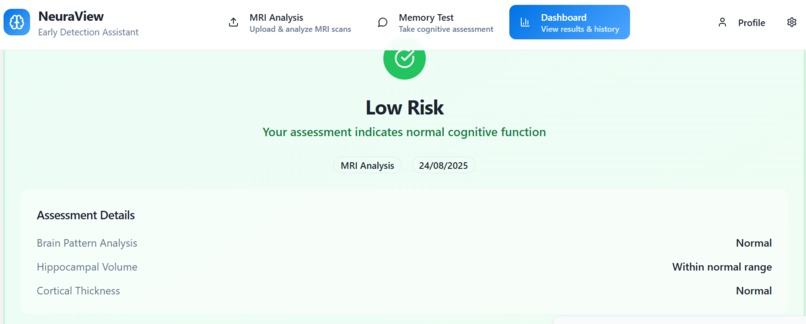
Risk Asessment

Inspiration
Alzheimer’s disease is one of the most challenging neurological conditions, affecting millions of families worldwide. We were inspired by the need for early detection and supportive tools that can make a real difference in the lives of patients and caregivers. Our motivation came from the idea that technology—especially AI and medical imaging—can be used to empower healthcare professionals with better insights.
What it does
NeuraView is an AI-powered platform designed to assist in the early detection of Alzheimer’s. It allows users to upload MRI scans and input cognitive health indicators (such as memory lapses, confusion frequency, or difficulty in daily tasks). The system analyzes this information and provides insights into the likelihood of Alzheimer’s progression, offering support for both patients and doctors.
How we built it
We built NeuraView using:
- FastAPI for the backend to handle image uploads, process data, and return predictions.
- React + Tailwind UI for a clean, user-friendly frontend.
- ONNXRuntime for running deep learning models efficiently.
- Pillow & scikit-image for image preprocessing.
- Machine Learning models trained on MRI datasets to detect early Alzheimer’s markers.
Challenges we ran into
- Finding reliable datasets for training and testing the model.
- Balancing model accuracy with inference speed for real-time predictions.
- Managing CORS, server deployment, and integration between the frontend and backend.
- Handling medical data responsibly while ensuring user privacy and security.
Accomplishments that we're proud of
- Successfully building an end-to-end pipeline from MRI upload → preprocessing → AI prediction → user-friendly results.
- Designing an intuitive UI that makes complex medical insights easy to understand.
- Overcoming deployment hurdles to make NeuraView accessible on a live server.
What we learned
- How to integrate AI models into real-world applications using FastAPI and React.
- The importance of data preprocessing in medical imaging.
- Deploying and maintaining machine learning applications in a production-like environment.
- The value of teamwork, iteration, and debugging across multiple tech stacks.
What's next for NeuraView
- Expanding the dataset for better model accuracy and generalization.
- Adding features like progress tracking for patients over time.
- Collaborating with healthcare professionals for clinical validation.
- Exploring mobile app integration to make Alzheimer’s risk assessments more accessible worldwide.
Built With
- fastapi
- javascript
- numpy
- onnxruntime
- pillow
- pydantic
- python
- react
- scikit-image
- tailwind-css
- typescript




Log in or sign up for Devpost to join the conversation.