-
-
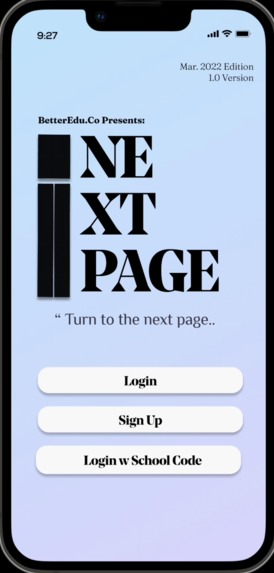
Login Screen
-
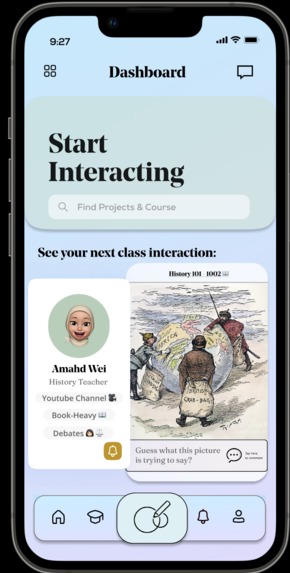
Dashboard Final UI
-
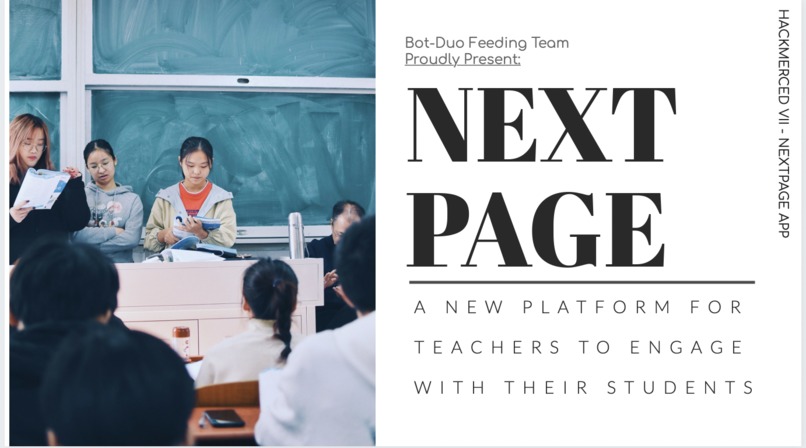
Access Visme for full presentation


Inspiration
Taking from our own experience with online learning, we found how in the most online learning environment, engagement with the classroom is closely non-existent. Then paired with distractions and technical complexity and difficulty, our group tries to find a solution to see how to fix this.
After some brainstorming, and research, we made a list that shows the level of engagement that each classroom might have, and as expected, the places that have less-engaging environments tend to be where there is more reliance on the technology platform.
It is not simply the technology platform that matters, as we dive deeper to understand how engagement happens in a classroom. The thing we learned here is that technology platforms play a big role in influencing all three processes before, during, or after a classroom lecture.
However, we identified that most app does not provide a good platform to engage before&after the lecture, which reduces student engagement.
Here, we identified that most platform does not provide a pleasurable experience duration before and after a lecture starts. Thus, decreasing students’ engagement, despite it tends to matter a lot more.
That is why our app is focused on creating a platform where the teacher can also engage with the student before and after a lecture starts.
What it does
My application will distinguish between teachers and students, and then the teachers are able to upload their videos to our app and the students can watch them as resources later on. More specifically, we use Tiktok as the interface so that the young generation get more interested in the courses that the teachers.
How we built it
We use Flutter and Firebase to make this app, Flutter to make backend and frontend and uses those to link with the database which is Firebase. I use Firebase storage to store the videos and the data of the users such as username or students. As for creating the mock UI, we used figma for that.
Challenges we ran into
This is the first time we make in Flutter, however how luckily it’s almost the same like react-native but more convenient so that’s why we are able to make this app. Another challenges for us is to envision why from a user standpoint would want to use our app, and for us, we went with user-driven content as it proves to provide lots of engagement.
Accomplishments that we're proud of
Besides being proud of us working as a group and have this app done in 36 hours. Challenges of coordinating, clashes in creative ideas, and learning how to compromise with one’s skills and demand. **However, most of all, our group is proud that we were able to both create a proof of concept (video-driven) content, while we were able to also demonstrate a possible “finish product”
What we learned
We understand that in order to create an engaging online-learning environment, getting teachers a way to easily engage with the students before & after class.
What's next for Next Page
When mentioning about user-driven contents, the next step for NextPage is to expand to as much people as can, in order to create a sustainable base. After then, our hopes: NextPage can focus on creating more ways of encouraging engagement, from adding a games-like feature that teacher can publish to create more engagement. Not only that, NextPage would also love to start partnering with many schools to create a more unified system which will allow teachers to not overlap content, making original content more plausible, instead of overloading it.
How to Run our app from Github
1). You need to install Flutter from their website https://flutter.dev/
2). Type "start ms-settings:developers" in cmd in the folder having our files to start the development environment
3). Type" Flutter pub get" in cmd to get all the packages
4). Turn on your android simulators
5). Type "Flutter run" to run our app


Log in or sign up for Devpost to join the conversation.