-
-
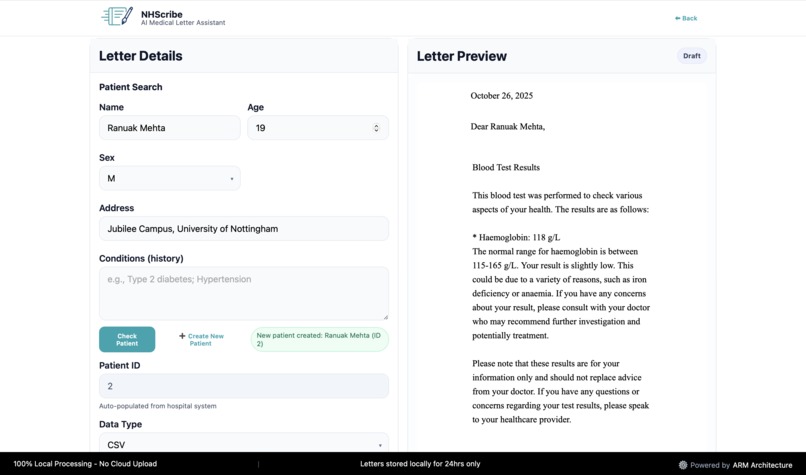
Letter Generation + Editing Screen
-
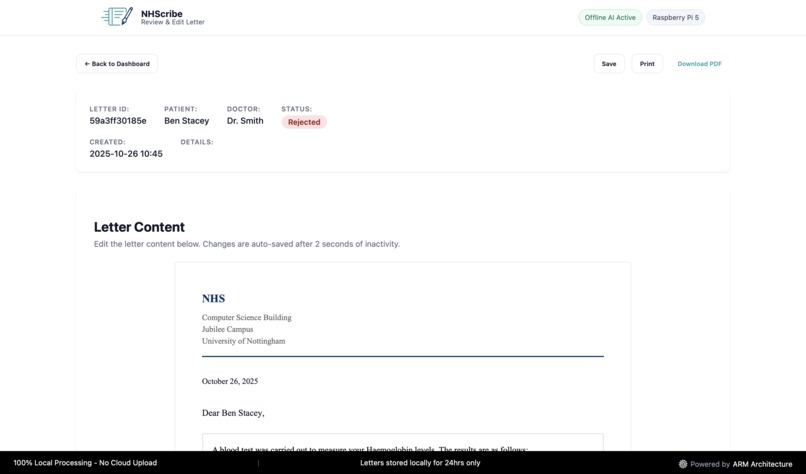
Letter Editing Page
-
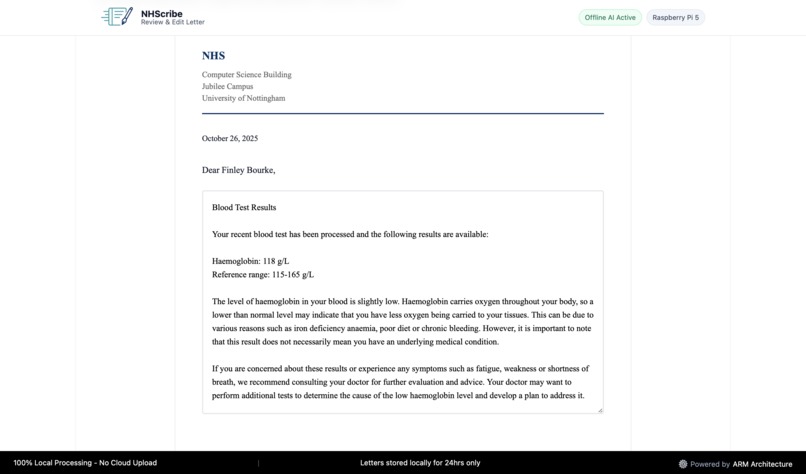
Letter Editing Page 2
-
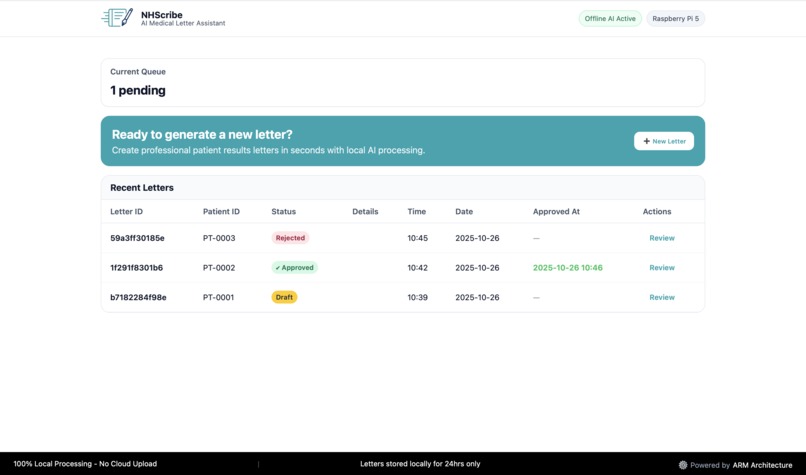
Dashboard
-
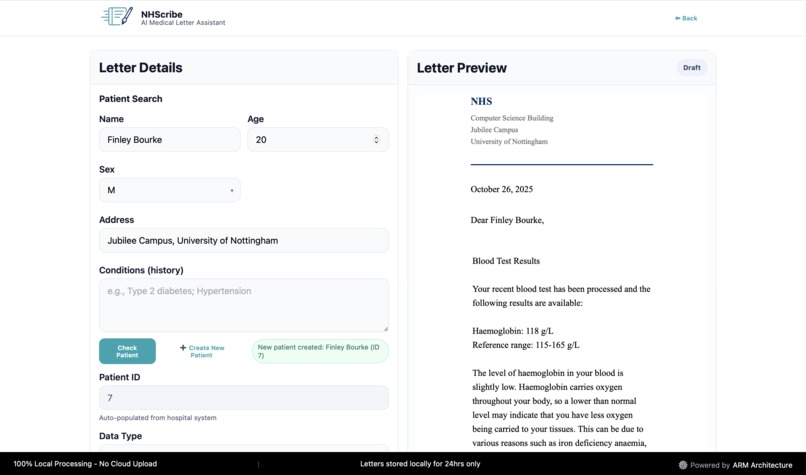
Generation


Inspiration
One of the biggest bottlenecks in NHS patient care is the administrative backlog, with up to 2 of every 5 admin days spent typing and sending results letters manually. Meanwhile, strict patient data confidentiality laws prevent hospitals from using cloud-based LLM tools to automate this process. We wanted to build something that helps doctors return results faster while keeping all data fully private and on-site.
What it does
Our application generates patient results letters locally, directly from haematology test data. It runs entirely on a Raspberry Pi, ensuring no data ever leaves hospital premises.
Doctors can:
- Upload or enter patient details and test results
- Automatically generate a results letter using a locally hosted AI model
- Edit, approve, or reject the letter before sending
- Export it securely as a PDF
This reduces admin workload and speeds up patient communication without compromising privacy.
How we built it
How We Built It
Frontend: React webapp for clean letter review and approval interface
- Backend: Local FastAPI server running on a Raspberry Pi
- LLM: Lightweight on-device text generation for result interpretation and letter drafting
- PDF Generation: Automated through Python ReportLab
- Data Flow: CSV or JSON input → secure local processing → editable output letter
Challenges we ran into
- Network setup when porting to raspberry pi
- Implementing editing of PDFs
- Integrating our work, particularly between FastAPI endpoints and React Frontend
- Prompt Engineering Ollama Model
Accomplishments that we're proud of
Built a fully functional end-to-end prototype that runs 100% locally on a Raspberry Pi — with no external network calls or cloud dependencies.
Successfully generated, edited, and exported real NHS-style results letters directly from sample haematology data.
Demonstrated that AI tools can comply with strict Healthcare data governance while still saving staff time and improving patient communication.
What we learned
- How to deploy AI responsibly in highly regulated environments, balancing innovation whilst also considering real world limitations.
What's next for NHScribe
- Model fine-tuning on anonymized NHS letters to improve medical tone, accuracy, and consistency.
- Expanding beyond haematology to support other test types like biochemistry and radiology reports. -Building an offline results dashboard for clinicians to track pending letters, approvals, and turnaround times.
Built With
- css
- fastapi
- html
- javascript
- ollama
- python
- react
- sqlalchemy
- uvicorn


Log in or sign up for Devpost to join the conversation.