-
-
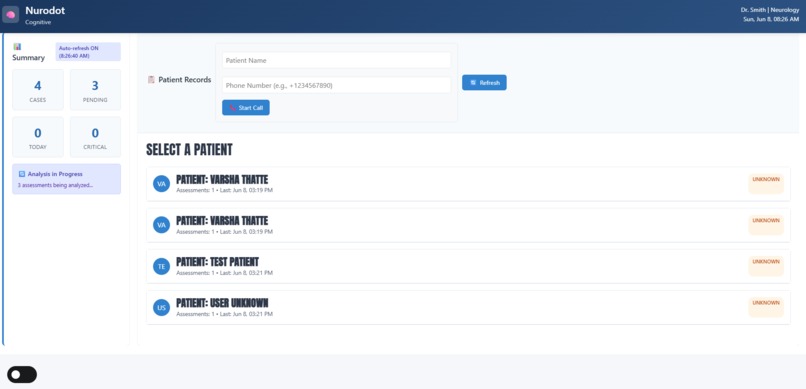
Home page for clinicians
-
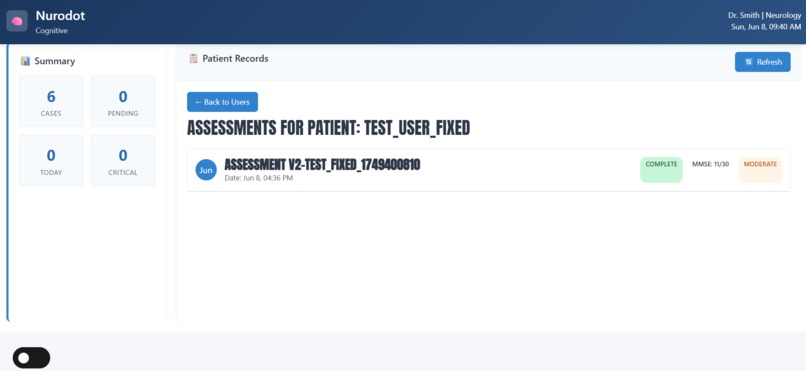
Assessment score
-
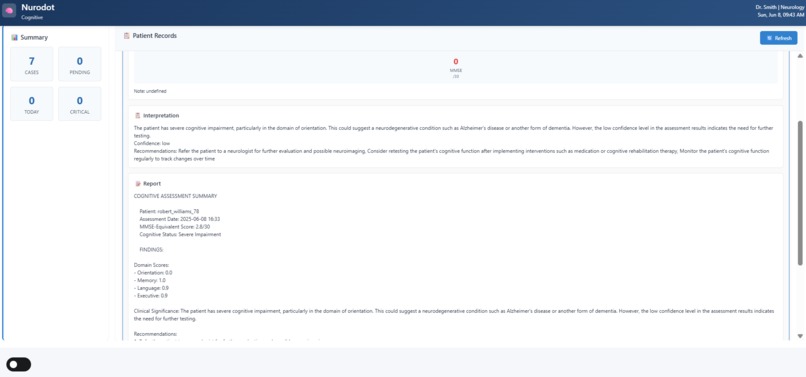


Our Journey with Nurodot: Building a Voice AI-Powered Platform for Alzheimer’s Detection
Inspiration
The Nurodot project was born from a deeply personal place. My colleague Varsha Thatte and I have both seen the toll Alzheimer’s and dementia take on our families. We witnessed how routine cognitive assessments, like the Mini-Mental State Examination (MMSE) and the Montreal Cognitive Assessment (MoCA), were often delayed due to limited resources, leaving families without the early interventions that could make a difference. This frustration fueled our desire to create a solution.
With the recent advancements in LLMs, we experienced massive improvements in voice recognition and text-to-speech solutions. We saw an opportunity to combine our personal drive with cutting-edge technology to address a critical gap in healthcare, motivating us to build Nurodot—a platform powered by voice AI that aids early detection and triage of neurological disorders by enabling doctors to autonomously conduct cognitive screening tests.
How We Built the Project
Building Nurodot was a technical adventure that brought together a range of tools and expertise. Here’s how we did it:
Platform Overview: Nurodot is a cloud-based, HIPAA-compliant platform designed to detect Alzheimer’s early and prioritize care. It integrates voice AI driven cognitive testing, and analysis, all hosted on Google Cloud for scalability and security.
Technical Backbone:
- Backend: We used a Flask application on Google Cloud Run to handle requests and manage workflows.
- Data Management: Google Cloud SQL (PostgreSQL) stores patient data and results, while Eleven Labs stores the phone conversations. Redis manages task queues.
- Cognitive Testing: Clinicians trigger tests (MMSE, MoCA, CDR) via a Twilio API endpoints which sends out a phone call to the patients. Patients then hear audio prompts (Text-to-Speech), respond verbally, and we process responses with Eleven Labs for transcription and emotional insights. Scores are calculated by processing patients answers against the ground-truth.
- Triage System: Our custom
TriageEngineassesses urgency (Critical, Urgent, Moderate, Routine) from the cognitive tests to triage the riskiest patients first. Critical cases trigger alerts via Twilio (SMS). - Compliance: We ensured HIPAA compliance with audit logging, secure storage, and API key authentication.
The result is a seamless, scalable system that empowers clinicians with actionable insights, all while keeping patient data safe.
Challenges Faced
The road to building Nurodot was full of obstacles. Integrating diverse technologies—GCP, Twilio, Elevenlabs, Webflow—into a unified platform was a technical puzzle.
HIPAA compliance added another layer of complexity. We had to secure every aspect of the system, from data storage to notifications, to ensure that it can realistically work with the strict compliance and regulatory laws the health care industry has in place. This meant implementing strict access controls and logging mechanisms.
The AI models posed their own challenges. Ensuring their accuracy and reliability in a medical context was critical, as false results could have serious consequences. We spent significant time validating our prompts and fine-tuning the speech recognition tools for patients with varying cognitive abilities.
Finally, designing a user-friendly experience for both clinicians and patients was tricky. We had to balance technical sophistication with accessibility, which led us to using Twilio powered phone calls to conduct the tests. This ensured even that even the older generation with limited experience with technology could adopt and utilize our tool.
Despite these hurdles, Nurodot has been a labor of love. It’s a testament to what’s possible when technological innovation solves an age old problem , and I’m proud to contribute to a tool that could change lives.
What We Learned
This project taught me more than I could have anticipated. I gained a deeper understanding of Alzheimer’s and dementia, not just as clinical diagnoses but as profoundly human experiences that affect patients and their loved ones. I learned that early detection isn’t just a medical goal—it’s a lifeline that can preserve quality of life through timely care.
I also discovered the transformative power of technology in healthcare. By harnessing AI, neuroimaging, and speech recognition, we could detect subtle signs of cognitive decline that might otherwise go unnoticed. The project showed me how blending neuroscience, engineering, and AI can tackle complex problems and deliver real-world impact.
Login details for the website
username: admin password: nurodot123


Log in or sign up for Devpost to join the conversation.