-
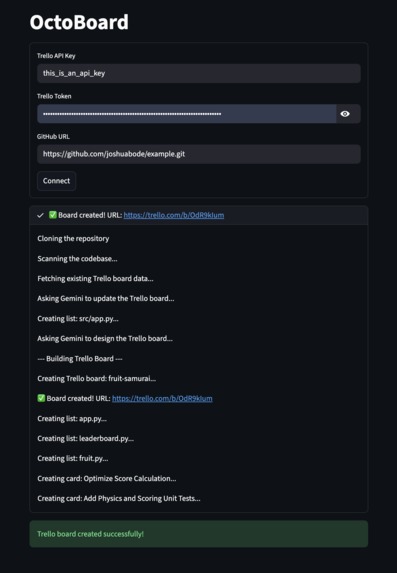
Project Creation Demo

💡 Inspiration
We realised that in almost every medium to large-scale project we've undertaken, we deeply regretted not investing time upfront to create a proper plan. Without that initial structure, we inevitably ended up refactoring major architectural concepts later in the development cycle—often multiple times—which consumed far more time than creating a plan would have taken in the first place.
This frustration became the core inspiration for our project: we wanted to capture all the benefits of thoughtful planning without requiring the significant upfront time investment that typically prevents developers from planning in the first place.
The "Already Started" Problem
A key part of our inspiration also came from recognising how often projects begin without proper structure. We've all experienced that moment—weeks into development—when you realise you've lost track of what needs to be done, or that your initial approach needs significant rework. The project is too far along to abandon, but it desperately needs the organisation it should have had from the start.
🎯 What it does
OctoBoard automatically analyses a codebase, via a public GitHub repository, and generates a fully populated Trello board with actionable development tasks. It scans your project structure and file contents, then leverages Google's Gemini AI to identify areas for improvement, potential bugs, missing features, refactoring opportunities, and testing needs. The tool intelligently creates organised lists and cards based on your code's actual state, not generic templates. If a board already exists for your project, OctoBoard updates it by comparing the current codebase with existing cards, archiving completed tasks and adding new ones as your project evolves.
🔨 How we built it
We built OctoBoard using Python with Streamlit for the web interface, integrating both the Trello REST API and Google's Gemini AI SDK. The core architecture involves a codebase scanner that recursively walks through project directories, intelligently filtering out unnecessary files like dependencies and build artefacts. We crafted detailed prompts for Gemini that guide the AI to act as a principal engineer, analysing code structure and generating specific, actionable tasks rather than generic suggestions. The Trello integration handles board creation, updates, and card management, while a mock status system allows the tool to run both as a CLI application and through the Streamlit GUI seamlessly.
🚧 Challenges we ran into
Getting Gemini to return consistently structured JSON responses was initially frustrating, as the AI would often wrap responses in code blocks or deviate from the schema. We had to implement robust cleaning and parsing logic to handle these variations reliably. Managing the dual-mode functionality—running standalone via CLI versus through Streamlit—required careful abstraction of the status reporting system to avoid context errors. The logic for determining whether to create a new board or update an existing one proved tricky, especially when handling edge cases like boards that existed but were inaccessible or had been renamed. We also struggled with the card distribution bug, where all cards were being added to only the last list due to incorrect loop scoping.
🏆 Accomplishments that we're proud of
We're proud of creating a tool that genuinely solves a real problem we face as developers—the friction between writing code and maintaining project boards. The AI-powered analysis produces surprisingly insightful and actionable tasks that go beyond surface-level observations, often identifying subtle technical debt and improvement opportunities. We also learned about CI/CD and managed to create a GitHub actions
📚 What we learned
We gained deep experience working with modern AI APIs, learning how to craft effective prompts that generate structured, reliable outputs from language models. The project taught us important lessons about API rate limiting, error handling, and gracefully managing external service dependencies. We discovered the importance of defensive coding when parsing AI responses, as even well-crafted prompts can produce unexpected variations. Working with the Trello API gave us valuable experience in REST API integration and state management across external systems. Most importantly, we learned that AI can be a powerful collaborator in understanding and organising complex codebases when given the right context and guidance.
🚀 What's next for OctoBoard
We plan to implement a more sophisticated update mechanism that asks Gemini to explicitly specify which cards to create, update, or archive, then use Trello's PUT endpoints for proper card updates rather than just creating new ones. Integrating OctoBoard as a GitHub Action would enable automatic board updates on every pull request or push to main, creating a seamless CI/CD integration for project management. We want to add support for multiple project management platforms beyond Trello, including Jira, Linear, and Asana, making the tool more versatile. Adding customizable AI personas (e.g., "security-focused," "performance-focused") would let teams tailor the analysis to their specific needs. Finally, implementing a card priority scoring system based on code complexity metrics and dependencies would help teams focus on the most impactful tasks first.
Built With
- github-actions
- google-gemini-api
- python
- streamlit
- trello-api


Log in or sign up for Devpost to join the conversation.