-
-
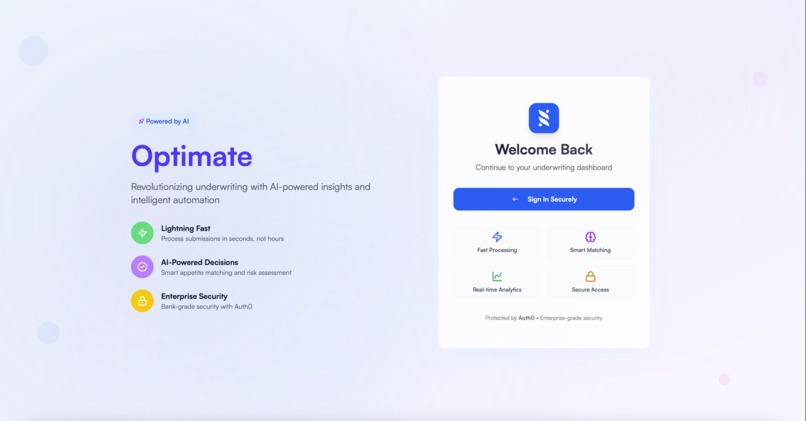
Login
-
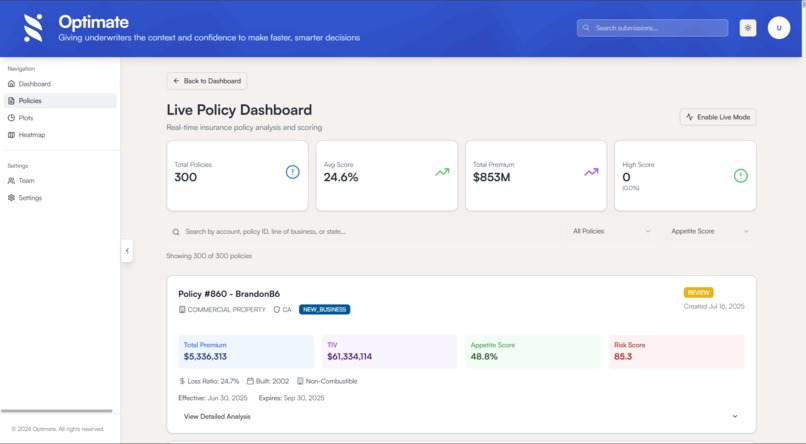
Live Policies
-
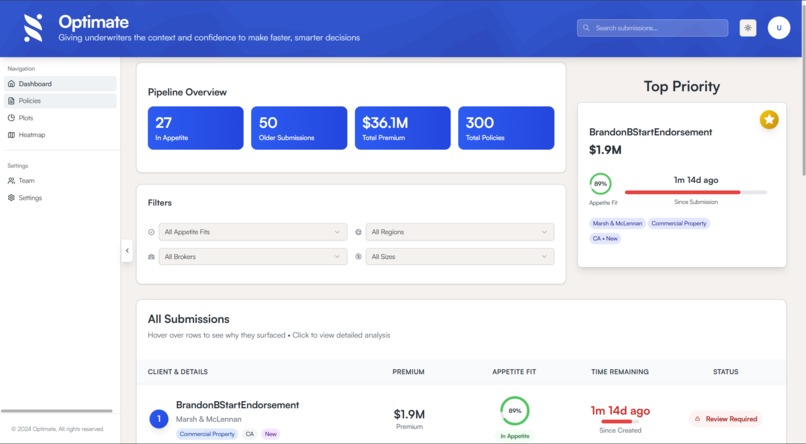
Dashboard
-
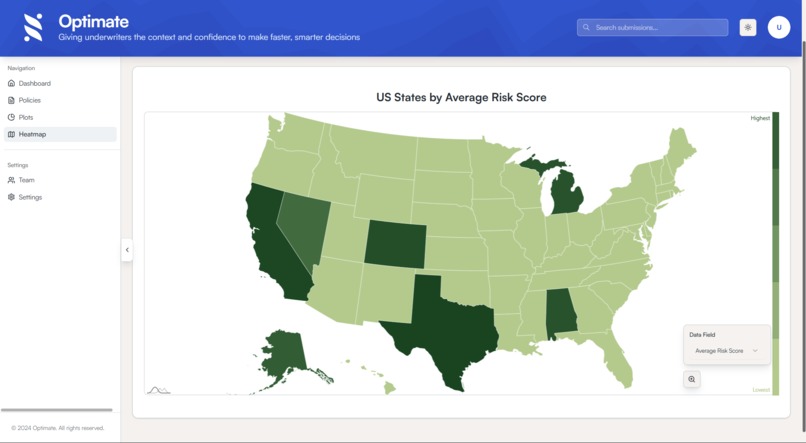
Heatmap
-
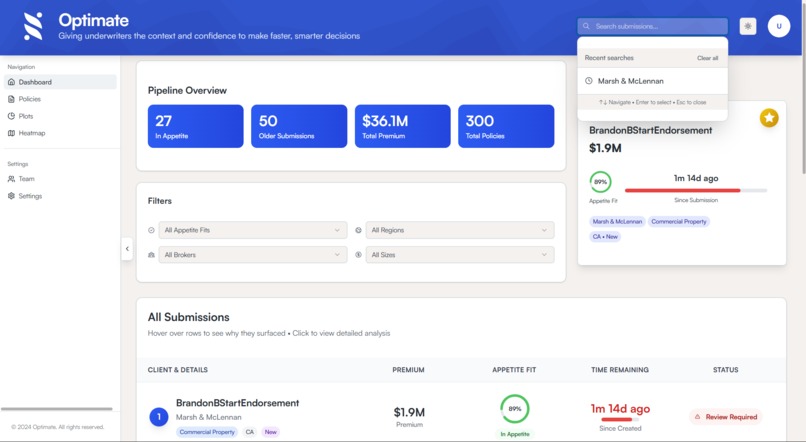
Search
-
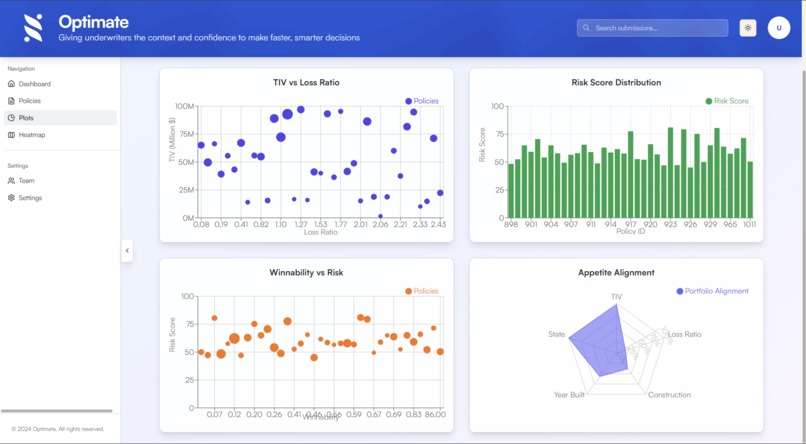
Plot


Inspiration
We were inspired by Federato’s challenge statement:
“Reimagine the RiskOps landing page experience. The goal is to build a dashboard experience that, upon user login, intelligently surfaces a curated set of submissions that are most aligned with the carrier's appetite; enabling faster and more effective underwriting decisions.”
This sparked the idea for Optimate, our AI-powered underwriting dashboard. Underwriters often face the challenge of sifting through massive amounts of policy data to make high-stakes decisions under pressure. We wanted to reimagine this workflow by combining:
- AI and reinforcement learning to prioritize in-appetite submissions.
- Interactive dashboards for clarity and transparency.
- Data-driven insights grounded in underwriting guidelines and risk metrics.
- Live tracking and plots to monitor portfolio performance in real time.
- Heatmap visualizations to instantly show policies across states, colored by appetite and risk scores.
Our inspiration came from observing how underwriters juggle complex, and sometimes conflicting, factors; such as Total Insured Value (TIV), loss ratios, building age, and state regulations. By building Optimate, we aimed to show how modern AI and intuitive visual design can turn this complexity into actionable intelligence, enabling smarter, faster, and more confident decisions.
What it does
Optimate is an AI-powered underwriting dashboard designed to make risk assessment smarter, faster, and more transparent. It transforms raw policy data into actionable insights and visualizations that help underwriters focus on what matters most.
With Optimate, underwriters can:
- See top matches: Instantly view the top 10 submissions that best align with appetite guidelines and the underwriter’s selected policy.
- Understand the “why”: Access a detailed breakdown of AI-driven justifications and rules that explain why each submission was prioritized.
- Take action with confidence: Approve or decline submissions directly from the dashboard, supported by clear reasoning and data.
- Train the AI: Provide feedback and satisfaction scores that feed into reinforcement learning, making the system smarter over time.
- Visualize risks: Explore an interactive heatmap of U.S. states showing areas of high and low risk appetite, alongside dynamic plots and live tracking of portfolio performance.
- Chat with AI: Engage in two-way conversations with the AI at the individual policy level, enabling underwriters to ask questions, receive clarifications, and co-decide on risk assessment with contextual awareness.
Together, these features make Optimate a one-stop platform for turning underwriting complexity into clarity.
How we built it
We built Optimate as a full-stack application combining a modern web framework, AI services, and scalable cloud infrastructure to deliver real-time insights to underwriters.
Frontend & Deployment
- Built using Next.js (App Router) and deployed on Vercel for fast, serverless performance and seamless CI/CD.
- Used TailwindCSS and shadcn/ui to design a clean, consistent, and responsive interface with minimal overhead, enabling rapid iteration of charts, heatmaps, and dashboards.
- Integrated Auth0 for secure authentication and role-based login, ensuring underwriters have personalized access to their own submissions and preferences.
- Built using Next.js (App Router) and deployed on Vercel for fast, serverless performance and seamless CI/CD.
Data Layer & Processing
- Pulled the Federato API dataset (policies, premiums, TIV, loss ratios, etc.) and ingested it through a Python pipeline, where we enriched the raw data with:
- Risk scores and appetite scores based on underwriting guidelines.
- Live tracking metrics for policies over time.
- Aggregated account-level analytics weighted by premium and loss ratio.
- Stored enriched data in a format optimized for visualization and AI query workloads.
- Pulled the Federato API dataset (policies, premiums, TIV, loss ratios, etc.) and ingested it through a Python pipeline, where we enriched the raw data with:
AI & Insights Engine
- Used Cohere’s LLMs with a Retrieval-Augmented Generation (RAG) pipeline:
- Broke policy data and underwriting guidelines into embeddings and indexed them.
- Enabled the AI to justify its decisions (“why this policy is in-appetite”) by pulling grounded references from guidelines and historical data.
- Implemented reinforcement learning from underwriter feedback, where every approve/decline and satisfaction score helps refine appetite scoring logic over time.
- Added a context-aware AI chatbot that works at the individual policy level, enabling underwriters to have two-way conversations with the AI about specific submissions.
- Used Cohere’s LLMs with a Retrieval-Augmented Generation (RAG) pipeline:
Storage & State Management
- All application state, including user preferences, saved searches, favorite policies, chat history, and cached embeddings metadata, is persisted in DynamoDB, giving us low-latency reads and writes at scale.
- This persistence enables underwriters to pick up where they left off, track past decisions, and build a living history of their interactions with the AI.
- All application state, including user preferences, saved searches, favorite policies, chat history, and cached embeddings metadata, is persisted in DynamoDB, giving us low-latency reads and writes at scale.
Visualizations & Analytics
- Leveraged Recharts and custom D3 visualizations to build:
- Interactive plots of policy performance metrics.
- Heatmaps of U.S. states colored by appetite/risk scores.
- Dynamic leaderboards of top in-appetite policies.
- Designed the dashboard to surface both macro insights (portfolio-level risk distribution) and micro insights (policy-by-policy explanations).
- Leveraged Recharts and custom D3 visualizations to build:
In short, Optimate integrates a modern web stack with AI-driven insights, reinforcement learning, and powerful visualizations; all aimed at making underwriting decisions smarter and more transparent.
Challenges we ran into
Domain Understanding
Insurance and underwriting were completely new domains for our team. At first, we struggled to understand concepts like Total Insurable Value (TIV), loss ratios, and appetite guidelines. It took deliberate effort to translate Federato’s problem statement and sample guidelines into clear, actionable rules for our AI model and dashboard. Once we built that context, we could design features that truly aligned with underwriters’ workflows.
Collaboration & Version Control
Working as a team of four developers in a time-boxed hackathon meant rapid iteration and frequent code merges. Naturally, merge conflicts cropped up in our GitHub repo. We learned to coordinate by:
- Establishing a practice of announcing merges into
main, - Pulling changes immediately after merges, and
- Splitting work into smaller, well-scoped branches to reduce overlap.
This improved our velocity and reduced lost time on conflicts.
AI Model Development
We wanted our AI to do more than simple filtering. Designing the reinforcement learning loop was challenging, especially under hackathon constraints. We had to:
- Define reward functions based on underwriter satisfaction feedback,
- Balance rule-based scoring (from appetite guidelines) with LLM-powered reasoning, and
- Build a lightweight but extendable training loop that could adapt over time.
This gave us a crash course in connecting theory (RL foundations) with real-world application.
Cloud Infrastructure
We chose AWS DynamoDB for storing user data, embeddings, and chat histories because of its scalability and low latency. But setting it up securely was non-trivial. Challenges included:
- Configuring IAM roles and policies to avoid over-permissive access,
- Ensuring smooth integration with our Next.js app, and
- Handling rate limits and schema design under the pressure of real-time queries.
Visualization & Real-Time Data
Designing meaningful heatmaps, plots, and live tracking views presented both technical and design hurdles. We had to map appetite scores and risk metrics into visuals that underwriters could understand at a glance. Optimizing rendering performance for large datasets while keeping the UI responsive was a balancing act.
Despite these hurdles, each challenge became an opportunity: we learned new domains, tightened our team workflow, pushed our AI design skills, and deployed a secure, scalable cloud app; all within the hackathon timeframe.
Accomplishments that we're proud of
Timely Delivery
We successfully built and delivered a working product within the hackathon timeframe, ensuring it stayed aligned with Federato’s problem statement while going beyond the basics with live tracking, heatmaps, and an AI chatbot.
Adopting New Technologies
Our team dove into new tools and frameworks; CohereAI, Auth0, AWS DynamoDB, Next.js (App Router), and shadcn/ui; and integrated them into a production-ready application in just a few days. This rapid learning curve not only expanded our technical toolkit but also boosted our confidence in quickly mastering unfamiliar technologies.
AI Model Exploration
We researched and implemented the fundamentals of reinforcement learning, applying it to real-world underwriting data. While lightweight, our model demonstrated how underwriter feedback (approve/decline, satisfaction scores) could guide iterative improvement of appetite scoring.
Visual Storytelling
We built intuitive plots, live tracking views, and heatmaps that made abstract metrics like risk score and appetite score immediately understandable. Seeing complex insurance data come alive visually was one of our proudest achievements.
What we learned
Improved Team Communication
Working under time pressure taught us the importance of concise, transparent communication. We learned to coordinate merges, delegate responsibilities clearly, and make fast collective decisions.
Technical Growth
We deepened our knowledge of:
- Building RAG pipelines with Cohere,
- Designing secure and scalable systems with AWS DynamoDB,
- Implementing reinforcement learning concepts in a practical setting, and
- Deploying production-ready UIs with Next.js + TailwindCSS + shadcn/ui.
Industry Insight
We gained valuable exposure to the insurance and underwriting industry. By working with appetite guidelines, TIV, loss ratios, and premiums, we developed a clearer picture of how underwriters balance competing factors and why decision-support tools like Optimate can make a real impact.
Hackathon Mindset
Perhaps most importantly, we learned how to take a vague, high-level challenge and turn it into a polished, end-to-end solution that blends AI, cloud, and UX in a way that solves real-world problems.
What's next for Optimate
We see Optimate not just as a hackathon project, but as the foundation of a scalable underwriting intelligence platform. Our next steps include:
Deeper AI Integration: Expand beyond RAG and reinforcement learning by exploring fine-tuned LLMs that can model more nuanced underwriting strategies and simulate “what-if” scenarios for submissions.
Real-Time Data Feeds: Integrate external data sources such as weather risks, property valuation APIs, or catastrophe modeling to make appetite scores more dynamic and responsive to changing conditions.
Explainability at Scale: Enhance the AI explanations with richer visual cues (confidence intervals, score breakdowns, and sensitivity analysis) so underwriters can trust not just the results, but the reasoning.
Collaborative Workflows: Add features for teams of underwriters; such as shared views, comments, and case histories; to bring transparency and accountability to group decisions.
Mobile & Cross-Platform Support: Extend Optimate to mobile and tablet experiences so underwriters can access dashboards and chat with the AI on the go.
Production-Grade Infrastructure: Move from DynamoDB prototypes to a more robust multi-region cloud setup with monitoring, audit trails, and enterprise-grade security, making it deployable in real-world underwriting teams.
By continuing to evolve Optimate, we aim to transform it into a trusted partner for underwriters; combining the precision of AI, the clarity of visualization, and the adaptability of human feedback.
Conclusion
With Optimate, we set out to reimagine underwriting by blending AI, data visualization, and human feedback into one seamless platform. What started as a hackathon challenge grew into a vision for how underwriters can make faster, smarter, and more confident decisions; supported by explainable AI, reinforcement learning, and intuitive dashboards.
Our journey taught us not only new technologies and industry insights, but also the power of collaboration under pressure. Most importantly, we demonstrated that even in a complex and highly regulated domain like insurance, innovation can come from rethinking the experience at the intersection of AI, design, and trust.
Built With
- amazon-dynamodb
- auth0
- aws-dynamodb
- cohere
- cohereai
- d3.js
- federato-api
- next
- next.js
- oauth
- python
- recharts
- reinforcement-learning
- retrieval-augmented-generation-(rag)
- shacdn
- shadcn/ui
- tailwind
- tailwindcss
- vercel


Log in or sign up for Devpost to join the conversation.