-
Logo
-
Stats
-
Workflow
-
Key Features
-

Thanks!


Inspiration
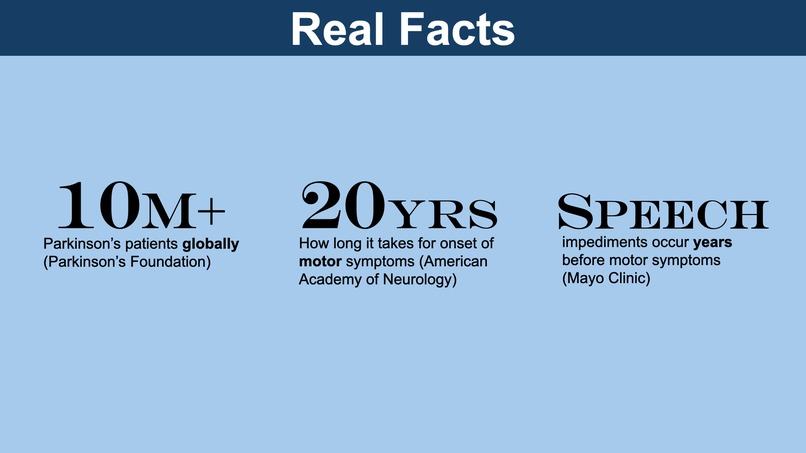
The idea for ParkinSense came from observing the undue hardship that Parkinson's Disease (PD) patients have to go through if they are diagnosed too late. Because of the nonlinear growth in neural degeneration with every passing moment, we realized patients need as much time as possible to act against it before treatments become ineffective.
What it does
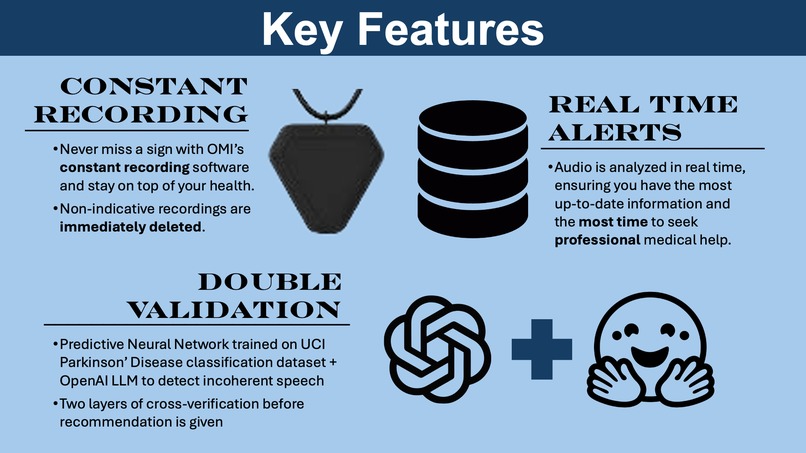
ParkinSense is an innovative use of AI voice recognition technology to identify key signs of speech impediment / non-motor onset symptoms of PD, powered by a neural network and an LLM. This allows ParkinSense users early alerts of PD onset, which would make them more likely to seek professional medical help earlier.
How we built it
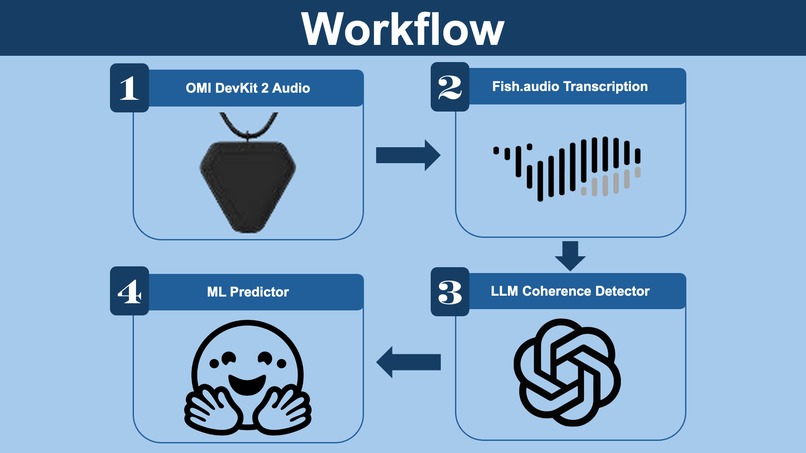
We built ParkinSense using a combination of neural networks, LLMs, and the OMI Dev Kit 2 microphone necklace. A neural network was trained on a UCI PD Classification dataset to determine whether the speaker in an audio file showed signs of slurred speech, while OpenAI's ChatGPT was tasked with determining whether a speaker was coherent or not. These results were then given to the user with a recommendation to seek medical attention or not.
Challenges we ran into
The biggest challenge we faced was tuning the neural network to correctly determine whether a speaker showed signs of slurred speech. On top of that, we also faced significant challenges in connecting the different components of the product together - from the Google Cloud Storage bucket to the neural network + fish.audio, and then from their outputs to the front end.
Accomplishments that we're proud of
We're particularly proud of the fact that we had a hardware component in our project, which let us get a glimpse of the impact our product could have on the world. Building on the OMI Dev Kit allowed us to truly think in the perspective of the user, which is a very important factor in products like ParkinSense.
What we learned
As we built ParkinSense, we learned about the practicalities of applying this in the real world with real patients. Talking to expert mentors in AI at the venue was very helpful in determining the direction we went with ParkinSense.
What's next for ParkinSense
We plan to expand to clinical environments to test ParkinSense on real PD patients to create a feedback loop and improve our product's accuracy. Our long term goals are to enhance and expand ParkinSense's capabilities and ultimately launch in the healthcare space as a revolutionary personal health tool.


Log in or sign up for Devpost to join the conversation.