-
-
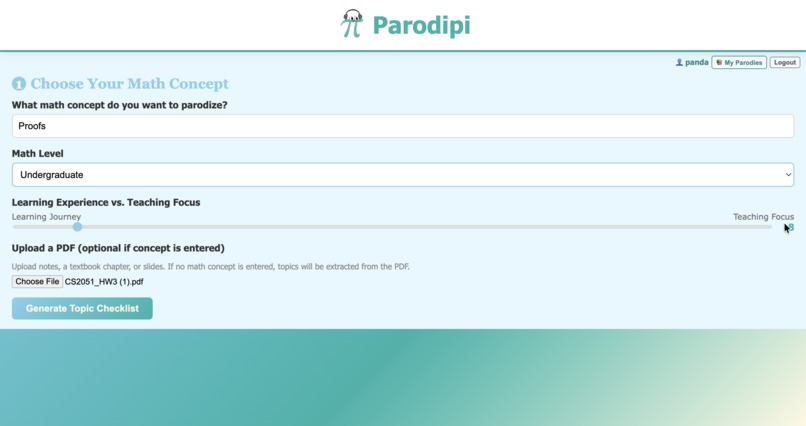
Landing page
-
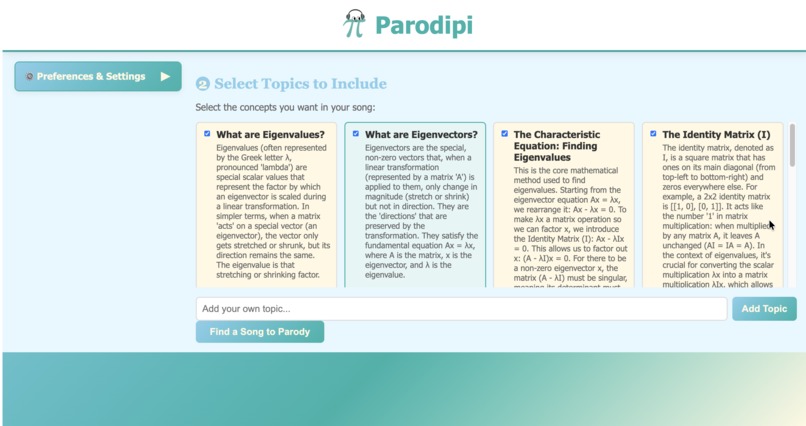
Select or deselect auto-generated concepts
-
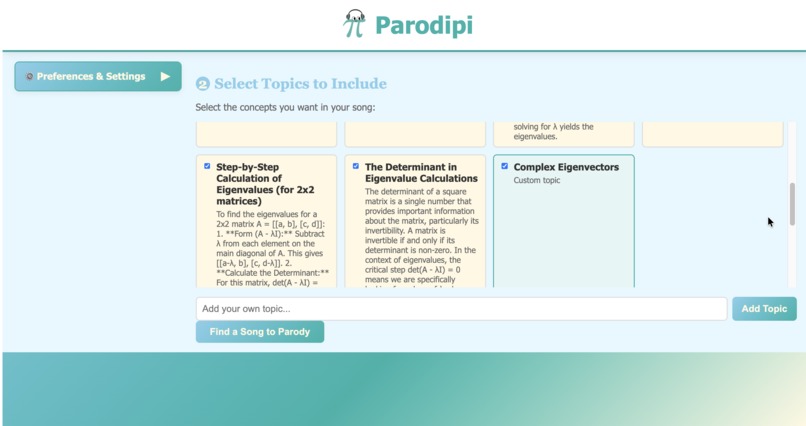
Add your own concepts!
-
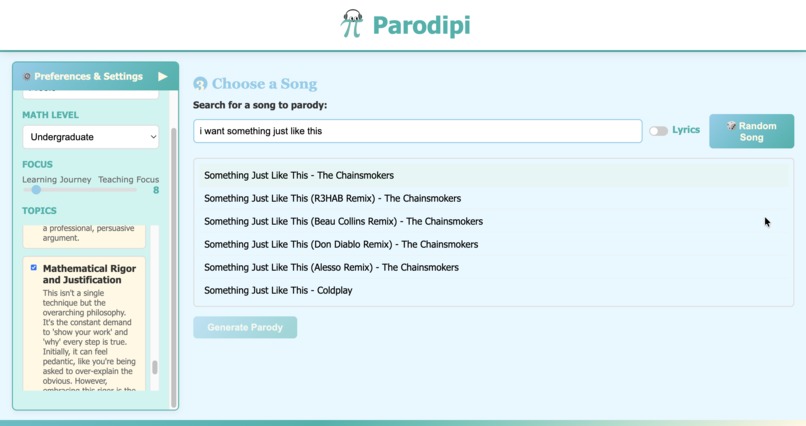
Search for songs you like
-
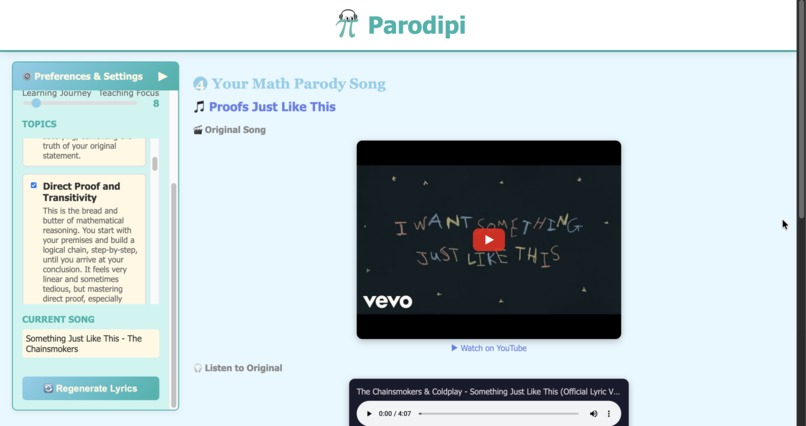
Links to original song video and mp3
-
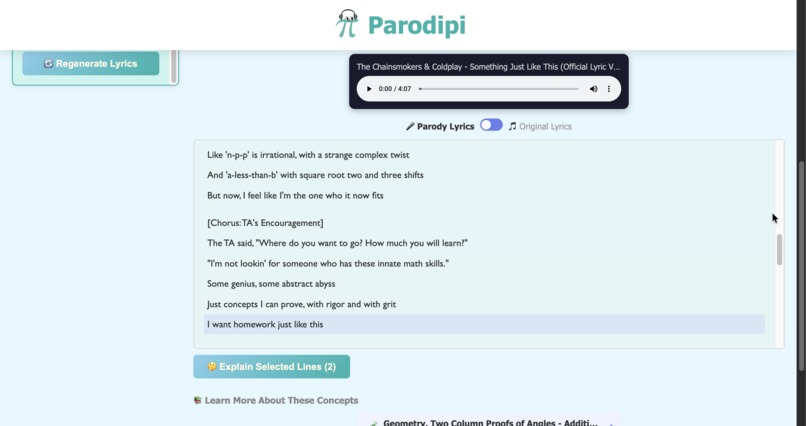
Toggle between parody vs. original lyrics
-
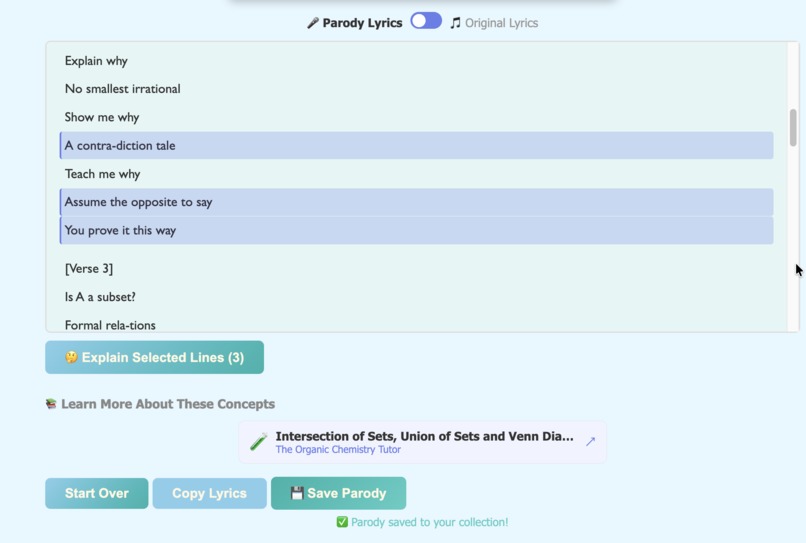
Select lyrics to have AI explain
-
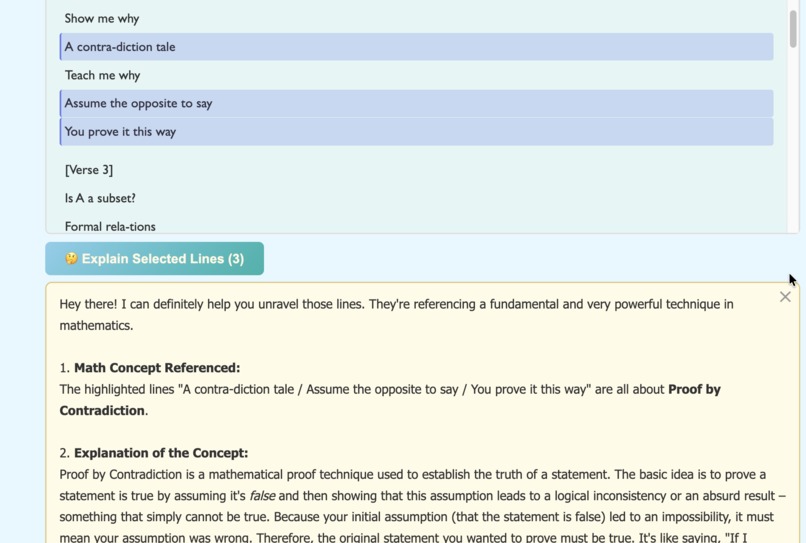
Have AI explain lyric concepts
-
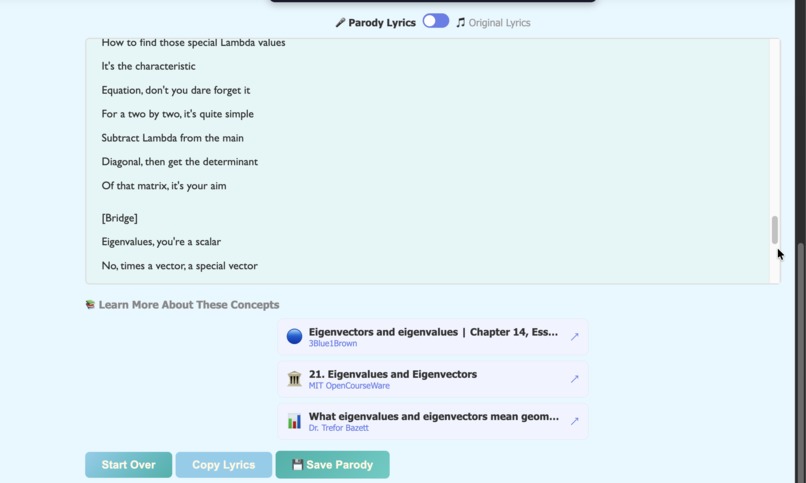
Links to related resources
-
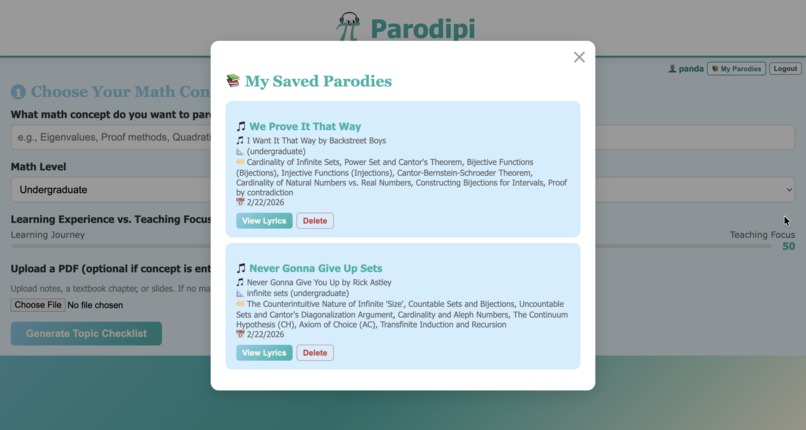
Saved data for logged users
-
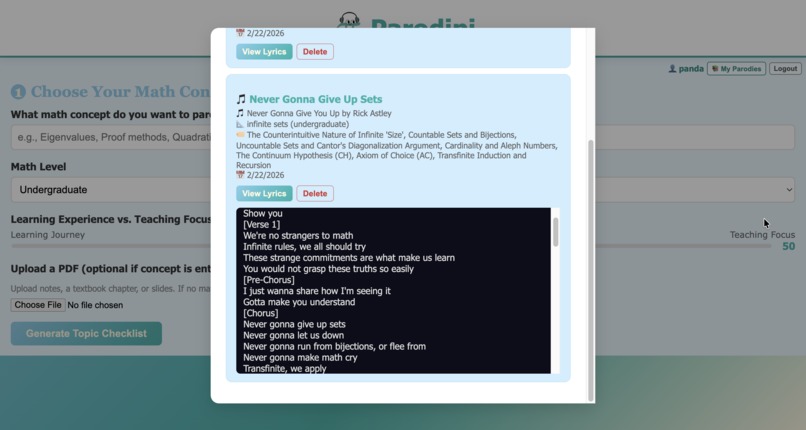
Saved lyrics for logged users
-
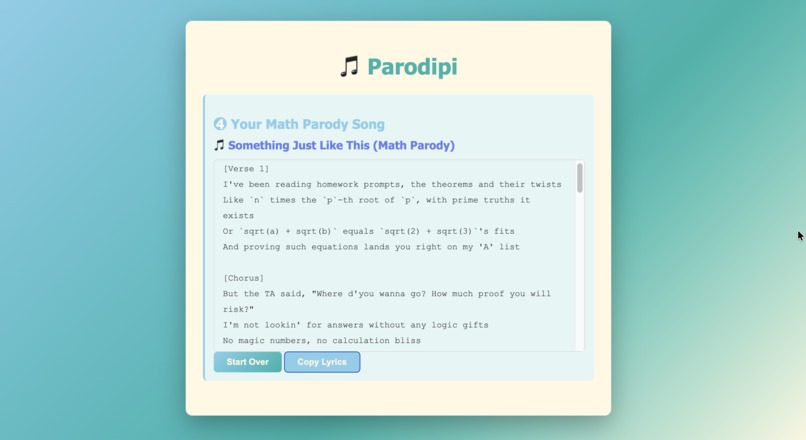
Vintage lyrics about CS2051-HW3 in an earlier version
-
Cute pi creature logo


Inspiration
What if after a lecture about Hessian Matrices or eigenvalues, your professor starts singing your favorite karaoke song -- but the lyrics are actually about the math concepts!
That's how we came up with $$Parodi\pi$$ Parody-fy
Our project was inspired by the difficult (but very interesting) math courses here at Georgia Tech. With Georgia Tech being an academically rigorous school, we wanted to create a project that turns (potentially) confusing concepts into catchy songs.
Having taken courses like Linear Algebra, Multivariable Calculus, and Discrete Mathematics, we wanted to provide a tool for other students to succeed in their classes and, more importantly, have a good time.
TL;DR: We want more people to find fun in math (;
What it does
As the name says! We generate math parody songs given a chosen topic. Given a math concept and song choice, Parodipi creates a parody that teaches the student relevant topics with AI features and web scraping capabilities through google gemini and genius api keys. You could also upload a pdf of your math homework or math formulas, and Parodipi can also extract topics from that.
How we built it
We used Google Gemini (gemini-2.5-flash) API to provide song metadata and lyrics and generate math topic breakdowns, rhythm-aware parody lyrics, explanations, and educational resources. YouTube scraping and yt-dlp allowed us to embed videos and stream audio directly in the app. PyMuPDF (fitz) extracts text from uploaded PDFs, and a Flask backend orchestrates APIs, authentication, and data flow.
Our stack combines Python on the backend with JavaScript, HTML, and CSS on the frontend. Python handles AI calls, scraping, PDF parsing, streaming, and user management. JavaScript powers the interactive multi-step UI, lyric highlighting, and media players, while HTML/CSS ensure a responsive, polished design.
We support this system with tools like Flask, google-genai, BeautifulSoup, requests, and Gunicorn, along with secure password hashing and CSV-based storage for users and saved parodies. Our curated database includes 670+ songs across 16 artists, balancing scale with recognizable, popular tracks.
Challenges we ran into
The most challenging part about this project is that LLMs had small deviations in syllables when generating songs causing it to throw off the timing and flow. Because they are not inherently optimized to produce lines with a precise syllable count or consistent rhythmic structure, we implemented an agentic workflow for lyrics generation. We also engineered the LLM prompts to analyzed syllable structure and analyzed the data using pandas to count the syllables so that the generated parody lyrics could be sung to the original song’s beat as closely as possible.
Another challenge was building a song database that was both large in scale and relevant to users. We needed broad coverage across genres while also ensuring that popular, recognizable songs were included. To solve this, we selected a comprehensive existing song database as our foundation and then augmented it by manually adding widely recognized and currently popular tracks. (And of course, all the songs that we like.)
Accomplishments that we're proud of
We are proud of integrating our frontend and backend to create an interactive, AI-powered math parody platform. By leveraging robust technologies like Flask, Python, Google Gemini AI, and JavaScript, we developed a product that transforms math concepts into memorable musical parodies.
The UI/UX design was also very interesting, since we want our project to stand out from just being a LLM-wrapper. We designed the parody song creation process so that the user has full agency, and the pipeline fosters meaningful human-computer interaction and can bring a smile to faces!
Beyond our technical achievement, we're excited that Parodipi has real-world impact. Our platform makes learning math engaging and accessible as it helps students understand complex topics, spark creativity, and connect with trusted educational resources. We hope Parodipi inspires learners and educators to see mathematical concepts in a whole new perspective! One of us is a TA and another one of us really wants to be a TA in the future, and this is something that we might want to use for educational entertainment purposes.
What we learned
Through building $$Parodi\pi$$, we gained invaluable experience in:
- Integrating AI models to generate creative, educational math parodies and explanations
- Building a workflow for uploading and analyzing math PDFs, extracting relevant concepts automatically
- Scraping and processing real-world song lyrics and YouTube videos to enhance learning and engagement
- Designing a user authentication system and CSV-based database for personalized parody saving and retrieval
- Developing a responsive, visually appealing interface that makes math learning interactive, musical and fun.
What's next for Parodipi
We plan to:
- Add More AI Customization: Let users choose tone, style, and difficulty for their parody lyrics and explanations. Improve the lyrics generation function to better match syllable count and patterns to the original song.
- Collaborative Parody Creation: Enable real-time co-writing and sharing of parodies with friends or classmates. Additionally, make the parody lyrics editable so the user can collaborate.
- Expanded Resource Library: Curate more trusted educational videos and interactive math tools for every concept; maybe even connect to manim to create math visualizations.
- More Math Memes: Generate a math meme to go with the parody song.
- Connect to Database: Let users save their parodies and progress devices with secure storage in a database.
$$Parodi\pi$$ isn’t just a math tool, it’s a creative and fun platform for making learning memorable, musical, and effective!




Log in or sign up for Devpost to join the conversation.