-
-
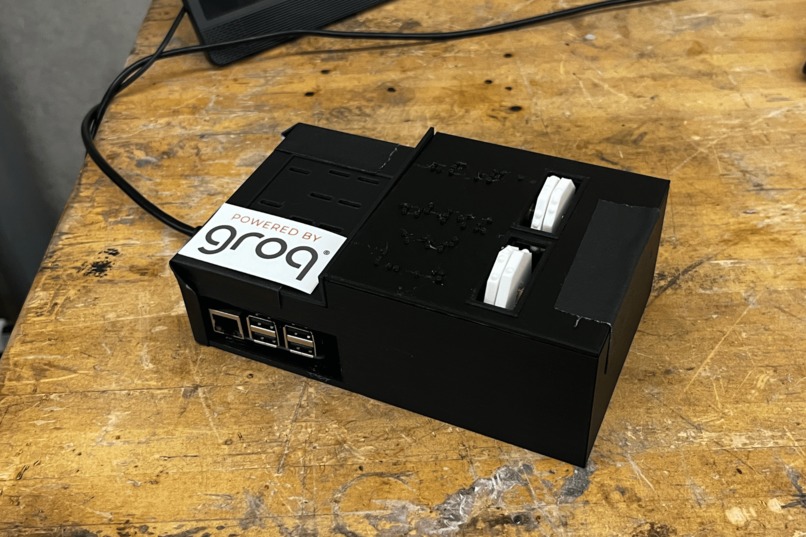
Our First Prototype
-
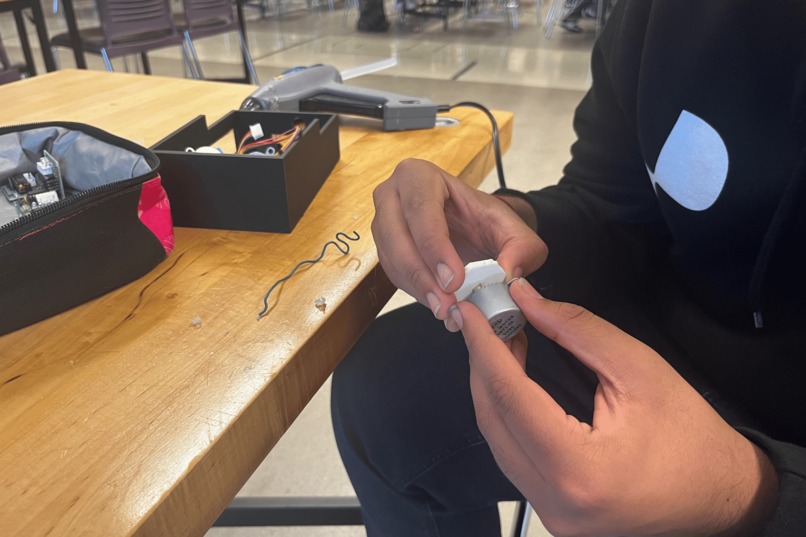
Fitting The Display
-
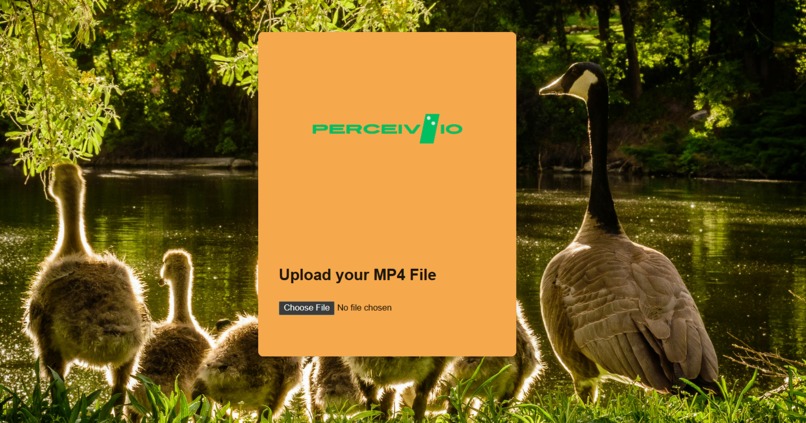
Our app that handles sent videos and profile access
-
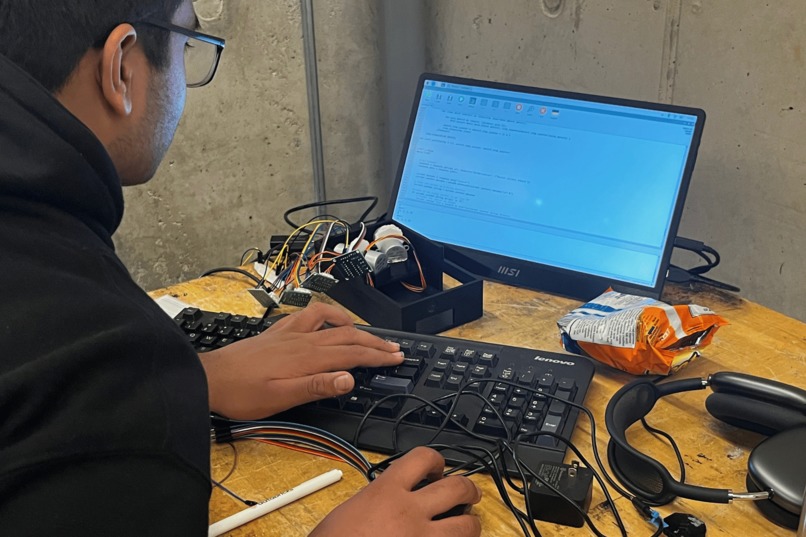
Programming the Logic
-
-
-
-
-
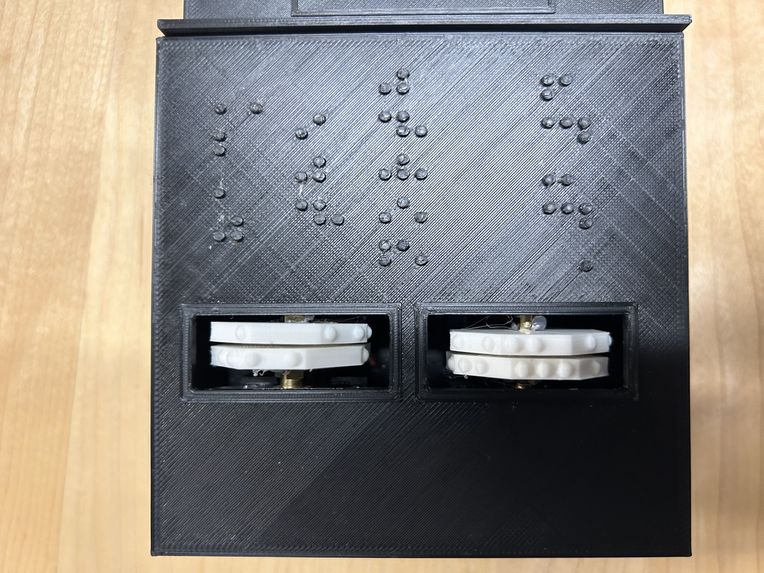
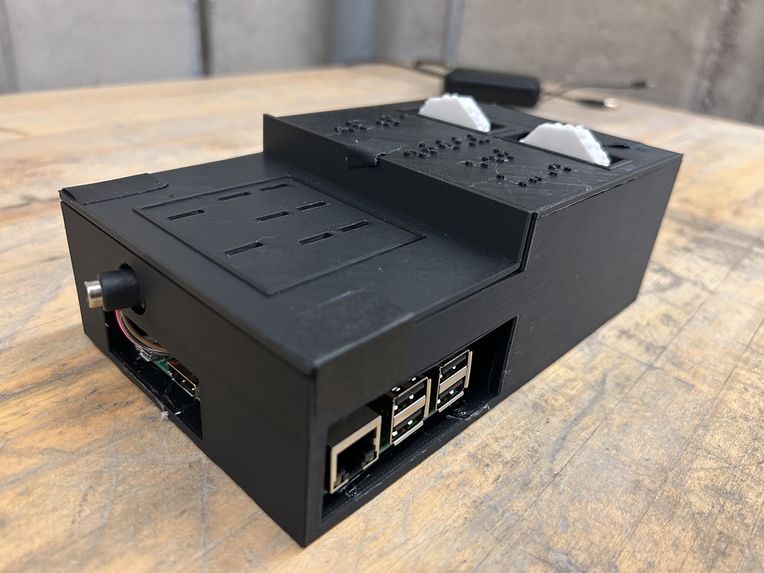
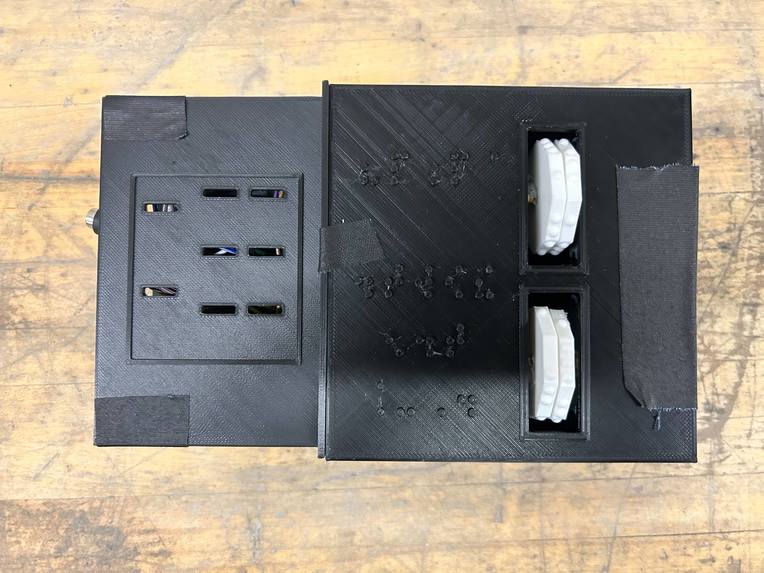
The braille on the top says "Hack The North"
-
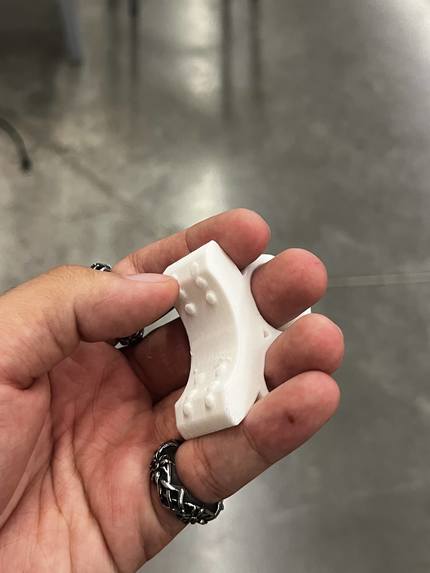
Our Vision of the Future


💡 INSPIRATION
We first thought of building something for the deaf & blind because one of our team member's close family relations has slowly been acquiring age-related dual vision and hearing loss.
Deafblindness has been traditionally overlooked. The combination of sensory losses means existing solutions, such as sign language for the deaf or speech transcription for the blind, cannot be used. As a result, over 160 million Deafblind people around the world are severely limited in their ability to communicate.
Current solutions require uncomfortable physical contact or the presence of a 24/7 guide-communicator, preventing independence. These barriers to being able to freely explore and interact with your world can lead to you feeling isolated and alone.
🎯 OUR GOAL
Our goal was to build a communication device that can help Deafblind persons understand and communicate with the world without invasive physical contact, a requirement for a volunteer communicator, or an inaccessible/impractical design.
🔭 WHAT IS PERCEIV/IO?
PERCEIV/IO is a novel hardware device powered by the latest AI advancements to help the Deafblind.
We designed PERCEIV/IO to have two main use-cases. First, used a camera to take periodic captures of the world in front of the user and use AI image-to-text technologies to translate it into braille, which is then displayed on a tactile hand-held device that we have fabricated. This can help a Deafblind person understand their surroundings, which is currently very limited in scope. Second, we designed a speech-to-braille system to help allow for communication with the Deafblind. We also incorporated sentiment analysis to effectively convey the tones of standard English phrases to make communication more robust. The specific details can be found in the next section.
We hope some of the ideas generated during this hackathon turn are able to be used in organizations such as CNIB Deafblind Community Services in order to help them with their goal of assisting people who need it most.
📣 FEATURES
- Get a description of the world in front of you translated into braille directly at your fingertips.
- Live English-to-braille translation & sentiment analysis to allow for more robust communication.
- Store a profile of the user so PERCEIV/IO can recognize common occurrences such as people and places.
- An accompanying, fully functional, universally deployed web app that allows you to view your profile and update it with any necessary info.
🛠️ HOW WE BUILT IT
Hardware
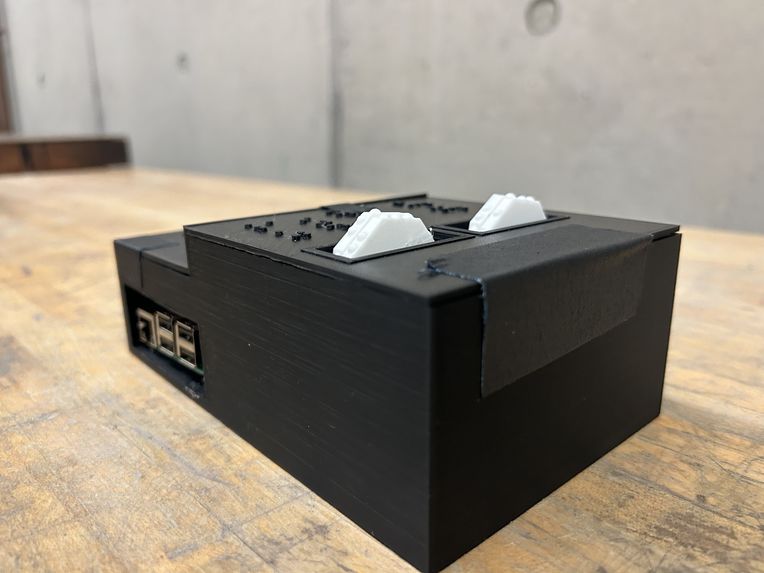
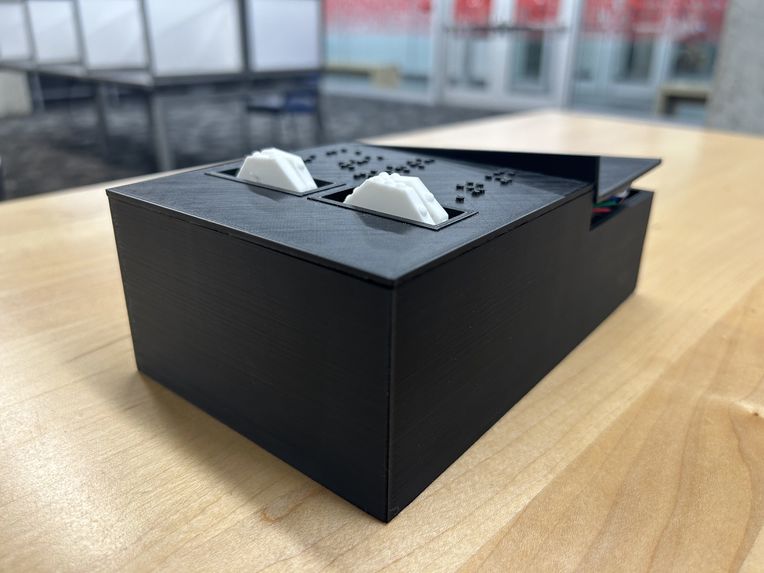
We designed our hardware using four stepper motors and their drivers, 3D printed braille discs, 3D printed stepper motor housings, a Raspberry Pi 3B, and custom 3D printed housings. Each stepper motor controls an octagonal braille disc. Placing two of these side-by-side creates a full braille cell, with different stepper motor rotations producing different braille characters. We designed the Raspberry Pi code on Python and developed our own algorithim for converting text directly into stepper motor coordinates (position to display the correct braille character).
Software
We used image recognition AI based on Groq using their Llava v1.5 image-to-text endpoint, and that text is then put through Groq's Llama 3.1 70b endpoint to condense it down into just two or three words. We used Google Speech-to-Text and the Facebook RoBERTa base model for simple sentiment analysis with a Genesys-based sentiment analysis feature currently being deployed. We developed our own code to convert into Grade II Unified English Braille Code.
On the backend, our database is based on Convex along with our accompanying app. We also built a prototype, web-hosted app on the Streamlit platform integrated with hugging face ML models loaded through the transformers pipeline.
We facilitated wireless communication between the apps and the hardware through Github by running functions to update a file and check for updates on a file. We are also working on a Genesys based AI chat bot, the responses of which would be translated into braille and communicated to the user.
🌎 ENVIRONMENTALLY CONSCIOUS
As users of AI during this boom of innovation over the last couple years, we strive to be as environmentally conscious as possible and be aware of the power we are consuming whenever we prompt an LLM. Over the course of a large model's first one million messages, it has an estimated power cost of 55.1Mwh. That's enough power to power roughly 120 American homes for a year!
Thankfully, with Groq, not only do we have access to lightning-fast response speeds, but due to their LPUs, SRAM, and sequential processing we are using less power than if we were to use the traditional NVIDIA counterpart. Conserving energy is very important to us, and we are thankful for Groq to providing a solution for us.
🧗♀️ CHALLENGES WE'VE OVERCOME
Hackathons are about nothing if not overcoming challenges. Whenever a piece of hardware broke, software wouldn't cooperate, or motors wouldn't connect, we would work as a team to solve the issue and push on through. It ended up being a very rewarding experience for all of us.
One major challenge that's still fresh in my mind is our issues with the Raspberry Pi. We ended up going through three Pi's before we realized that none of their SD cards had any OS on them! Eventually, with the help of the amazing mentors here at Hack The North (thank you again Moody!), we we're able to get the SD card flashed and were able to start uploading our code. Thankfully, due to our adoption of SOLID principles and our policy of encapsulation, we were able to implement the code we has worked on in the meantime with ease.
Our hardware issues didn't end there! After careful testing of almost every different software & hardware component to determine why our code was not working, we found that 2 stepper motor drivers were faulty. With the help of mentors, however, we got this resolved and we learned the painstakingly careful process of hardware verification!
Another problem was more to do with logic- turning an image into text is easy. Turning that text into braille, and then turning that braille into signals from a Raspberry Pi into 4 proprietary stepper motors that control half of a braille character each is whole other. Luckily with some wisdom from our team members with past experience with these kinds of electronics combined with some logic learned in hardware classes, we as a team were able to come up with the implementation to make it work.
🏆 WHAT WE'RE PROUD OF
We are most proud of coming up with a novel idea that uses novel technology to help people in need. I think it is everyone's desire to develop something that is actually useful to other humans, especially while utilizing the latest technologies. We think that technology's greatest advantages are the advantages it is able to give to others in order to promote diversity, equity and inclusion.
Some Specifics
The device our team members' relative would have to use costs upwards of $3000 USD (link). This is prohibitively expensive, especially given that many of the world's Deafblind come from underprivileged nations. The prototyping costs for our hardware were free, thanks to Hack the North. However, we estimate manufacturing costs to be under $100 given the low-cost hardware, making this system far more affordable.
Second, our system is novel in its comprehensive approach. Current solutions (such as the $3000 product) require a connection to an external computer to function. This means they cannot be used portably, thereby preventing a Deafblind person from being able to explore. Moreover, they do not integrate any of the image-to-braille or speech & sentiment-to-braille technologies, severely limiting their scope. We believe our project will substantially improve the status quo by allowing for these features. Our device is portable, can be used without additional peripherals, and integrates all necessary conversion technology.
Lastly, our prototype has two fully-functioning braille cells that follow the distance and format requirements of Grade II Braille. This means that our hardware is not just a proof of concept for a braille device, but could actually be implemented directly in Deafblind communities. Moreover, it is likely to be extremely efficient as the stepper motor design does not require individual motors for each braille pin, but rather just one motor for a whole column.
Perhaps most importantly, though...
We are so proud of the fact that we came up with and created a working prototype for our idea within only 32 hours(!!!). For many of us, this was our first time working with hardware within such a short time frame, so learning the ins and outs of it enough to make a product is a huge accomplishment.
💡 WHAT DID WE LEARN?
Over the course of this hackathon, we learned so much about the Deafblind community by reading online testimonials of those who have been diagnosed. It allowed us insight into a corner of the world that we had otherwise not known much about prior. Through developing our product while keeping these testimonials in mind, we also realized the difference between developing a product in order to beat others in a competition and developing a product because we believe this could actually be useful to real people one day.
The many sponsors here at Hack The North were also very valuable in teaching us about their product and how we can implement them into our product to improve it's functionality and efficiency. For example, Groq were very helpful in describing exactly why utilizing their API was more energy efficient than the big guys. We were super eager to learn about new technologies such as Symphonic labs, as we realized their use-case as an AI that can read lips was very applicable to our device.
🔜 THE FUTURE OF PERCEIV/IO
We have thought long and hard about the future of PERCEIV/IO. We've already come up with a laundry list of ideas that we want to implement sometime in the future in order for this product to achieve it's full potential. The number one thing is to shrink the size of the actual hardware. Raspberry Pi's are extremely useful for prototyping- but are a bit too bulky for use in a commercial product. We want to achieve a size similar to a smart watch with similar processing power.
We also want to relocate the camera and have it wirelessly communicate with the computer. One idea was to embed the camera into a pair of sunglasses in a similar style to Spectacles by Snap Inc.
And finally, we are waiting for the day where AI technology and hardware reaches a point where we can run all models locally, without the need for a massive power bank or network connection. That would truly untether the user from any external requirements for a real feeling of freedom.



Log in or sign up for Devpost to join the conversation.