-
-
Data Sense
-
homepage
-
Digital Presense
-
Digital Persona
-
persona
-


Inspiration
The inspiration for PersonaGen stemmed from a deep-seated human desire to connect and to preserve the essence of loved ones.
It started with a personal tragedy. A friend died, and the months that followed were filled with a recurring thought, "if I could just talk to him one last time. One more conversation." The sensation of things left unsaid and unfinished goodbyes was so powerful. It struck me deeply, while I could not remember everything about the time with my friend or hope to conjure a picture of him from some image I had taken, I did have a much more intense and real option available - an interactive and lifelike digital persona. Through this, I could engage the past again and, maybe, have closure.
Another strong motivating factor was a little boy who lived in my neighborhood with his grandparents. The boy's whole world was his grandmother. One day, his grandmother, who had a heart attack while he was at school, passed away. He was a little boy. He had no idea what the word death meant and just lost his smile. I watched him slip into such deep sadness and such a quiet depression that I broke my heart for him. I kept thinking, "What if he could just say something to her one more time? What if he could just tell her by?" I became so affected by this sad situation that I developed a prototype of this project, with a simple digital version of his grandmother from old journals and audio recordings. When I finally showed the little boy the prototype, he cried when he was able to say what his heart had been longing so much to say. I knew in that moment that this project was for something bigger than the technology and that it was about healing and connection.
In addition to these personal narratives, there were also changes in generative AI models and the increasing amount of personal data that each of us produces daily. This data, or digital footprint—text messages, posts made on social media, photos of friends and family, and audio recordings—felt like a rich, underexplored resource that we could synthesize into a coherent, interactive digital identity.
How big is the problem?
PersonaGen: Bridging the Unseen Divide – A Transformative Solution for Connection and Knowledge
The Magnitude of the Issue: A Universal Human Longing
PersonaGen addresses a profound and universal human need that spans across emotional healing and intellectual discovery. The problem we solve isn't merely a niche concern; it is fundamental to the human experience itself:
The Ache of Loss and Unsaid Words:
- Pervasive Grief: Annually, tens of millions of people worldwide experience the loss of a loved one. In the U.S. alone, over half of all Americans (57%) reported experiencing a major loss within the past three years. This isn't just about sadness; a significant percentage (7-10% of adults, higher for specific types of loss) suffer from Prolonged Grief Disorder, leading to debilitating depression, anxiety, and even suicidal ideation for 20-50% of those seeking treatment.
- The Unmet Need for Continued Connection: Beyond traditional mourning, there's a deep-seated human desire for continued connection. Studies indicate that 30-34% of individuals report experiencing perceived interactions with the deceased, and over 60% of bereaved individuals express a desire for continued contact with their lost loved ones. PersonaGen offers a meaningful, interactive avenue for this innate human yearning, providing comfort and a sense of closure that current methods often cannot. The stories of a child finding peace in "speaking" to his grandmother, or an adult reconnecting with a friend, underscore this vital, emotional chasm.
- Market Demand: The grief counseling market is projected to grow from $3.34 billion in 2024 to $5.36 billion by 2029, with a clear trend towards technology-enabled solutions for personalized bereavement support. Digital legacy services are also booming, reflecting a desire to manage and preserve digital footprints after death. PersonaGen is perfectly positioned at the forefront of this evolving landscape.
The Quest for Deeper Understanding and Interactive Knowledge:
- Limitations of Static Learning: Our understanding of historical figures, influential thinkers, or even complex personal narratives is often constrained by static media—books, documentaries, and archival materials. These resources, while informative, lack the dynamic, responsive engagement necessary for truly immersive learning and nuanced inquiry. We can read about a great mind, but we cannot converse with them.
- The Power of Experiential Learning: The educational technology (EdTech) market is undergoing a profound transformation, driven by AI. The global AI in EdTech market is expected to surge from $5.3 billion in 2025 to over $98 billion by 2034, with personalized learning applications holding a dominant share. Students using AI-powered adaptive platforms show up to a 19% improvement in test scores and achieve mastery 31% faster. PersonaGen extends this personalization beyond curriculum, allowing users to "learn to their heart's content" by engaging directly with the digital persona of a personality, asking follow-up questions, debating ideas, and gaining insights that no textbook can provide.
- Unlocking New Research Avenues: For researchers, historians, and biographers, PersonaGen offers an unprecedented tool for interactive exploration of their subjects. Imagine not just analyzing Einstein's papers but questioning his thought process, or discussing political theory with a digital Machiavelli. This elevates research from analysis to experiential dialogue.
Targeted Audience: A Spectrum of Human Needs
PersonaGen is designed to resonate with a diverse and extensive audience, catering to both deep emotional needs and a pervasive intellectual curiosity:
Individuals and Families Coping with Loss:
- Grieving Individuals: Those actively mourning a deceased friend, family member, or even a beloved pet, seeking comfort, a sense of continued presence, or the opportunity for unsaid goodbyes. This includes adults, and especially children, for whom traditional grief support can be challenging.
- Memory Keepers: Individuals who wish to preserve the legacy, stories, and unique personality of elderly relatives or those facing terminal illness, creating a "living archive" for future generations.
Educators, Students, and Lifelong Learners:
- Students (K-12, Higher Education): For interactive learning about historical figures, authors, scientists, and political leaders. Imagine a history class where students can "interview" Abraham Lincoln or discuss physics with Marie Curie.
- Educators and Researchers: As a powerful tool for creating engaging curricula, facilitating deeper dives into biographical studies, and conducting novel forms of research by interacting with expert personas.
- Lifelong Learners & Enthusiasts: Anyone with a passion for history, biography, science, or art who desires a more immersive and personalized way to engage with the minds of their heroes or delve into specific eras and disciplines.
Content Creators, Storytellers, and Documentarians:
- To bring historical narratives to life in documentaries, interactive exhibits, or educational content, allowing audiences to engage directly with the digital "voices" of the past.
Digital Legacy Planners:
- Individuals interested in planning their own "digital afterlife," ensuring their personality, wisdom, and stories can persist and interact with future generations, transcending physical boundaries.
By addressing both the profound emotional need for connection in the face of loss and the growing demand for interactive, personalized knowledge, PersonaGen taps into massive, underserved markets. It's not just a technological advancement; it's a human-centric innovation designed to enrich lives and transform how we remember, learn, and connect across time.
What it does
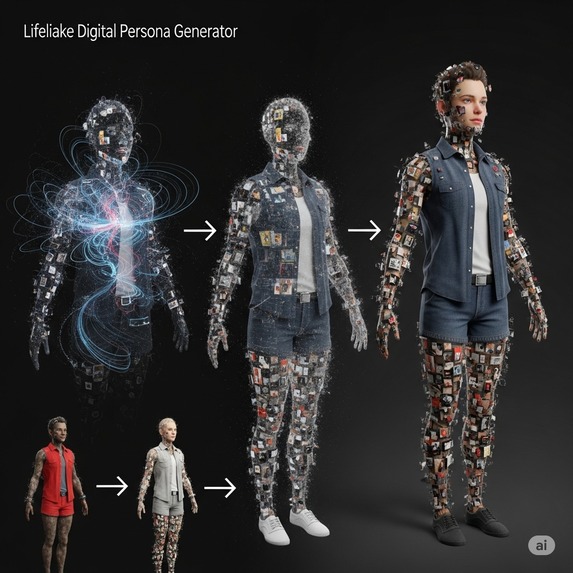
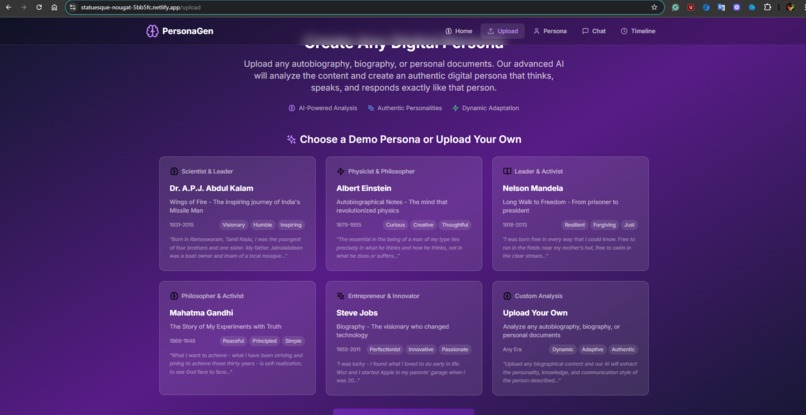
PersonaGen is a full-stack AI-powered application that transforms user-provided autobiographical data and media into an intelligent, lifelike digital persona. Users can upload various forms of personal information, including text documents (biographies, journals, social media data), audio recordings (voice notes, interviews), images (photos across different life stages), and videos.
Once the data is ingested, PersonaGen utilizes a modular Agentic AI system to process and synthesize this information:
Data Ingestion: The DataIngestAgent handles the uploaded files, transcribing audio and video, and extracting text from various formats.
Persona Building: The PersonaBuilderAgent analyzes the text to extract key personality traits, significant life events, emotional baselines, and communication styles.
Memory Creation: The MemoryAgent embeds the processed information into a vector database, creating a long-term memory for the persona that can be queried semantically.
Avatar Generation: The AvatarAgent creates a visual representation of the persona based on the extracted traits and optionally uploaded images, using APIs like D-ID and Artbreeder.
Interactive Chat: The ChatAgent allows users to interact with the digital persona through text and voice, responding in a manner consistent with the extracted personality and drawing upon its memory.
Storytelling: The StoryAgent curates and generates narrative snippets and a visual timeline of key life events, providing a dynamic overview of the persona's history.
Essentially, PersonaGen aims to create a digital twin that can not only store information about a person but also interact and express itself in a way that reflects their unique identity.
How we built it
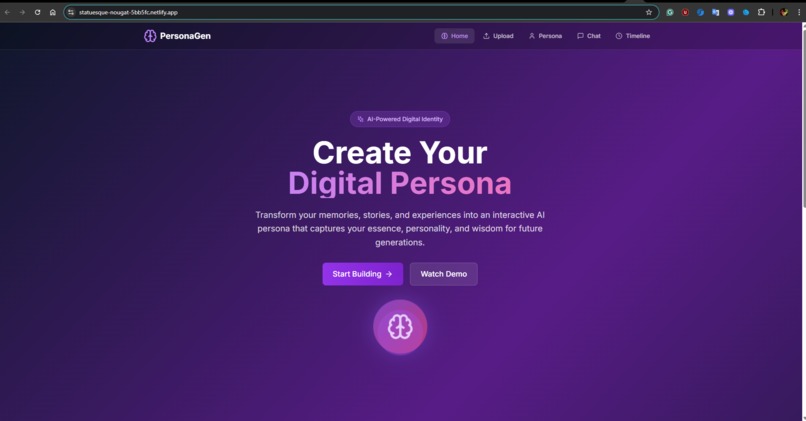
In an age where artificial intelligence can generate text, images, and even music, the idea of creating a digital persona from a real person's life story is both fascinating and powerful. PersonaGen was born from the desire to bridge the gap between static biographies and interactive, lifelike digital experiences. Imagine uploading a memoir or biography and instantly being able to converse with a digital version of that person—one that not only knows the facts of their life but also speaks with their unique voice, beliefs, and worldview. This project set out to make that vision a reality, leveraging the latest in AI and web technology. PersonaGen is a full-stack web application that allows users to upload any biography, autobiography, or personal document in PDF format. The system then extracts the text, analyzes it using Google's Gemini AI, and constructs a detailed digital persona. Users can chat with this persona, receiving responses that reflect the personality, knowledge, and style of the original subject. The result is an engaging, educational, and sometimes moving experience, turning static documents into living conversations.
Key Features:
- Upload any PDF biography or autobiography
- Automatic extraction of persona traits, beliefs, knowledge, and communication style
- Interactive chat with the generated persona, grounded in the document's content
- Modern, animated frontend for a delightful user experience
- Robust, scalable backend with advanced AI integration
PersonaGen was crafted as a modern, full-stack web application, combining robust backend AI processing with a beautiful, interactive frontend. The backend began as a Python FastAPI service but was migrated to Node.js/Express for a unified JavaScript stack, simplifying development and deployment. We used multer for secure PDF uploads, pdf-parse for extracting text, and integrated Google Gemini AI for both persona extraction and chat. Custom normalization logic was developed to handle the unpredictable output formats from the AI, ensuring consistent persona profiles.
The full frontend was designed and developed by Bolt.new, using React, Vite, and Tailwind CSS. The UI features animated loading states, drag-and-drop PDF upload, and a dynamic chat interface, all built with a focus on user experience and accessibility. Framer Motion was used for smooth animations, and the component-based architecture ensures maintainability and scalability. API integration and state management were carefully implemented for seamless communication with the backend.
Challenges we ran into
- AI Output Variability: Gemini AI sometimes returned persona data in Markdown code blocks, with missing or extra fields, or in unexpected formats. We had to develop robust parsing and normalization logic to handle these cases.
- PDF Parsing Edge Cases: Some PDFs were scanned images or had unusual formatting, requiring careful error handling and fallback strategies.
- Migration Complexity: Moving from Python/FastAPI to Node.js/Express involved refactoring API endpoints, updating dependencies, and ensuring feature parity without introducing regressions.
- Frontend-Backend Sync: Ensuring consistent API contracts and handling CORS for local development was essential for a smooth user experience.
- Real-Time Feedback: Implementing animated loading states and responsive UI required close coordination between the frontend and backend to provide timely feedback to users.
Accomplishments that we're proud of
- Seamless AI Integration: Successfully integrated Google Gemini for both persona extraction and chat, handling a wide range of output formats and edge cases.
- Unified JavaScript Stack: Migrated the backend to Node.js/Express, streamlining development and making the project more accessible to contributors.
- Robust PDF Handling: Built a reliable PDF upload and text extraction, supporting a variety of document types and gracefully handling errors.
- User Experience: The frontend, fully developed by Bolt.new, is fast, beautiful, and intuitive, making advanced AI technology accessible to all users.
- Comprehensive Documentation: Created detailed documentation and write-ups to make the project easy to understand, use, and extend.
What we learned
- AI Output Normalization: Working with LLMs like Gemini requires anticipating and handling unpredictable output. Robust parsing and normalization are essential for a seamless user experience.
- Modern Tooling: Tools like Vite, Tailwind, and nodemon significantly accelerate development and improve code quality.
- Security Best Practices: Managing API keys and secrets securely with environment variables is crucial for any production-ready app.
- Iterative Debugging: Migrating technology stacks is challenging and requires patience, thorough testing, and a willingness to refactor.
- Collaboration: Clear documentation, git hygiene, and well-defined API contracts are key to successful teamwork and project scalability.
What's next for PersonaGen
- Persona Editing: Allow users to tweak or refine the generated persona before chatting.
- Voice Interface: Integrate text-to-speech and speech-to-text for a more immersive experience.
- Multi-Document Personas: Combine multiple sources to build richer, more nuanced digital personas.
- Deployment: Package for easy deployment to cloud platforms (e.g., Vercel, Netlify, Heroku).
- Open Source Community: Invite contributions and expand the project's reach.
- Podcast feature for the personas using **elevenlabs.io as audiobooks, news narration, podcasts, video game voices, film pre-production, and social ads all the extensive domains.
- Memory Retrieval Services: Using tavus.io, we can rememorate an event for the loved ones, and someone, who are devasted cuzz of leaving someone.
Conclusion
PersonaGen transforms static biographies into living, interactive experiences. By combining robust PDF parsing, advanced AI, and a modern web stack, we've created a platform that's both technically impressive and deeply engaging. Whether for education, entertainment, or digital preservation, PersonaGen opens new possibilities for how we interact with the stories of real people.
Thank you for exploring PersonaGen!
Built With
- bolt.new
- elevenlabs.io
- gemini
- javascript
- tavus


Log in or sign up for Devpost to join the conversation.