-
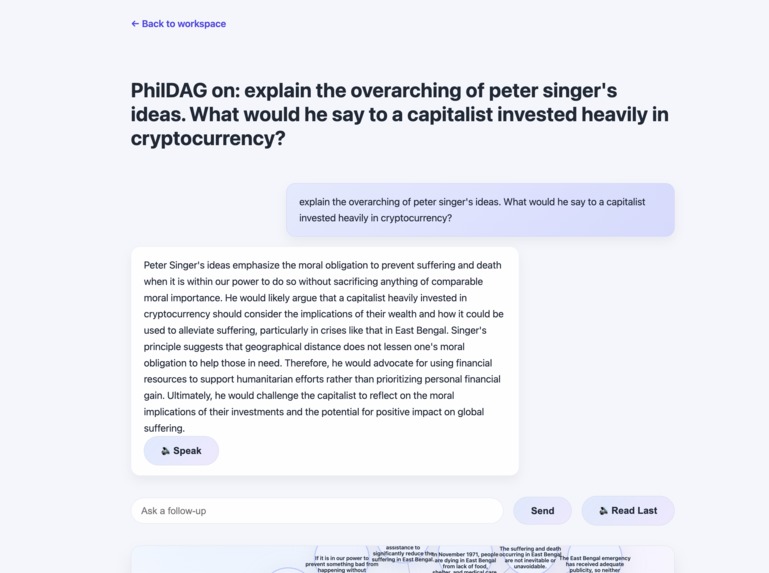
Chat
-
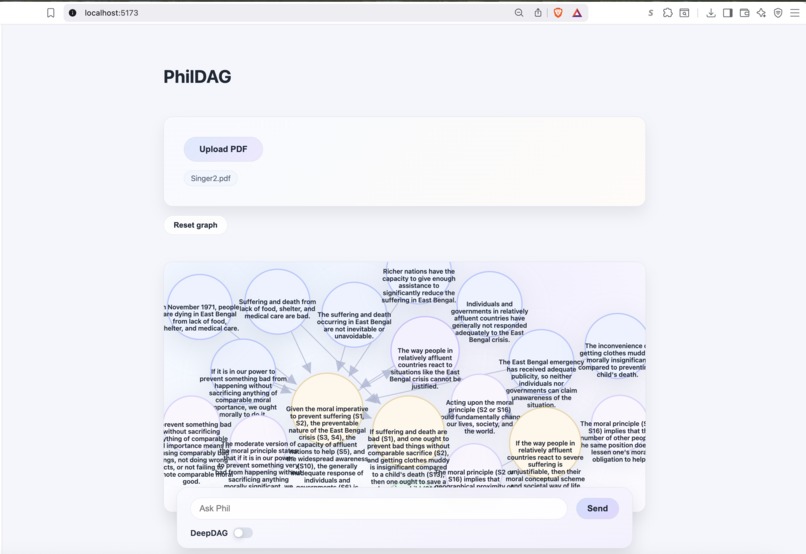
DAG


Inspiration
We are a group of philosophers who think a lot about the right way to live. We experienced many contradictions when analyzing different philosophical frameworks, and it is often difficult to keep all the arguments and logical conclusions in mind. Thus, we hoped to create an app that outsources our thinking - which is very PhilDAG comes in.
What it does
PhilDAG is an app that systematizes philosophical and logical arguments. It processes a pdf document and creates a tree of knowledge: a graph whose nodes are statements in the paper, and whose edges are arguments that derives one statements from another (or a set of statements). Finally, PhilDAG provides a chat interface that allows users to interact with the graph: such as figuring out the logical conclusions from first principles or what statements are necessary to support an argument, or just generally explanations of philosophy, and provides a graph to understand its answers.
How we built it
- Backend: Python (FastAPI) orchestrating Gemini to parse documents into our schema.
- Frontend: React + TypeScript for the uploader, DAG visualizer, and conversation UI.
Challenges we ran into
A literal hardware failure, water on a teammate’s laptop, knocked him out for a chunk of the hackathon. Early work was schema-heavy, so too many cooks slowed us down; we had to rethink task partitioning until the pipeline stabilized.
Accomplishments that we're proud of
We shipped a working end‑to‑end system: PDF -> structured argument graph -> interactive chat/DAG explorer.
What we learned
Designing interoperable schemas (for arguments, statements, citations, artifacts) across backend and frontend was a crash course in thoughtful data modeling.
What's next for PhilDAG
We will use PhilDAG to solve all of our internal philosophical debates. #AskPhil


Log in or sign up for Devpost to join the conversation.