-
-
-
Cortex Analyst Agent


Inspiration
We are facing a global waste crisis, yet individual action often feels unrewarded and untracked. We wanted to answer the question: "What if cleaning up the planet felt like a video game, but paid like a job?"
Inspired by the mechanics of Pokémon GO and the transparency of blockchain, we built Plastic Guardians. We wanted to turn every piece of litter into a "bounty target," creating an immediate financial incentive for environmental stewardship while generating verifiable data for cities and organizations to track pollution hotspots.
What it does
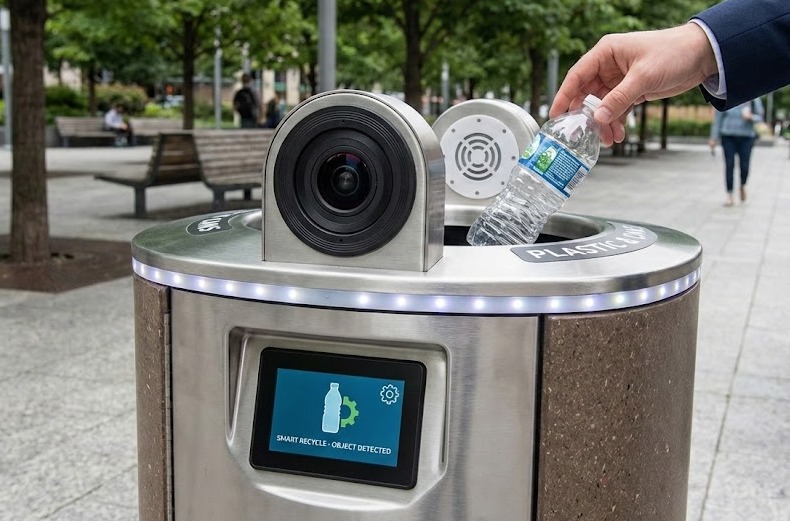
Plastic Guardians is a web application that is intended to be installed at garbage can / recycle bin. It uses Google Gemini Vision to instantly identify the object, material type, and estimate its weight.
Instant Crypto Reward: Upon collection, the system sends a real-time transaction on the Solana Blockchain, transferring SOL to the user's wallet.
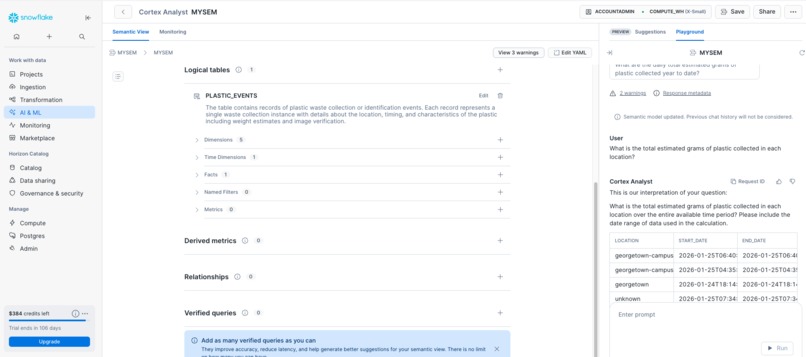
Talk-to-Data Chat: Administrators can chat with the live database using Snowflake Cortex AI, asking natural questions like "How many plastic bottles were found in Atlanta?" and receiving SQL-backed answers instantly.
How we built it
Frontend: A responsive HTML5/JavaScript web app with a custom "Field Ops" HUD aesthetic using Tailwind CSS.
Vision AI: We used Google Gemini 2.5 Flash for its speed and multimodal capabilities to analyze video frames and return structured JSON data (bounding boxes, classification, hazard status).
Data Layer: We utilized Snowflake as our central data lake. We implemented Snowflake Cortex (Llama 3 model) to power our chatbot, enabling it to dynamically generate SQL queries based on the PLASTIC_EVENTS table schema without pre-written rules.
Blockchain: We integrated Solana (using solders and Python) for high-speed, low-cost transactions for bounty reward program.
Backend: A robust FastAPI server orchestrates the traffic between the user, the AI models, the database, and the blockchain.
Challenges we ran into
Limit of opencv yolov8 model: This model was not successfully recognizing objects, certain failures were detection of remote control when a plastic bottle was in camera. This model was not consistent at all to recognize plastics. We ended up switching to Gemini. Getting the AI to reliably output strict JSON for our database while maintaining natural language capabilities for the chatbot required extensive prompt engineering.
Accomplishments that we're proud of
The power of Cortex: We learned that Snowflake isn't just for storage; Cortex allows us to treat our database as an intelligent agent that can reason about its own data.
Blockchain as Data Storage: We gained a deeper appreciation for Solana's Memo program as a way to create immutable audit logs for real-world physical actions, not just financial ones.
Prompt Engineering is Coding: We learned that defining strict JSON schemas in our system prompts is just as critical as writing the Python code that parses them.
What we learned
The power of Cortex: We learned that Snowflake isn't just for storage; Cortex allows us to treat our database as an intelligent agent that can reason about its own data.
Blockchain as Data Storage: We gained a deeper appreciation for Solana's Memo program as a way to create immutable audit logs for real-world physical actions, not just financial ones.
Prompt Engineering is Coding: We learned that defining strict JSON schemas in our system prompts is just as critical as writing the Python code that parses them.
What's next for Plastic Guardians
Ultrasonic Sensor Integration: While optical recognition is great, we plan to install hardware ultrasonic sensors on cleanup grabbers. This will allow us to auto-recognize specific plastic densities and volume without relying solely on lighting conditions or camera angles.
Mainnet Launch: Moving from Devnet to Solana Mainnet to enable real-world value transfer.


Log in or sign up for Devpost to join the conversation.