-
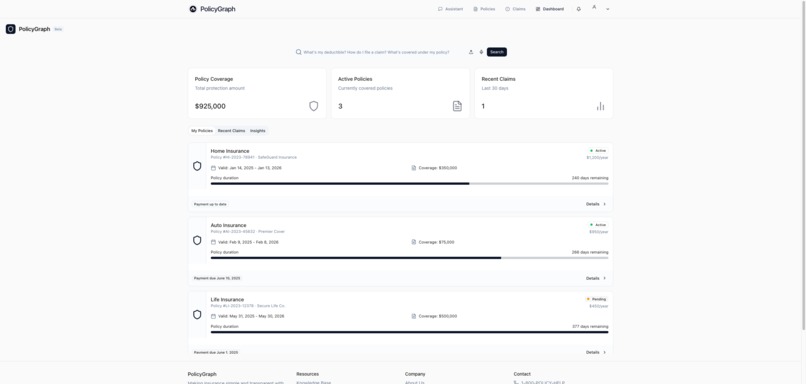
Policygraph
-
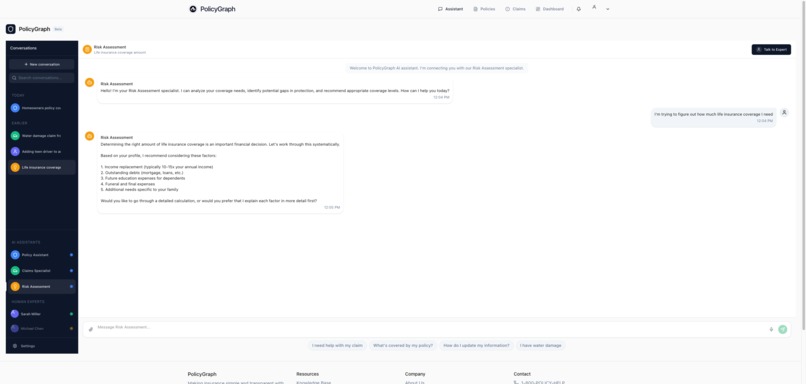
Agents workflow
-
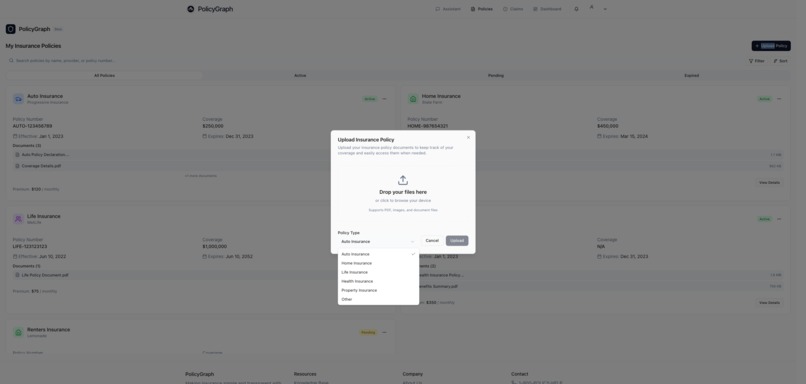
Policy agent
-
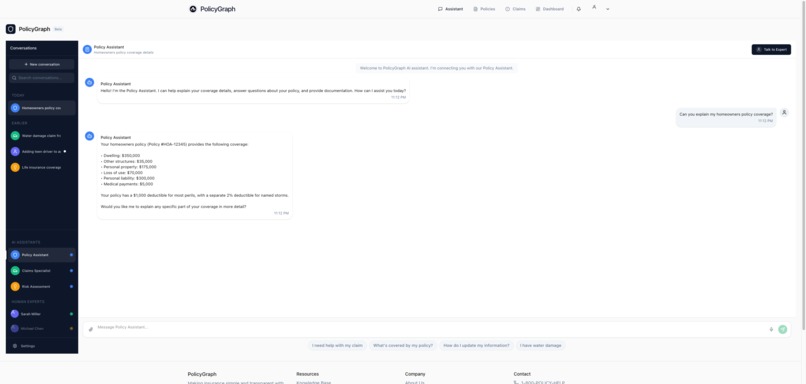
Human expert agent handoff


✨ PolicyGraph: Project Story ✨
💡 Inspiration
The insurance industry, a cornerstone of modern society, is paradoxically plagued by inefficiencies stemming from its own data. Vast troves of information – policies thick with legalese, claims histories scattered across systems, and customer interactions buried in disparate databases – create a significant bottleneck. Professionals spend valuable time hunting for crucial details, leading to delays, increased costs, and a less-than-ideal experience for both them and their clients. We saw an opportunity to leverage the power of knowledge graphs and Retrieval-Augmented Generation (RAG) to cut through this complexity and unlock the true potential of insurance data.
🚀 What it Does
PolicyGraph is a privacy-focused Multi-Modal Graph RAG agent tailored for the insurance domain. It ingests and intelligently connects diverse data sources – including textual policy documents, claim records, and even visual evidence like images of damage – into a unified knowledge graph.
When a user poses a question or provides multi-modal input, our agent efficiently retrieves the most relevant information from this graph and uses it to generate precise, contextually rich answers and insights, delivered through a responsive conversational interface. This empowers users to:
- Quickly understand complex policies
- Navigate claims processes with ease
- Extract valuable intelligence from their insurance data
🛠️ How We Built It
PolicyGraph was architected as a responsive client-server system. The backend was developed in Python, using FastAPI to serve API endpoints and LangGraph for orchestrating our sophisticated conversational agent. This agent leverages the broader LangChain library and is powered by an OpenAI GPT-4o model for its natural language understanding and generation.
A cornerstone of our agent is its ability to interact with the Neo4j knowledge graph. We equipped it with specific tools:
search_graph_knowledge: For semantic information retrieval.get_cypher_query: For translating user questions into Cypher database queries.execute_cypher: To run those queries directly against Neo4j.
This setup allows PolicyGraph to dynamically access and reason over the insurance data—policy texts, claim details, and linked visual evidence—which we populated using custom ingestion and linking scripts.
For the frontend, we integrated agent-chat-ui, a React-based interface. Communication between the UI and backend leverages:
- RESTful APIs: For managing conversation threads (ensuring context and history are maintained).
- Server-Sent Events (SSE): For streaming the agent's responses token by token.
This streaming architecture ensures a fluid and interactive user experience. Data privacy and robust error handling were key design considerations throughout.
🚧 Challenges We Ran Into
- Complex Schema Design: Designing a flexible yet robust graph schema for diverse insurance data (policies, claims, visuals) was a primary hurdle.
- Multi-Modal Integration: Meaningfully correlating and retrieving textual and visual information presented significant technical challenges.
- Effective Prompt Engineering: Iteratively refining prompts for the LLM to accurately use retrieved graph context for precise, insurance-specific answers.
- Real-time Performance & State Management: Ensuring responsive streaming while managing complex conversational states within LangGraph, and optimizing Neo4j queries on the fly.
- Scope Management: Balancing our ambitious vision with the hackathon’s tight timeframe, requiring prioritization of core functionalities.
🎉 Accomplishments We're Proud Of
- Functional End-to-End Prototype: Successfully developed a working prototype of PolicyGraph.
- Rich Knowledge Graph Creation: Ingested and structured disparate insurance data (text and images) into a cohesive Neo4j knowledge graph.
- Intelligent & Contextual Responses: Witnessed PolicyGraph retrieve relevant, multi-modal information and generate accurate, context-aware answers.
- Streaming Architecture: Implemented a responsive streaming architecture using Server-Sent Events integrated with the LangGraph agent, providing a truly interactive user experience.
- Privacy-Focused Design: Confirmed the feasibility of providing advanced AI tools while upholding critical data security standards.
- Multi-Modal RAG Pipeline: Successfully processed and linked multi-modal data, showcasing a holistic approach to data understanding.
🧠 What We Learned
- Power of Graph Databases & LangGraph: Gained deeper appreciation for Neo4j's ability to model complex relationships and LangGraph's orchestration of sophisticated agentic workflows for intelligent information retrieval.
- Nuances of Multi-Modal Learning: Learned firsthand the complexities and potential of combining different data modalities for enhanced understanding.
- Importance of Data Preparation: Recognized that quality, structured input data is paramount for effective RAG systems, especially with knowledge graphs.
- Balancing Innovation and Practicality: Understood the importance of focusing on core, achievable functionalities within a hackathon timeframe while still showcasing innovation.
- Impact of Streaming for UX: Realized the significant positive impact of SSE and real-time feedback on the user experience in conversational AI.
🔮 What's Next for PolicyGraph
- Enhanced Data Integration: Expand integration to more data sources, including unstructured documents and real-time feeds.
- LLM Fine-Tuning: Explore fine-tuning the language model on insurance-specific data for improved accuracy and relevance.
- Advanced Reasoning: Implement more sophisticated graph traversal and reasoning in the LangGraph agent for complex analytical queries.
- UI/UX Evolution: Further develop
agent-chat-uifor a more polished, user-friendly experience, possibly adding graph data visualizations. - Workflow Integration: Explore API-driven integration points with existing insurance platforms and systems.
- Scalability & Performance: Continue optimizing Neo4j queries, LangGraph state management, and API performance as the system scales.


Log in or sign up for Devpost to join the conversation.