-
-
Polyflix X Polymarket
-

Landing Page
-
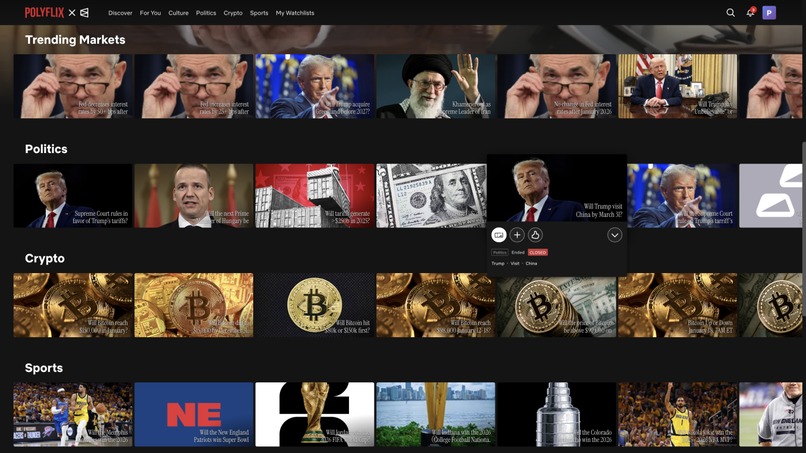
Home Page
-
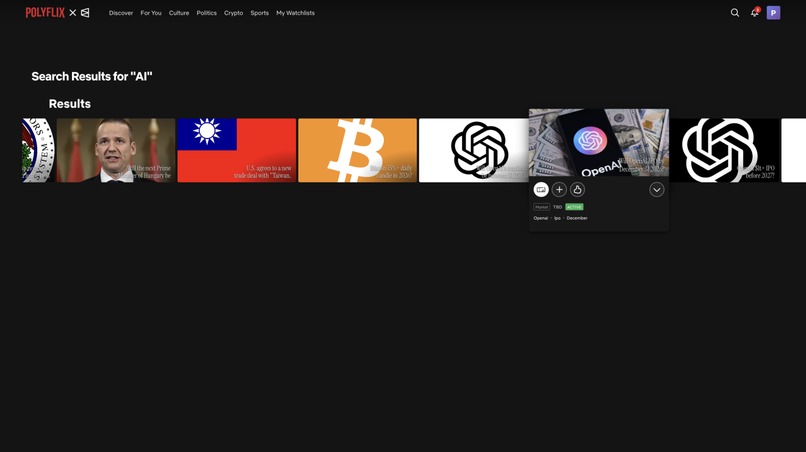
Search Feature
-
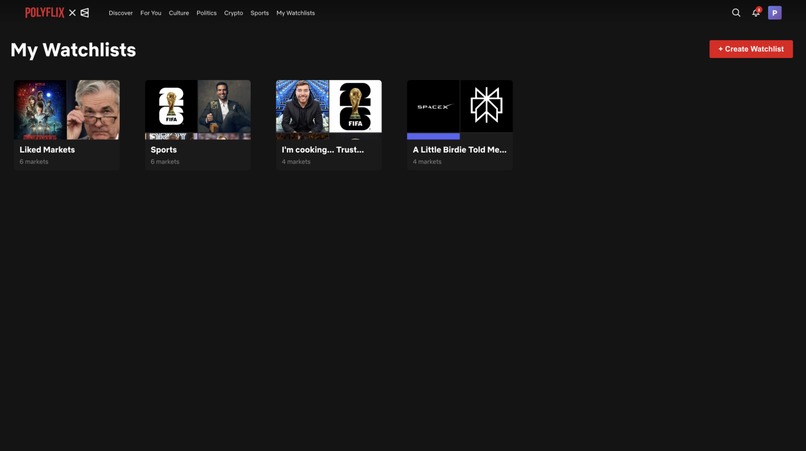
Watchlists Feature


Inspiration
In 2007, streaming as we know it changed forever. From its origins as a DVD-by-mail service, Netflix has evolved into a global streaming platform serving over 300 million households worldwide, where users turn to the service for entertainment and relaxation. Its familiar, sleek interface and intuitive user experience are the result of deliberate design choices, including the integration of powerful recommendation systems that optimize content discovery and viewing. With Polyflix, we aimed to mimic this experience in order to reduce cognitive friction and mental overhead a new trader might face, facilitating more casual trading on the Polymarket platform. [0]
What it does
Polyflix seamlessly interweaves various features at the heart of social systems and statistics, such as live communication options, a transparency-focused dashboard & network search system, and personalized recommendation systems. At a high level, Polyflix:
- Queries the Polymarket Gamma API to provide live, real-time insights to prediction markets sorted by category, and the CLOB API for time-series analysis on curated market selection
- Leverages Google's Gemini and Custom Image Search API to allow users to interact with markets on a more personalized level
- Builds an individualized context profile to understand the user's trading interests
- Serves a transparent platform in which users can see fellow Polyflixer's recent investments & various performance-based analytics All with the sleek UI that people know and love.
How we built it
The Polyflix frontend leverages...
- React for a component-based UI framework, supporting convenient feature integration & scaling
- React Router for client-side platform navigation
- CSS3 for Netflix-style styling
- LocalStorage for persistent, client-side data like preferences & watchlists [1]
The Polyflix backend is made with...
- Node.js & Express to serve a REST API server for live Polymarket Data
- Python & Fast API for the recommendation system, powered with an in-house machine learning model for more accurate insights
- CORS middleware for cross-origin resource sharing for frontend-backend integration
The Polyflix recommendation system runs on...
- NLP Bigram Analysis to identify meaningful topic clusters from your watchlist
- Multi-Factor Scoring to rank markets by volume, novelty, and relevance
- Temporal Awareness for prioritizing recently created markets with upcoming end dates
- Negative Preference Filtering to penalize disliked topics while preserving edge-case relevance
The platform leverages various APIs such as the Polymarket Gamma API, Google Gemini API, and Youtube Embed API (Google Cloud). The recommendation system leverages the FastAPI, Uvicorn, Pydantic, and httpx libraries.
Challenges we ran into
Some of the various hurdles we faced that influenced our design choices were...
- Choosing a Convenient Web Framework for Rapid Prototyping & Development: As we were constrained with the sub-24 hour time limit, we found tools like Next.js to be ineffective in quick development cycles. [2] To account for this, we opted for its more popular cousin, React.js.
- Challenges in our Trailer Generation Engine: Our original plan to further enhance the users browsing experience was to algorithmically generate documentary-style trailers for each market. However, due to limitations with time, web searching automation, and Creative Commons licenses, we eventually had to make the difficult decision to postpone the Trailer Generation Engine to a future release.
- Lack of Variation in Polymarket-sourced Image Media: While the Polymarket API does provide images for each market, many markets have the same image. When displayed on our media-centric platform, this resulted in a largely stagnated user experience with repetitive views. To work around this, we developed our own custom caching dictionary to provide a wider selection of media options during runtime for each market's card.
Accomplishments that we're proud of
In 24 hours, we were able to make an end-to-end platform to completely transform the entire user experience a new trader would have on the Polymarket platform. Blending social networks, AI-powered research, ML-powered recommendation systems, and sleek styling, we created Polyflix, a truly unique lens in which people can interact with the next generation of prediction markets.
What we learned
We're incredibly thankful for this opportunity to work so closely with the Polymarket API & platform, developing tools to truly innovate on the service's bridge between technology & humanity. We used this opportunity to gain hands-on experience with new technologies, such as TCP connections, Fast API, utility-based hybrid recommendation systems.
What's next for Polyflix
In the future, we hope to perfect the Polyflix platform by continuing the development of the documentary-style Trailer Generation Engine, finishing the trading UI, expanding our inferencing & insights to incorporate options trading strategies like synthetic puts, and more. We also hope to publicize our work through the Polymarket Builder's Program, which would allow us to reach more potential users & gain feedback on what users might like to see.
Authors
[0] In recent years, recreational traders have accounted for 25-30% of all trading in the stock market. Extrapolating this to the emerging industry of prediction markets, we can see an keen opportunity for product-market fit.
[1] We were limited in our system design choices in order to cater to the open-source limitations of the hackathon and budget constraints.
[2] React has been the dominant frontend library since 2013 and has a significantly larger codebase across the internet, including documentation, tutorials, and open-source projects. Because of this, when LLMs are trained on this massive corpus, they become highly adept at generating and understanding React code and its core concepts like components, JSX, and state management, when compared to Next.js.


Log in or sign up for Devpost to join the conversation.