-
-
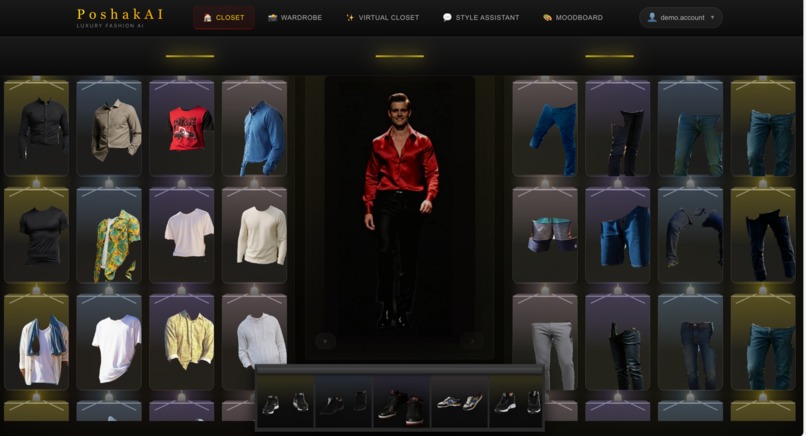
Experience the luxurious digital closet!

Poshaak AI - Digital Wardrobe Manager!
Inspiration
The fashion industry generates $2.5 trillion annually, yet most people struggle with a fundamental question every morning: "What should I wear?" We were inspired by the disconnect between overflowing closets and the feeling of having "nothing to wear." With the rise of fast fashion and online shopping, people buy more clothes than ever but lack the tools to manage, style, and make intelligent decisions about their wardrobe. We wanted to create an AI-powered solution that not only organizes your closet but understands fashion trends, weather patterns, and personal style to make getting dressed effortless and enjoyable.
What it does
Poshak AI is a comprehensive digital wardrobe management system that combines computer vision, AI-powered virtual try-on, and intelligent fashion recommendations. Users can:
- Digitize their wardrobe with automatic clothing detection using Segformer B2
- Virtual try-on multiple garments simultaneously powered by Gemini 2.0
- Get personalized style advice from our LangChain + Vertex AI assistant that considers weather, occasion, and local trends
- Discover fashion trends through our QLOO-powered Moodboard that shows what's trending in your location
- Identify wardrobe gaps with AI analysis that suggests what to buy next based on current trends
- Plan outfits for trips with location-specific fashion intelligence
How we built it
We built Poshak AI as a full-stack application with multiple components:
- Frontend: React.js web app with responsive design and React Native mobile app
- Backend: Flask API server deployed on Firebase Functions
- AI Pipeline:
- Segformer B2 for clothing segmentation (both local and Hugging Face API modes)
- Gemini 2.0 Flash for virtual try-on
- LangChain + Vertex AI for conversational style assistant
- QLOO API for real-time fashion trends and brand affinities
- Infrastructure: Firebase for authentication, storage, and hosting
- Design: Custom glass-morphism UI for luxury closet experience
Challenges we ran into
- Segmentation Model Selection: We experimented with Facebook's SAM2, MediaPipe, and various clothing segmenters before settling on Segformer B2 for its superior accuracy and 18-category classification
- Virtual Try-On Implementation: Tested OpenAI's image editing API and Gemini, ultimately choosing Gemini 2.0 Flash for its speed and quality. We explored mask-based editing techniques and implemented multi-garment try-on
- Cross-Platform Development: Building for both web and mobile was time-consuming, requiring different optimization strategies and caching mechanisms
- Deployment Architecture: Deciding between Cloud Run and API-based services was challenging. We implemented both modes - local model for development and API mode for production deployment
- UI/UX Design: Creating the luxury closet 3D glass display and the artistic Moodboard layout required multiple iterations to achieve the right aesthetic while maintaining performance
Accomplishments that we're proud of
- Successfully delivered a fully functional, production-ready application within the hackathon timeframe
- Created a beautiful, intuitive interface that makes fashion technology accessible to everyone
- Integrated multiple cutting-edge AI services (QLOO, Gemini, Vertex AI, Segformer) into a cohesive experience
- Built a solution that addresses real-world problems - helping people dress smarter, shop consciously, and plan better for trips
- Achieved seamless virtual try-on with multiple garments simultaneously
- QLOO integration provided invaluable fashion intelligence that elevated our recommendations
What we learned
Throughout this project, our team (Milind, Mukul, and Sapna) gained extensive technical knowledge:
- AI/ML Integration: Learned to orchestrate multiple AI models and APIs, handling different input/output formats and optimizing for latency
- Computer Vision: Deep understanding of semantic segmentation, mask processing, and image manipulation techniques
- LLM Engineering: Mastered prompt engineering, tool calling with LangChain, and building conversational AI agents
- Cloud Architecture: Implemented serverless functions, managed Firebase services, and optimized for scalability
- Cross-Domain APIs: Leveraged QLOO's cultural intelligence to bridge fashion trends with user preferences
- Team Collaboration: Despite time constraints, we maintained clear communication and leveraged each member's strengths - from backend architecture to UI design
Most importantly, we learned that technology can transform how people interact with fashion, making it more sustainable, personalized, and enjoyable.
What's next for Poshak AI
- Production Launch: Deploy the web app live with enhanced infrastructure for scale
- Holiday Card Feature: Implement seasonal fashion recommendations on the Moodboard
- Advanced Try-On: Integrate more sophisticated virtual try-on models for better realism
- Twin Wardrobe: Enable couples/friends to share and coordinate wardrobes
- UI Enhancements: Refine the user interface with more animations and interactions
- Mask Improvements: Expand clothing detection to accessories and more garment types
- Brand Partnerships: Collaborate with fashion brands for exclusive recommendations and affiliate programs
- Sustainability Features: Add carbon footprint tracking and sustainable fashion suggestions
- Social Features: Allow users to share outfits and get community feedback
Built With
- firebase
- gemini
- hugging-face
- langchain
- qloo
- react
- react-native
- segformer
- serper
- vertex


Log in or sign up for Devpost to join the conversation.