-
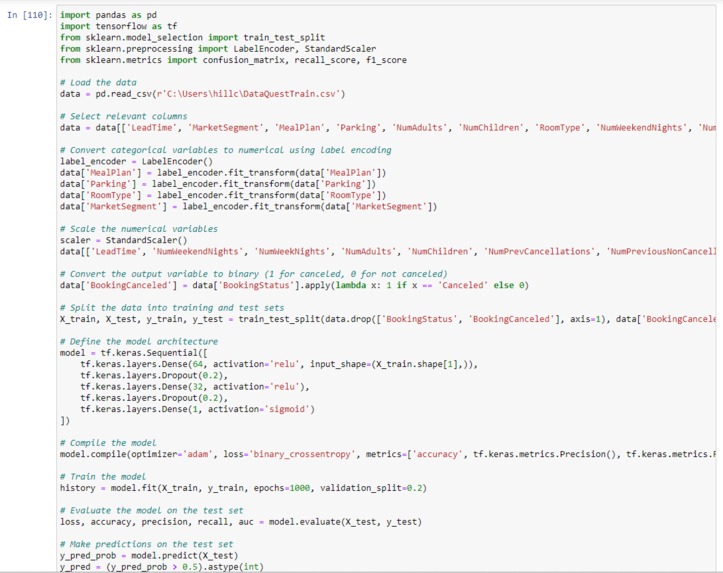
First half of Prediction Model
-
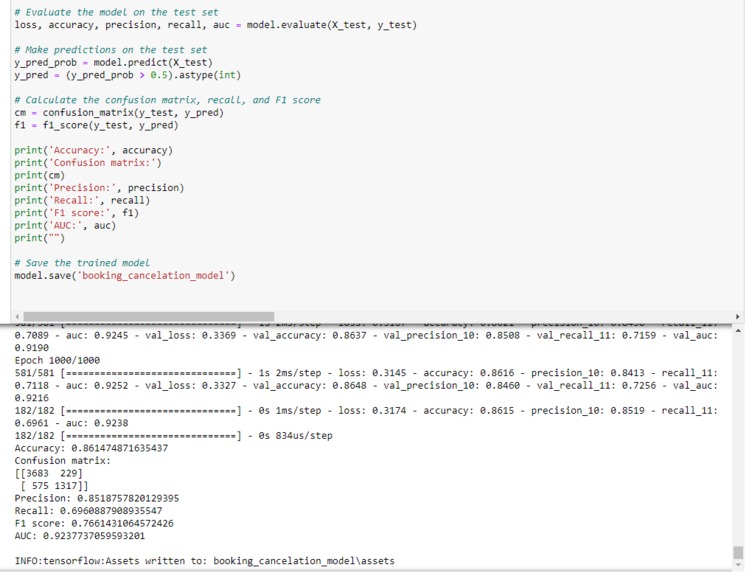
Second half of Prediction Model
-
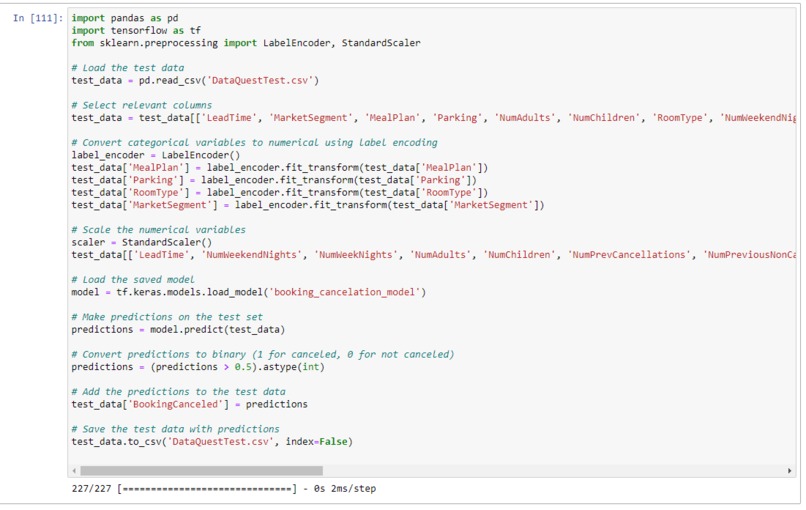
Testing and Saving to csv


Inspiration
We wanted to build a predictive model that could identify which hotel bookings were likely to be cancelled, as this could be useful for hotels to better manage their inventory and staffing.
What it does
The project builds a machine-learning model that predicts whether a booking will be cancelled or not based on various features such as lead time, room type, and market segment.
How we built it
We loaded data from a CSV file, selected relevant columns, and preprocessed the data by converting categorical variables to numerical ones using label encoding and scaling numerical variables using StandardScaler. We then split the data into training and test sets, defined and trained a neural network model, and evaluated its performance using various metrics. Finally, we saved the trained model for future use. Then we took the trained model and had it make predictions and save them to the test.csv file.
Challenges we ran into
The most difficult part was aligning the size of one output table with another input, which led to errors. Another challenge was learning how to implement two libraries in a short period of time.
Accomplishments that we're proud of
We successfully built a machine-learning model that achieved high accuracy in predicting hotel booking cancellations. We also learned how to preprocess and analyze data using pandas and sklearn and how to build neural network models using TensorFlow.
What we learned
We learned how to preprocess and analyze data using pandas and sklearn, how to build simple neural network models using TensorFlow, and how to collaborate effectively as a team.
What's next for Prediction Binary Classification Model
The next steps could include fine-tuning the model to improve its performance, exploring different types of neural network architectures, and running the model in a production environment for real-world use.
Built With
- python
- sklearn
- tensorflow


Log in or sign up for Devpost to join the conversation.