-
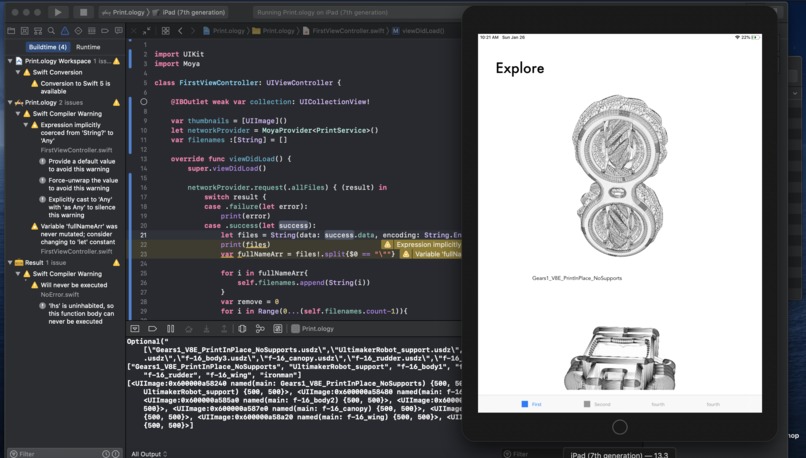
Swift IOS Integration
-
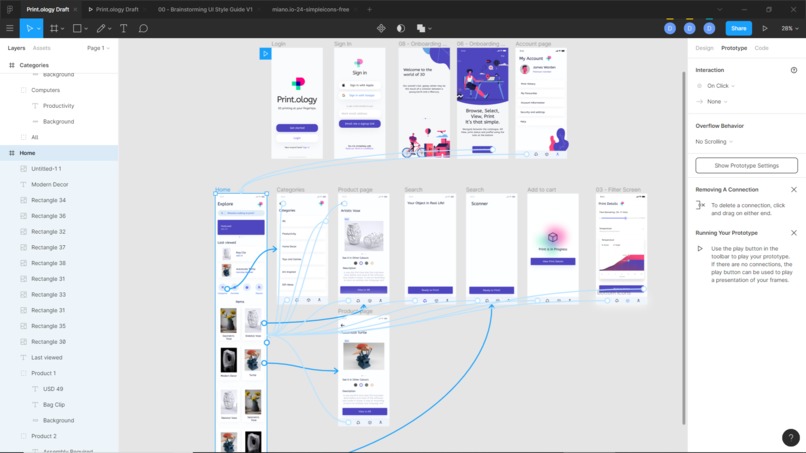
UI Prototyping
-
Presentation and Logo
-
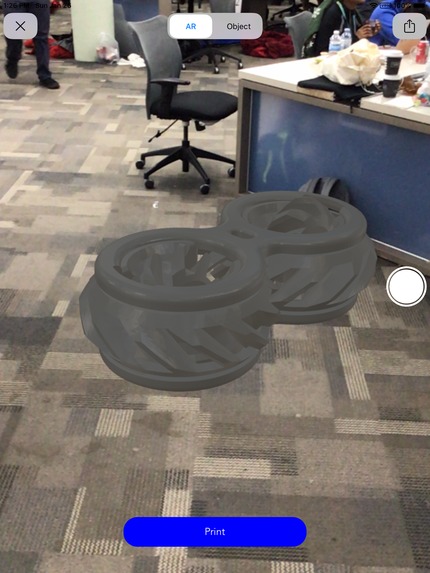
Augmented Reality Visualization of Fidget Spinner on our App
-
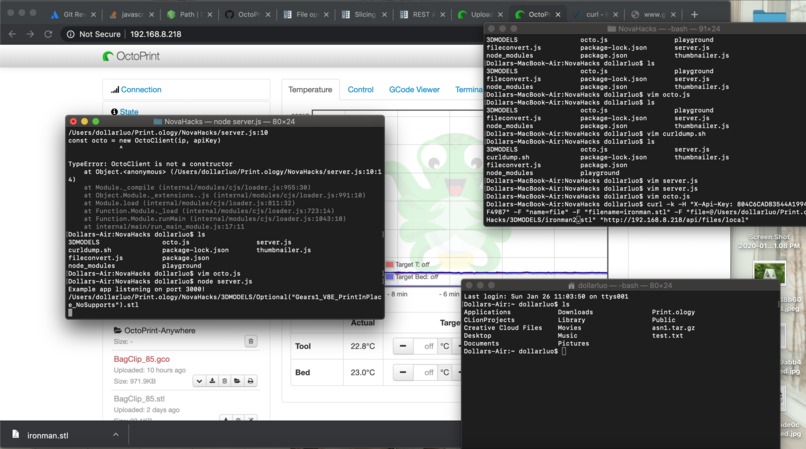
Using Command Line Functions to Automate Octoprint


Inspiration
3-D Printing. It has been around for decades, yet the printing process is often too complex to navigate, labour intensive and time consuming. Although the technology exists, it is only used by those who are trained in the field because of the technical skills required to operate the machine. We want to change all that. We want to make 3-D printing simpler, faster, and accessible for everyone. By leveraging the power of IoT and Augmented Reality, we created a solution to bridge that gap.
What it does
Printology revolutionizes the process of 3-D printing by allowing users to select, view and print files with a touch of a button. Printology is the first application that allows users to interact with 3-D files in augmented reality while simultaneously printing it wirelessly. This is groundbreaking because it allows children, students, healthcare educators and hobbyists to view, create and print effortlessly from the comfort of their mobile devices. For manufacturers and 3-D Farms, it can save millions of dollars because of the drastically increased productivity.
The product is composed of a hardware and a software component. Users can download the iOS app on their devices and browse a catalogue of .STL files. They can drag and view each of these items in augmented reality and print it to their 3-D printer directly from the app. Printology is compatible with all models of printers on the market because of the external Raspberry Pi that generates a custom profile for each unique 3-D printer. Combined, the two pieces allow users to print easily and wirelessly.
How I built it
We built an application in XCode that uses Apple’s AR Kit and converts STL models to USDZ models, enabling the user to view 3-D printable models in augmented reality. This had never been done before, so we had to write our own bash script to convert these models. Then we stored these models in a local server using node.js. We integrated functions into the local servers which are called by our application in Swift.
In order to print directly from the app, we connected a Raspberry Pi running Octoprint (a web based software to initialize the 3-D printer). We also integrated functions into our local server using node.js to call functions and interact with Octoprint. Our end product is a multifunctional application capable of previewing 3-D printable models in augmented reality and printing them in real time.
Challenges I ran into
We created something that had never been done before hence we did not have a lot of documentation to follow. Everything was built from scratch. In other words this project needed to be incredibly well planned and executed in order to achieve a successful end product. We faced many barriers and each time we pushed through. Here were some major issues we faced.
No one on our team had done iOS development before and we a lot through online resources and trial and error. Altogether we watched more than 12 hours of YouTube tutorials on Swift and XCode - It was quite a learning curve. Ultimately with insane persistence, a full all-nighter and the generous help of the Deltahacks mentors, we troubleshooted errors and found new ways of getting around problems.
No one on our team had experience in bash or node.js. We learned everything from the Google and our mentors. It was exhausting and sometimes downright frustrating. Learning the connection between our javascript server and our Swift UI was extremely difficult and we went through loads of troubleshooting for our networks and IP addresses.
Accomplishments that I'm proud of and what I've Learned
We're most proud of learning the integration of multiple languages, APIs and devices into one synchronized system. It was the first time that this had been done before and most of the software was made in house. We learned command line functions and figured out how to centralize several applications to provide a solution. It was so rewarding to learn an entirely new language and create something valuable in 24 hours.
What's next for Print.ology
We are working on a scan feature on the app that allows users to do a 3-D scan with their phone of any object and be able to produce a 3-D printable STL file from the photos. This has also never been accomplished before and it would allow for major advancements in rapid prototyping. We look forward to integrating machine learning techniques to analyze a 3-D model and generate settings that reduce the number of support structures needed. This would reduce the waste involved in 3-D printing. A future step would be to migrate our STL files o a cloud based service in which users can upload their 3-D models.




Log in or sign up for Devpost to join the conversation.