-

HomePage
-
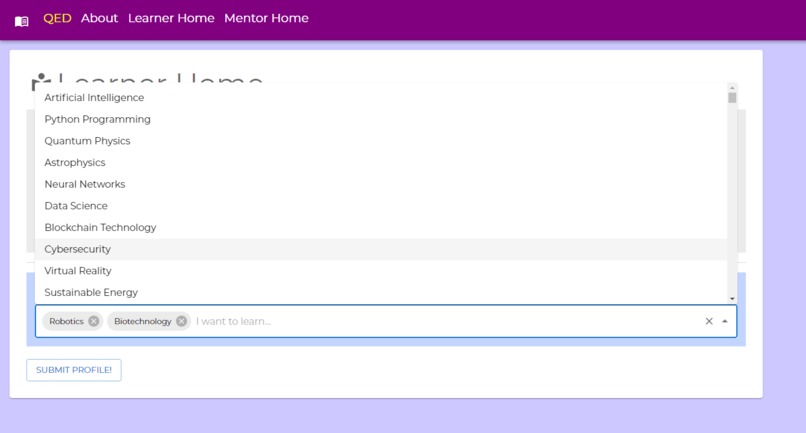
Choosing topics for learning
-
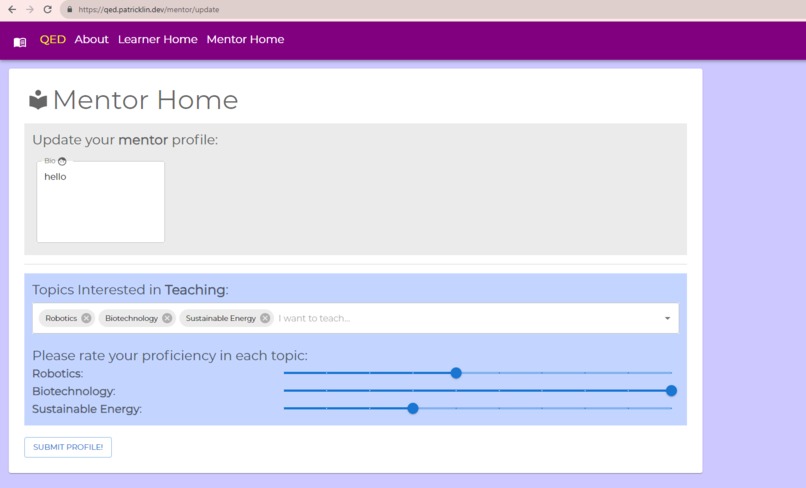
Developing a Teaching Profile


Inspiration
We wanted a platform where anyone could offer up their own skills and teach or mentor someone else seeking to learn that skill without going through a tedious process or face the pressure of asking questions publicly and getting shamed for it (looking at you StackOverflow). We also wanted something that could incentivize mentors to give good quality answers (i.e. $$$$$$) for users who want it.
What it does
On this platform, anyone could create a learner and/or a mentor profile. For each subject a mentor wishes to help someone in, they can rate their own skill. Learners will then get a generated list of mentors who match their criteria (e.g. location, proficiency, etc), which they can then choose mentors from and send requests to the mentors. Mentors will have a feed of these requests to work with. Initial arrangements (including possible compensation) can be done through the platform via a text chat, and they can further communicate using text, video, or meet up in person.
If a learner pays for a mentor, the platform could earn a commission fee and thus keep the platform operational.
How we built it
We started off with a simple drawn design flow chart and went from there. Identifying the key features needed, we started implementation right away. Despite the learning curve and various technical challenges along the way, we were able to proceed fairly quickly and arrive at a minimum viable product to serve as a proof of concept of what this idea could become with more time and effort.
Challenges we ran into
We wanted to explore the many different tech stack options offered by the hackathon sponsors, such as Redis Cloud and Google Cloud. Implementing the Redis NoSQL database took a bit of a learning curve, but we are glad and relieved that we were eventually able to fully implement our project idea using these new tech stacks.
Accomplishments that we're proud of
We're proud of being able to successfully create this prototype despite the relatively short time frame for this hackathon. We are also proud of being able to grasp new technologies like Redis Cloud and incorporate it into our project.
What we learned
We learned how to use Redis Cloud. We also learned that a piece of chocolate with 50mg of caffeine does not in fact keep you awake enough to code.
What's next for QED
We hope to improve our user-matching system using Redis Cloud's built in "vector similarity search" and potentially match users based on compatible character traits, learning styles, and teaching styles.
Built With
- ai
- express.js
- gcp
- react
- redis


Log in or sign up for Devpost to join the conversation.