-
-
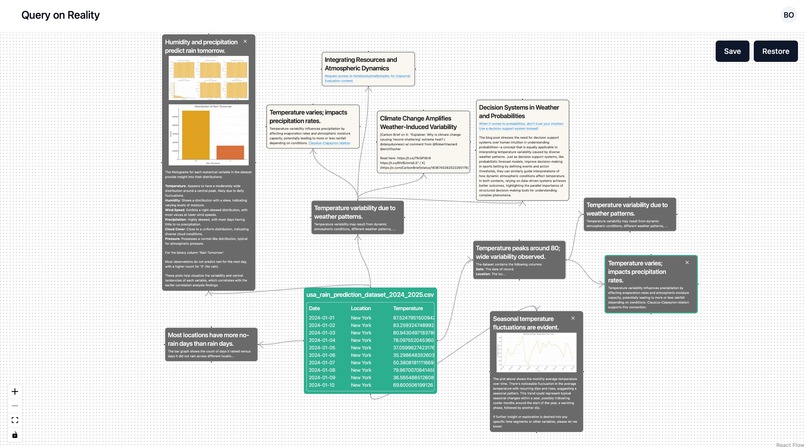
Example of querying USA rain prediction dataset for 2024-2025
-
Landing Page
-

The Dream Team


Inspiration
Behold the glory that is Query on Reality, the shining beacon of clarity in the sprawling wilderness of data overload. Data scientists, researchers, and those brave enough to embark on the treacherous path of exploratory analysis, rejoice! Gone are the days when you would sit, staring at an ocean of numbers, waiting for the magic of insight to wash ashore like a forlorn message in a bottle. No longer must you bow before the chaos of datasets! With Query on Reality, your destiny lies in creating a beautiful, ever-expanding mental map of connections, relationships, and jaw-dropping realizations about the world around you. Yes, I said jaw-dropping. It's science.
What does Query on Reality actually do?
Great question, hypothetical reader! Imagine a world where non-technical users don’t need to master the dark arts of coding just to understand their own data. Instead, they wield a gloriously intuitive, graphical mind map. You upload your file (and trust me, it’s a file worthy of legends). The system generates hypotheses, visualizes relationships between data points, and gracefully lets you ask those deep, existential questions that you’ve always pondered about your dataset—but were too afraid to ask.
How did we do it?
With grit, determination, and the fine art of caffeine-fueled late-night coding, we crafted a user-friendly experience. AI—our trusty sidekick—gave us the ability to visualize ultra-accurate plot representations. But we didn’t stop there. We harnessed the power of semantic search with Exa to sift through academic papers, making you feel like a scholarly wizard as we weave data and research together. It’s like having a PhD in your back pocket.
Challenges? Please. We laugh in the face of challenges.
Okay, we might have cried a little. But out of those tears came brilliance. During our conquest to inevitable success, we may have run into some challenges: for example, we may have hypothetically tried creating an algorithm to make an even spread of each node to ensure they don’t spawn on top of each other… we ended up choosing our sanity instead. But the toughest hurdle was getting responses to play nice with structured formats while balancing huge context windows. And yes, threading API calls while keeping the graph from turning into a chaotic spaghetti mess? Yeah, we did that too.
Accomplishments that we're proud of
Oh, where do we even begin? First, we harnessed our deep, arcane knowledge of data science to set up key prompting questions for our API endpoint. With this in hand, our initial exploratory data analysis wasn’t just good—it was legendary. We seamlessly combined insights from research papers into the analysis, effectively bridging the gap between raw data and scholarly wisdom like the grand wizards of academia.
But it didn’t stop there. Oh no. We unlocked a secret power: API threading optimization. The more nodes we added to the graph, the more our approach seemed to laugh in the face of long response times. With threading magic in full swing, we found a loophole that allowed us to cut down waiting time significantly, even as the graph grew more intricate than the plot of a sci-fi epic. Of course, we had some technical dragons to slay along the way. One particularly troublesome foe on the front-end side was creating new nodes without overlapping them with previous ones. Cue our algorithmic wizardry. We devised an ingenious method to ensure that each new node maximized its distance from the others, achieving harmony in our ever-expanding data universe.
On the backend, we waved our metaphorical wands and abstracted away all those pesky details like node definitions and the mechanics of generating new nodes. Now, instead of getting bogged down in minutiae, we stand proud, watching as our tool spawns beautifully structured graphs at the click of a button. In short, we didn’t just overcome technical challenges; we sent them running for the hills.
What we learned
Ah, the timeless tale of discovery. Like brave adventurers navigating the treacherous terrain of software development, we realized that an effective product is more than just lines of impeccable code—although, yes, we did write some of those. The real magic lies in balancing the clean, coherent logic of the backend with a creative, intuitive interface that makes the user feel like they’re gliding through the Matrix (without the red pill). The biggest challenge, however, wasn’t just building these pieces—it was figuring out how to integrate them smoothly.*
Picture this: each of us, like master artisans, was crafting our own features in our own distinct style, employing models and methods that were as different as night and day. But when it came time to stitch them all together, the middleware—ah yes, the middleware—became our proverbial mountain. Integrating everything was like a puzzle where each piece was shaped by a different philosophy. And so, we learned the hard truth: effective communication is not just a "nice-to-have," it’s the glue that binds the project together.
We realized that while short-term clarity is crucial (because, let’s be honest, explaining why your code is a work of art to someone who sees it as a Jackson Pollock is a unique joy), the long-term vision matters even more. We learned that sharing a common understanding of how all our parts fit into the larger system is essential. It wasn’t just about making sure our individual features worked—it was about seeing the bigger picture and creating something greater than the sum of its parts.
And let’s not forget the unsung heroes of this journey—our friendship and a hefty supply of Celsius energy drinks. Together, they fueled the all-nighter of all nighters, where we dug deep into our strengths, learned more about each other’s superpowers, and found a rhythm that synergized our workflows like a well-oiled machine. In the end, we didn’t just build a product—we built the kind of teamwork that legendary startups are made of.
What’s next for Query on Reality?
What’s next, you ask? Well, obviously, world domination through datasets. But before that, we’re planning to allow users to juggle multiple datasets at once and map connections between them like some kind of data ninja. And don’t worry, we’re going beyond CSVs—because we dream bigger than that. We’re talking primary and secondary sources, embedding searches, and a graphical interface so intuitive that you’ll wonder how you ever survived without it.
In short: Query on Reality is here to save your data and your sanity. Thank us later.
Built With
- ai
- exa.ai
- fast-api
- next.js
- opendata
- react
- react-flow
- tailwind




Log in or sign up for Devpost to join the conversation.