-
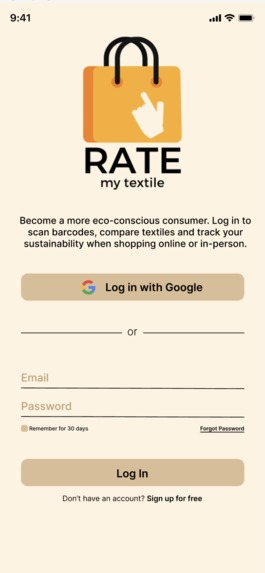
Log In Page
-
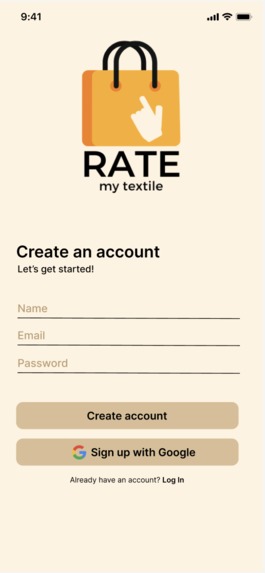
Sign In Page
-
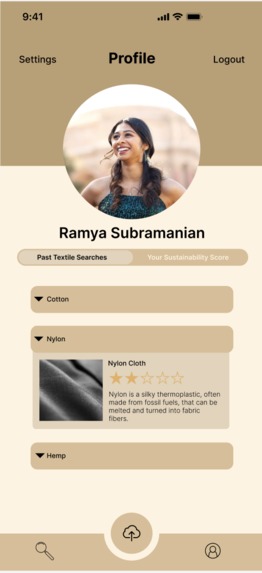
Profile Page
-
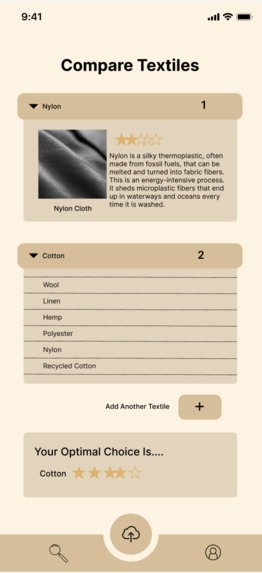
Compare Textile Page
-
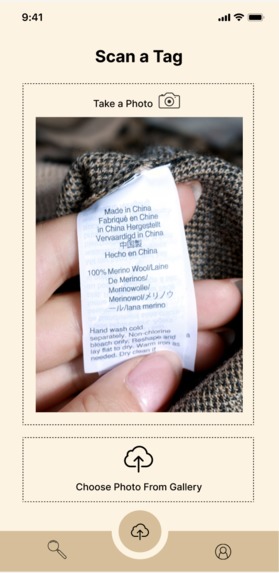
Scan Page
-
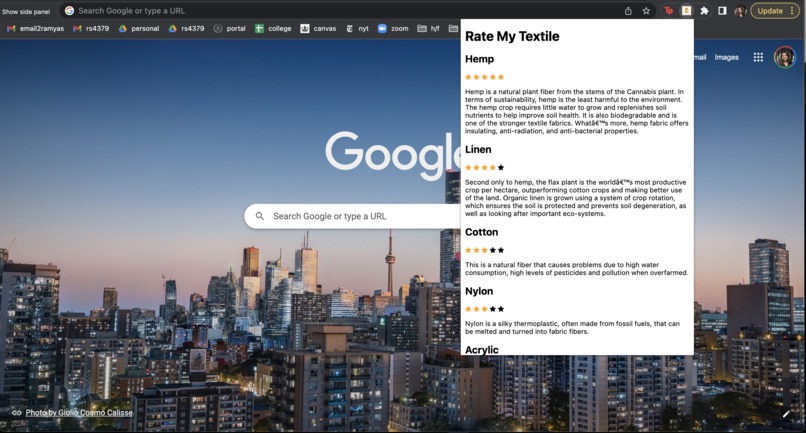
Google Extension


Inspiration
As we began to consider the topic of sustainability, our team was drawn towards the retail industry. Considering the fact that the fast fashion industry accounts for up to 10% of global carbon dioxide, we wanted to focus on a project that would help reduce consumer waste, specifically when it comes to textiles. We know we can’t stop people from buying clothes. However, we can encourage people to make more eco-friendly decisions when purchasing. For example, cotton depends heavily on pesticides compared to most other crops, using around ⅓ of a pound of pesticides PER shirt. Moreover, nitrous oxide, a greenhouse gas that is 300 times more powerful than carbon dioxide, is a huge byproduct of producing fabrics such as nylon and polyester. Because of this We chose to design a mobile app for convenient in-person shopping and program a Google Chrome extension for quick look-ups within an online retail experience.
What it does
Rate My Textile is both a mobile application as well as a Google Chrome extension. For retail consumers shopping in-store, Rate My Textile is easy to use as a mobile application. However, if consumers are shopping online, we have programmed an easy and efficient Google Chrome extension. Rate My Textile, as an app form, is an application that allows user(s) to check the sustainability of the textiles they are purchasing, in an easy-to-use fashion. The app allows the user(s) to scan the tag inside of their clothing, and the application identifies the type of textile and presents the user(s) with the sustainability rating and a short description. The “Research Textiles” page allows for users to compare multiple textiles with one another, and the application takes in the information and reveals the most sustainable textile among the options. The mobile application also allows the user to track their previous searches and also see their sustainability score on their personal profile page. In terms of the Google Chrome extension, they are able to view all of the types of textiles, as well as their sustainability rating. This extension allows a user to view how sustainable the textiles are without even moving tabs within their window, allowing them to more likely choose more sustainable textiles. Through this, user(s) are incentivized to view the eco-friendly options in an efficient and accessible manner, making this extension easy-to-use.
How we built it
We used Figma to design an engaging user interface for our mobile app. We incorporated features such as: 1) log-in page (username/password or via google), 2) sign-up page for new users, 3) profile page with a history of past searches and a personalized rating, 4) a scan and upload page and last but not the least, 5) a compare textiles page that allows users to compare 2 or more different textiles. Our interface is simple, elegant and seamless with a focus on convenience for users. In order to take our design a step further, we also chose to create a click-able prototype through Figma. We set up connections between buttons on different pages to show a slice of the smooth user experience. Users can navigate quickly from their profile to the scan page to check the material of their clothing item, to finally compare it with another option.
In order to create our Google Chrome extension, we employed HTML, CSS and JavaScript. Using the IntelliJ IDE, we were able to set up an html, css and json file respectively (using manifest.json for the extension connection) to build the chrome extension. Despite our entire team not having any experience with either of these languages, we were able to program a convenient Google Chrome extension that allows users to quickly reference the sustainability rating of several different textiles. To make this product concise, we chose a selection of popular/sustainable textile options and included a short description for each. We referred to several websites to inform our ratings (listed at the end of this section).
Challenges we ran into
Throughout the duration of our project, we struggled with two main things: a) the formatting of items in Figma, and b) chrome extension dropdown and search bar implementations. While working on our app mock-up on Figma, we faced a few problems with formatting each frame correctly so that they connected with one another to make a clickable prototype. Some frames were tilted and some had white space. To solve this challenge, we realized that we needed to focus on organizing all our components and frames so that they are easy to navigate and connect to each other.
On another side of our project, we faced several setbacks when coding our chrome extension. Our initial plan was to create a dropdown menu where users can select one or two of several textile options and view its specific rating and description. However, despite coding the whole thing completely correctly (it runs as an individual html page on the chrome browser), it did not work within the chrome extension. Because of this, we switched directions and decided to make a search bar feature instead. This, too, was incompatible with the google chrome extension. Finally, we decided to just show a brief description of the most relevant textiles for a quick reference and guide as users shop online.
Accomplishments that we're proud of
Sustainability is one of the only ways society can make sure to create a world that will be long-lasting. Part of creating a sustainable world is making sure that the textiles that we use are eco-friendly and not polluting the environment. We are proud to have created an easy and efficient option to allow retail consumers to have an option to be aware of their sustainability. Through this we are happy that we are able to encourage consumers to think more thoughtfully about their fashion choices and how they impact the environment. From a technical standpoint, our team was excited to dive into the textile industry and learn more about coding in HTML, CSS, and Javascript. This was the first hackathon for one of our members and the second hackathon for our other member, allowing us to have a unique learning experience. It was exciting to collaborate with one another and learn more about how programming can leave a tangible impact on the environment!
What we learned
BigRedHacks has been an unmatched learning experience for our team which taught us not only new technical skills (e.g. HTML, CSS, Javascript), but also more about sustainability and addressing a niche topic within that overarching field. In addition to learning about how to code and collaborate as a team, we learned more about app development and how to pitch an app. On the technical side, our team learned about web development, how to code a google extension, and prototyping through Figma. Lastly, we were able to be creative and learn more about a certain industry: textiles. We are leaving BigRedHacks feeling that we learned a lot of technical skills we can apply in future hackathons and hopefully build on our Rate My Textile project!
What's next for Rate My Textile
Rate My Textile has revolutionary potential to make retail purchases more eco-friendly and thoughtful. With both a mobile app and web-based chrome extension interface, users can easily incorporate sustainability within their shopping experience. There are several options to move this project forward. First, our team would need to develop a prototype app that can be deployed to users' phones. We plan on learning and using Apple’s developer tool, Xcode, to build a first version of this. Later, we can use Firebase to host our application and help us scale the project. In the future, Rate My Textile can also host an online sustainable clothing marketplace and allow users to track all purchases and create a digitized Eco-Closet to view and share.
Finally, we would like to expand the features of our chrome extension. We hope to spend more time debugging the chrome extension capabilities so that we can get more complex features running. Some of these include a search bar, dropdown menu, 2+ compare and contrast mechanism and a more thorough ML algorithm to determine textile ratings. This will also inform the scan and upload feature of our mobile application. As our team grows our technical capabilities, we are excited at the prospects Rate My Textile has.
Sources
Why Hemp is Good for the Planet
2022 Fashion Industry Environmental Impact
Project Demo
Built With
- css
- figma
- google-chrome-extension-developer-dashboard
- html
- intellij-idea
- javascript



Log in or sign up for Devpost to join the conversation.