-
-
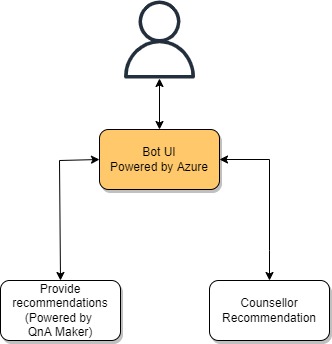
User flow - architecture

Inspiration
Research on women’s status has found that the contributions Indian women make to families are often overlooked, and instead, they are viewed as economic burdens. They have little autonomy, living under the control of first their fathers, then their husbands, and finally their sons. All of these factors exert a negative impact on the mental health status of Indian women.
Women's mental health issues are common but considered taboo in Indian society hence many find it extremely difficult to find ways of getting them addressed.
So, our team felt the responsibility of helping the women with the help of technology. We brainstormed several ideas by employing the design thinking approach. We conducted a field survey amongst women and found that more than 95% of respondents are suffering from mental issues out of which 81.3% said that they would welcome the use of technology to solve this issue.
For the purpose of this hackathon we wanted to create MVP (Minimum Viable Product) with the following:
Hypothesis:
- Users (mainly women) have access to the internet.
- All women know how to surf through the internet.
- Women should know how to read and write in their first language.
Stakeholders:
• Women in Corporate Industry • Age group range in focus: 20–60
Stakeholder Situations:
• When they realize they need help to know more about a situation that they cannot openly discuss with their parents, family, friends, husband, etc. • When they are unsure of a medicine, test, process, etc. • When they need information, and knowledge to help assess their situation.
Solution: Our team did rigorous research on several ideas for the scenarios and found that:
• Existing apps have unwanted features that were very time-consuming. o Outcome: Decided to make the user experience as simple as possible as it helps the user gain a positive experience
• Existing apps are not transparent enough and not trustworthy. o Outcome: Decided to make our solution trustworthy by including the guiding principles of Responsible AI So, the solution to this problem can be an AI-based chatbot called DiDiBOT (Didi means Sister in the Hindi language) where women can chat with it and: • Diagnose their mental state • Know more details about their mental condition and • Book an appointment with a specialist if required
So why choose a "responsible" bot? Reason being:
• Available 24/7 • Scalable with lower costs • Greater personalization • Ideal for a repetitive and transactional use case with a testable result
DiDiBOT Personality:
• Friendly • Gives a sister feeling
Bot goals:
- Intelligent
- Fast & Accurate
- Secure
- Trustworthy & Transparent
- Easy to access (accessibility built-in with Translator option)
Features on the chatbot:
• Generic information on women's mental health • Remedial solutions for a vast range of symptoms and cause repository • Articles and exercises on mental health betterment • A counselor's consultation via voice call, video call, real-time booking
What it does - Explained via User Story:
User Raji (imaginary name) was unable to make it to the work today due to a misunderstanding with a colleague at work. She was not able to consult a doctor immediately as she feels that her family and community might not be able to understand her emotions. She needs an alternate solution to get support. She happened to read about the features of DiDiBOT in a news article and she decided to reach out to DiDiBOT for support. She accesses DiDiBOT via the web (spoiler alert: Mobile version to be released real soon). Upon accessing the DiDiBOT she can interact with the chatbot in the language of her choice. This page also has suggested replies/questions which can actually help her to interact with the bot in an easier way. The chatbot suggests possible remedies to try out (by matching similar symptoms) and helps her to find an available counselor to chat with and provide real-time advice.
How we built it
We had created the bot using the Microsoft Bot Framework that uses QnA Maker Cognitive AI as well as the Text Translator API.
Key steps:
Created QnA Knowledge Base: To answer questions from the users a knowledge base has been created using a QnA Maker Cognitive AI resource. This contains all the knowledge base we need for our bot(DiDi) to chat with the user.
Text Translator - To enable our Bot to talk in multiple languages: We have created Text Translator API to translate the conversation to the user's preferred language. Currently, DiDiBOT translates more than 60 languages.
Bot Framework Emulator: For testing DiDiBOT, we used Bot Framework Emulator which is a desktop application that allows us to test and debug DiDiBOT on localhost or run remotely through a tunnel.
Deploy the bot to Azure: For Deployment, we had used azure CLI tools and the services provided in the Azure environment
Challenges we ran into:
o We faced technical issues in integrating the Translator service to the bot as we felt the cloud environment was not robust o We also found the documentation related to BOTs to be spread across many places instead of in a single consolidated location
Accomplishments that we're proud of:
o The interaction we did with real people made us realize that Women's mental health is a pressing issue that needs to be addressed with high priority o The design phase and research phase were enriching o Our development phase was exciting with a lot of learning
What we learned
o By employing the design thinking approach, we learned to think from a customer perspective o The guiding principles of responsible AI were nicely articulated by Microsoft and that enabled us to develop our bot in a more transparent, accessible, and trustworthy manner.
What's next for DidiBOT
o Integration of Speech services o Integration with LUIS o Creating a mobile-based app o Expand the reach by including women from all categories (like Rural, Domestic workers, etc.)
Built With
- ai
- azure
- bot
- botplatform
- cognitive
- microsoft-translator
- qna
- responsibleai




Log in or sign up for Devpost to join the conversation.