-
UI Landing
-
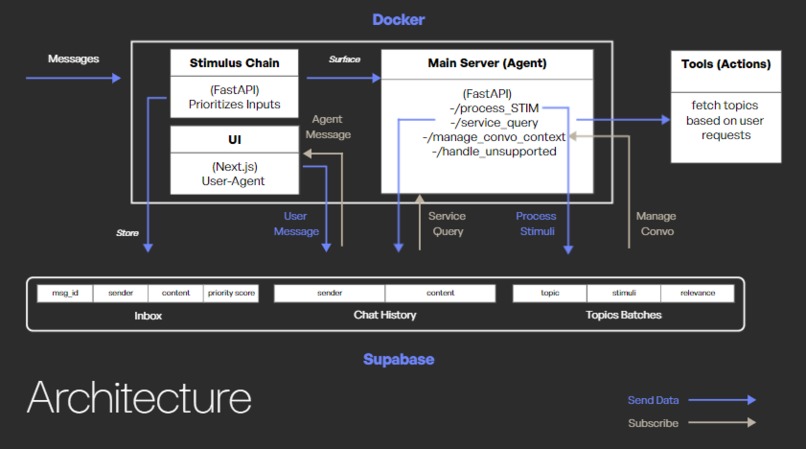
Architecture
-
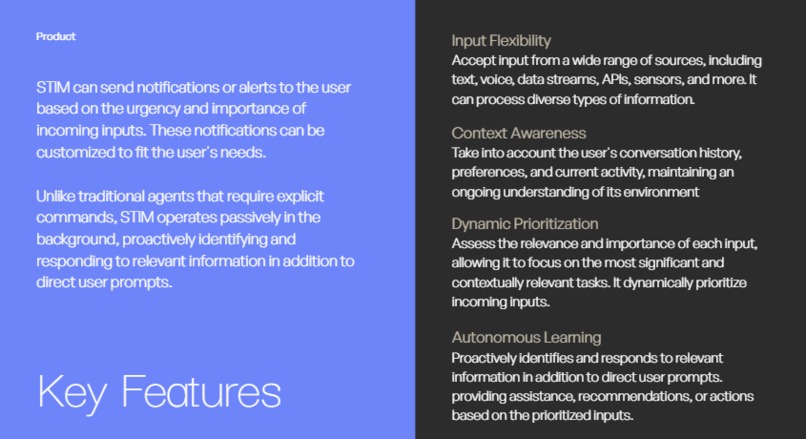
Key Feature
-
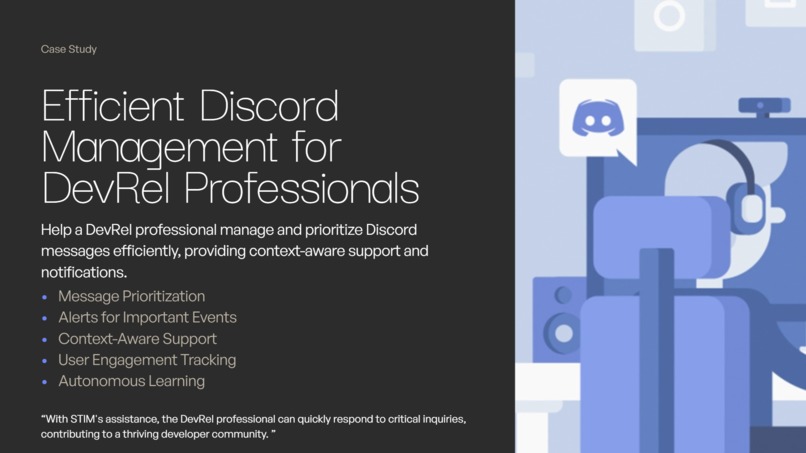
Case Study: DevRel Discord Management


Inspiration
Our mission is to explore non-linear agent architectures that operate in a more dynamic, contextual, and human-centric manner. As a starting point, we aim to build a prototype agent that can intake varied inputs in real-time and prioritize between them intelligently based on the live context.
The goal is to move beyond the limitations of linear, rule-based agents and enable more persistent, passive computing interactions. We draw inspiration from visions like the hyper-capable agents in Accelerando by Charles Stross, which highlight the potential for AI systems to operate autonomously with a keen sense of environmental context.
What it does
Our prototype is a non-linear personal alert agent refers to an intelligent assistant that can monitor a user's environment, context, and preferences and proactively issue alerts and notifications in a dynamic, non-linear way. It will take continuous inputs from sources like sensors, APIs, and user conversations.
Key Features
- Input Flexibility: STIM is built to accept input from a wide range of sources, including text, voice, data streams, APIs, sensors, and more. It can process diverse types of information.
- Context Awareness: The agent maintains an ongoing understanding of its environment and the user's preferences, adapting its prioritization based on the context. It takes into account the user's conversation history, preferences, and current activity.
- Dynamic Prioritization: STIM employs advanced algorithms and machine learning to dynamically prioritize incoming inputs. It assesses the relevance and importance of each input, allowing it to focus on the most significant and contextually relevant tasks.
- Autonomous Learning: Over time, STIM autonomously learns from user interactions and feedback, improving its prioritization capabilities and understanding of user preferences.
- Notification and Alerts: STIM can send notifications or alerts to the user based on the urgency and importance of incoming inputs. These notifications can be customized to fit the user's needs.
- Persistent and Passive Operation: Unlike traditional agents that require explicit commands, STIM operates passively in the background, proactively identifying and responding to relevant information without direct user prompts.
- User Assistance: The agent can provide assistance, recommendations, or actions based on the prioritized inputs. For example, it can suggest tasks, answer questions, or initiate actions autonomously.
How we built it
(See attached Architecture Diagram)
Challenges we ran into
One of the significant challenges we encountered during the development of STIM was mapping out its architecture. Ensuring that the agent's structure was well-defined and capable of meeting our objectives required careful planning and consideration.
Accomplishments that we're proud of
This project will serve as a preliminary exploration into more dynamic, contextual, and human-aware agent architectures. We believe developing assistants and agents with these capabilities will enable more meaningful and cooperative human-AI interactions compared to current linear, response-based systems.
What we learned
The development of STIM taught us invaluable lessons in agent design and dynamic computing. We learned that striking the right balance between autonomy and user control is essential for user acceptance.
What's next for STIM
- Multimodal Inputs: The agent is capable of handling multimodal inputs, such as combining text, voice, and sensor data to make contextually informed decisions.
- More Action: Add more actions for the agent to execute as a subsequent task.
- Multichannel Alerts: Issues personalized alerts on channels like phone, smart speaker, wearable etc. Alert modes can include sound, light, haptics.
Built With
- agent
- docker
- fastapi
- langchain
- postgresql
- protocol


Log in or sign up for Devpost to join the conversation.