-
-
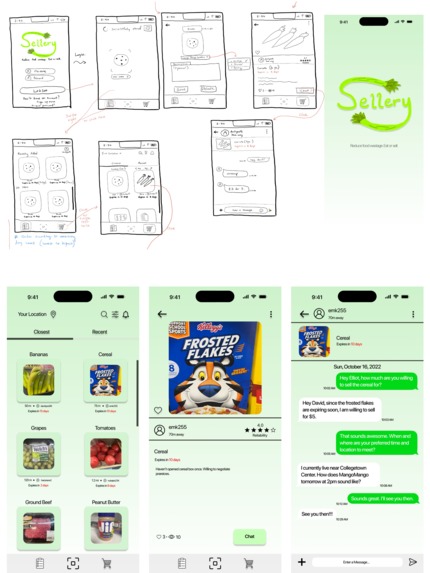
A collection of Sellery's low-fidelity and mid/high fidelity sketches.

Inspiration
As a group of four college students living alone and off-campus for the first time, our team was inspired by the often overlooked yet frequent inconvenience of grocery goods ending up spoiled; trashing these goods would present several problems: waste of money, wastage of foods, and recurring guilt/disappointment.
Having started off the hackathon with collaborative research on some of the world's most pressing environmental sustainability issues, our team was once again reminded of the gravitational damage that mass food wastage incurs. 6% of global greenhouse gas emissions arise from food wastage and nearly 240 billion USD worth of food are annually wasted among US households. These are problems that Sellery deem as controllable through mindful changes in action.
What it does
Sellery provides two main features. First, it aims to promote users' bought grocery goods and their respective expiration dates. Sellery does this by having implemented a real-time object-identifying scanning software that maps common grocery goods to their expected expiration dates. Second, it provides an interactive marketplace through which users, whom may be buyers or sellers, can actively buy and sell grocery goods at much lower prices (through bargaining) than their prices at time of purchase. Such a marketplace allows for foods to flow in circulation, that may otherwise be discarded as food waste.
How we built it
We used tensorflow's cocoSSD object detection model to track and draw bounding boxes around grocery items captured in live camera stream. We also utilized google cloud vision AI API to get a label of detected items. We then store these items in SQL database. Finally, we used react-native to build a prototype application.
Challenges we ran into
- Managing FPS and interpolation of object tracking motion was very difficult. We wanted to make our application look smoother, but were not able to improve quality up to our expectation within the time constraint.
- We intially found ideation process very difficult. We spent almost half of our time coming up with the idea.
- It was very difficult to manage incorrectly labeled data. We had to play around with the confidence score and eventually were able to get an optimal result.
Accomplishments that we're proud of
All jokes aside, we are very proud of our logo; the two ends of the celery sticks flowing circularly represent our intended focus of fruitful food circulation as a means of reducing food wastage. Celery is spelled "Sellery" because we wanted to encapture the marketplace nature of our functionalities.
In his Business and Sustainability seminar, Professor Dowell emphasized the phrase "try for the fix, not just the band-aid." In other words, he stressed the importance of tackling an issue not by merely shifting the burden to someone else or later in time, but truly attempting to bring about a momentum shift. We envision and believe that, although our product is only a prototype thus far, it holds tremendous potential in paving the way towards a global and sustainable culture targeted towards reducing food wastage.
As a team consisted of 3 members without any prior hackathon experience, we are extremely proud of the entire process of product development.
What we learned
Individually, we all learned how best to maximize our strengths and support each others' weakenesses in a highly intense spurt encompassing the beautiful process of taking ideation into fruition. We learned the value of efficient thinking, risk taking, and maintaining confidence.
Technicality-wise, we were exposed to a diverse set of tools, such as different coding-languages, deisgn platforms, and communication platforms. One of our biggest challenges throughout the hackathon was the concept of real-time object-identification and tracking, an avenue that served to be technically intensive, yet academically rewarding.
What's next for Sellery
- Implementing AR to generate smoother UX in real-time object identification and tracking.
- We hope to extend Sellery's marketplace feature to larger third-party enterprises such as UberEats, franchise convenience stores, and local restaurants.
- Following this hackathon, we plan to further hone our product by training the cocoSSD ML-model with extensive lists of grocery items.
- We also plan on enhancing expiration date approximation by sophisticating our database.
Built With
- amazon-ec2
- amazon-web-services
- cocossd
- django
- expo.io
- google-cloud-vision
- react-native
- sql
- tensorflow


Log in or sign up for Devpost to join the conversation.