-

Team Logo
-
Data visualization


Inspiration
Every great startup starts with an idea, but turning that idea into a product often hits a wall when it comes to backend setup. We noticed that countless founders, creators, and early-stage teams lose valuable momentum because they don’t have the technical expertise or time to build infrastructure from scratch. Our vision was simple: what if creating a backend could be as easy as having a conversation?
What it does
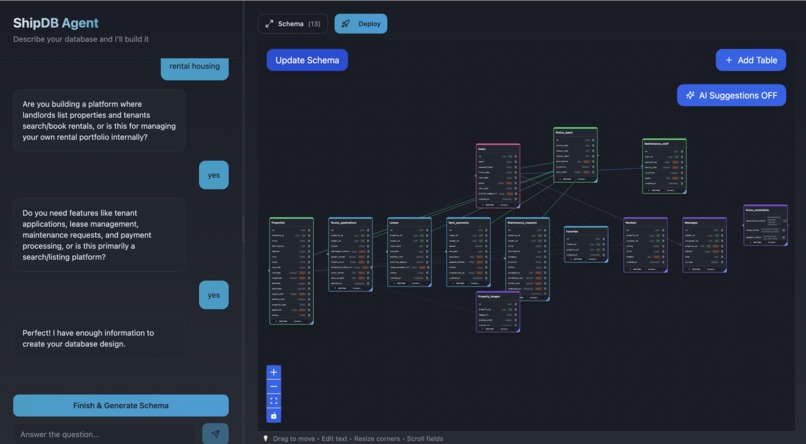
ShipDB is an AI-powered database architect that turns a short chat with the user into a complete, production-ready schema. The React/Vite frontend guides requirements via conversation, while a FastAPI backend calls Claude to generate PostgreSQL DDL, JSON schemas, and DynamoDB tables, with optional one-click AWS deployment. Users can review results in a clean “Generated Schema” panel and (optionally) request AI improvements like adding a new table or merging existing ones. It’s built for speed: start a project, answer a few questions, get high-quality schemas and deployment paths in minutes.
How we built it
ShipDB is a full-stack web app that combines an intelligent AI backend with an intuitive React/Vite frontend. The frontend provides a chat-based UI where users can start, continue, and complete a requirements-gathering conversation. This conversation is sent to our FastAPI backend, which powers the core logic through an AIAgentService.
The backend integrates with Claude via the Anthropic API to transform user input into a structured product specification, then automatically generates multiple schema formats, PostgreSQL, JSON, and DynamoDB. Using boto3 and RDS, our deployment services can even provision real databases directly from these generated specs.
On the frontend, users see a clean chat interface, a resizable workspace, and a “Generated Schema” panel or modal for instant schema previews. The backend exposes REST endpoints (plus a health check) and loads configuration through Pydantic Settings from a .env.
Challenges we ran into
One of our biggest challenges was building the interactive database schema visualizer with complex dropdowns and real-time relationships between tables. Making this complex design intuitive helped refine our frontend logic and UI rendering. Another major hurdle was enabling users to generate and deploy databases to the cloud through a simple conversation. Ensuring accuracy, security, and smooth provisioning required a lot of iteration and testing.
Accomplishments that we're proud of
We successfully built and deployed a fully functional AI-powered chatbot that can gather user requirements through conversation and generate structured database schemas. We also developed the backend logic and visualization system that turns those schemas into an interactive, dynamic database chart, allowing users to explore their data tables in real time.
What we learned
Throughout building ShipDB, we gained hands-on experience integrating Claude AI to power a dynamic, conversational chatbot capable of understanding and structuring complex product requirements. We learned how to efficiently transfer and deploy complete databases to live servers, optimizing both speed and reliability in the process. One of our biggest takeaways was designing an interactive schema visualization, allowing users to see and interact with their generated database tables in real time. Beyond the technical skills, we learned how to bridge AI, backend automation, and user experience design into a seamless product that simplifies one of the most complex parts of building a startup, creating the backend itself.
What's next for ShipDB
Our next step is to scale ShipDB and make it a truly universal infrastructure builder. We plan to expand support to every major cloud provider, including Google Cloud, Microsoft Azure, and more, while also connecting to a wider range of databases such as MongoDB, Pandas DataFrames, and other modern data systems. We imagine a future where anyone can generate, deploy, and manage any database on any platform with just a simple conversation.
Built With
- amazon-web-services
- anthropic
- boto3
- dynamodb
- fastapi
- javascript
- openai
- postgresql
- python
- react
- tailwind
- typescript
- uvicorn


Log in or sign up for Devpost to join the conversation.