-
-
The missing layer between web2 and web3

Inspiration
Background 1: Managing Web3 accounts could be cumbersome, unfriendly to users, and vulnerable to hacking. Based on research by ChainAnalysis, the number of lost bitcoins due to account loss reached 3.79 million($150 billion).
Background 2: Web3 Dapps cannot access users’ Web2 profiles and social graphs in a decentralized, verifiable, and private way.

The key problem: account systems in web2 and web3 are natively separate, technically unconnected, and even inherently in conflict with their value.
What it does
By providing Web3 users with a secure, user-friendly Web2-style account management experience, Shuttle Protocol aggregates cross-web user profiles and social graphs. The great value in these aggregations, which are completely owned by users, can be unlocked and used in scenarios such as Web3 Social, DID, De-Fi and DAOs.
How we built it
The Shuttle protocol uses Secure Multi-party Computation (MPC), Threshold BLS Signatures, and Trusted Execution Environment (TEE) technology to manage private keys and allows owners to access with a customized combination of Web2 third-party authentication services including SMS, email, Google, and even Web3 address.
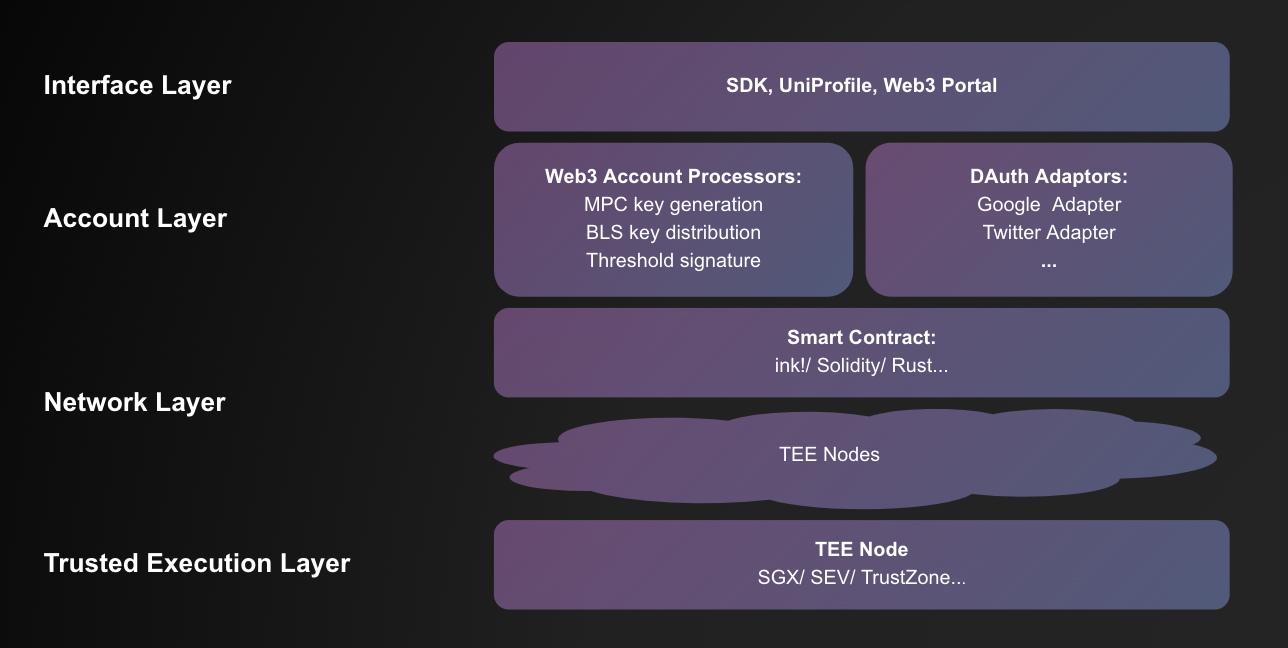
Shuttle created Decentralized OAuth by combining TEE MPC and OAuth technologies. We named it “DAuth”. DAuth allows users to complete the authentication of profiles such as Google, Twitter, Github, etc., and associate it with the user's Web3 account in a decentralized way. These profiles and their associated data are private, only the user can authorize access.
Github: https://github.com/shuttle-protocol
Challenges we ran into
- To let more Web3 projects adopt and integrate Shuttle to form an ecosystem and hence gain more user base gradually;
- To maximize the value of user profile data in Web3 while ensuring users’ data security and privacy;
Accomplishments that we're proud of
- We are successfully applied for Web3 Foundation Grants
- We got a 3-rd prize in Web3 Hackathon
What we learned
We talked to lots of Web3 native projects of DID and Web3 social. They are looking forward to integrating with Shuttle to get a no-boundary profile and social graph across Web2 and Web3.
What's next for Shuttle Protocol
- We will design and implement an on-chain tokenomics system to incentivize necessary parties in the protocol.
- Support more TEE implementations, such as Trusted Zone of ARM, and SEV of AMD;
- Explore more possibilities in the composable Web3 Lego, including DID integrations, Web3 social graph, and Web3 Advertisement.

Built With
- blockchain
- bls
- c++
- mpc
- oauth
- rust
- secret-sharing
- tee


Log in or sign up for Devpost to join the conversation.