-
-

Signal seek logo
-

Signal Seek Banner
-
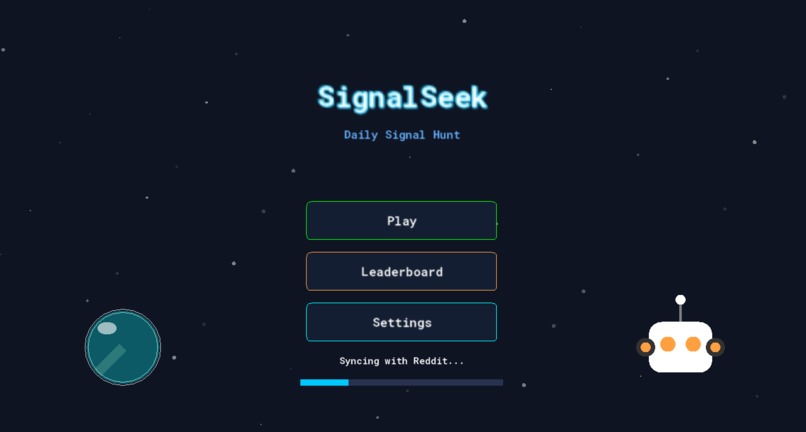
Signal Seek Menu
-
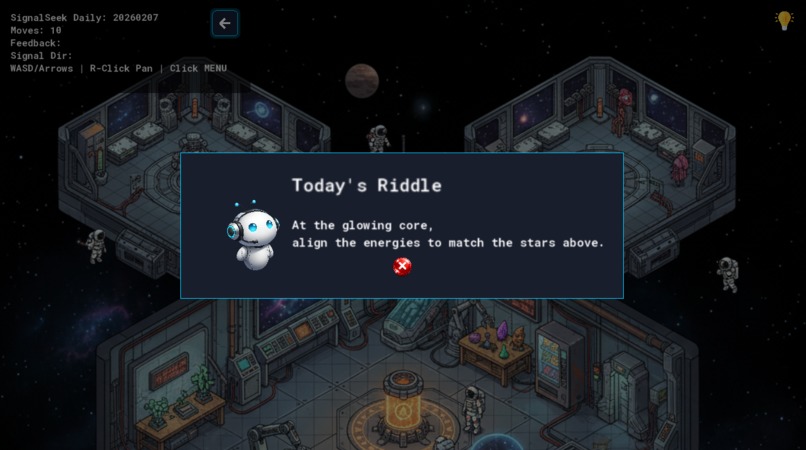
Signal Seek Riddle
-
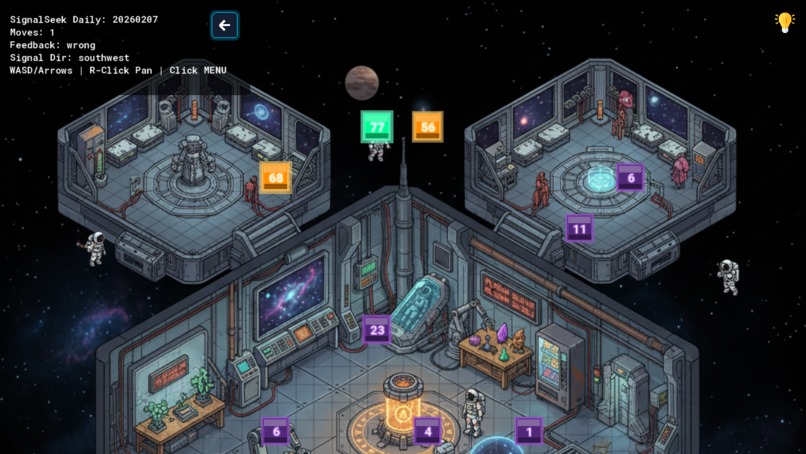
Signal Seek Gameplay


Signal Seek - Project Story
About the Project
Signal Seek is a grid-based exploration and puzzle game centered around one idea: meaning is often hidden in noise.
In the game, players help an outsider intelligence recover fragmented cultural signals scattered across different environments. These signals are guided by riddles generated by a damaged scouting bot, some helpful, some misleading. Using logic, interpretation, and proximity-based feedback, players must determine which signals are real and which are false.
The project blends exploration, riddles, and uncertainty into a system where discovery feels earned rather than handed out.
Inspiration
The core inspiration for Signal Seek came from observing how information behaves online, especially on platforms like Reddit.
Posts, comments, and cultural references often carry meaning that only makes sense if you've been around long enough. Context matters. Signals can be distorted, misinterpreted, or taken out of place, yet still feel convincing.
Additional inspirations include:
- Signal processing concepts, where proximity and strength indicate relevance
- Exploration-based games that reward curiosity over reflexes
- The idea of an outsider trying to understand human culture through incomplete data
Signal Seek is an attempt to turn these abstract ideas into a playable system.
What I Learned
Building Signal Seek taught me a lot beyond just gameplay logic.
Technical Learnings
On the technical side, I learned how to:
- Design systems where uncertainty is intentional, not a bug
- Structure game data (points of interest, riddles, signals) in a scalable way
- Use proximity and distance calculations to drive gameplay feedback
For example, signal strength is derived from distance using a simple inverse relationship:
Signal Strength = 1 / (1 + d)
Where d is the distance between the player and the signal source.
Design Learnings
On the design side, I learned:
- How to justify mechanics through narrative
- How to make riddles feel contextual instead of arbitrary
- How false information can be used as a gameplay feature rather than a frustration
How The Project Was Built
Signal Seek was built using GameMaker Studio 2, with a strong focus on modularity and iteration.
Key systems include:
- A grid-based world with chunked map layouts
- Points of Interest (POIs) that store signal data and riddles
- A sensor system that increases signal feedback as the player approaches a true source
- Support for corrupted or false signals to add ambiguity
Assets and data are structured so that new environments, riddles, and signals can be added without rewriting core logic. This made experimentation easier and allowed the game's systems to evolve alongside the story.
Challenges Faced
One of the biggest challenges was balancing clarity versus mystery.
- If riddles were too vague, players felt lost
- If they were too clear, the puzzle disappeared
Another challenge was designing false signals that felt believable. A bad false signal feels unfair, but a good one teaches the player to slow down, observe, and verify.
Finally, tying all gameplay mechanics back into the narrative required iteration. Every system needed a reason to exist in the world, not just a mechanical purpose.
Reflection
Signal Seek started as a small idea about chasing signals on a grid, but it evolved into a project about interpretation, context, and trust in information.
Built With
- devvit
- gamemaker


Log in or sign up for Devpost to join the conversation.