-
-
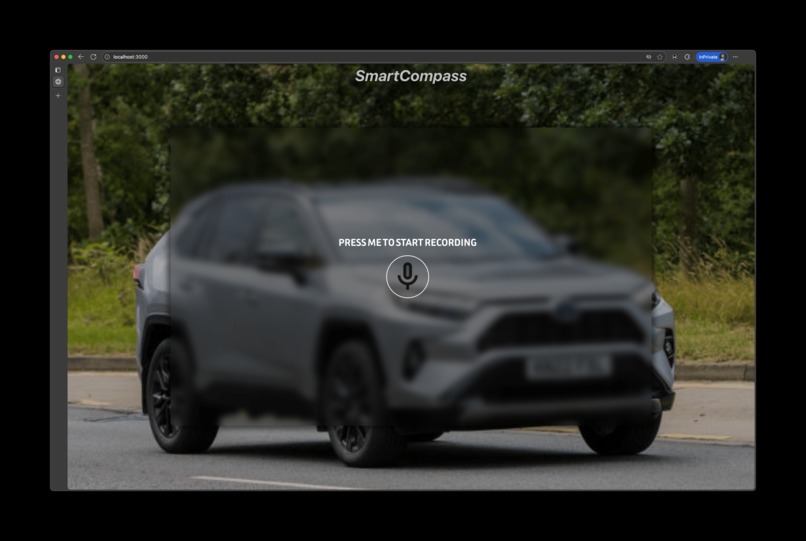
Landing page for application
-
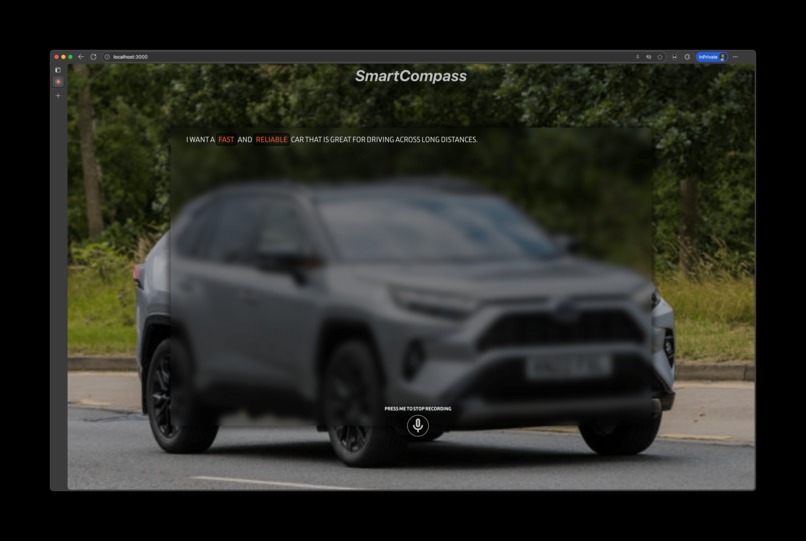
Voice to text in real time (highlights key words)
-
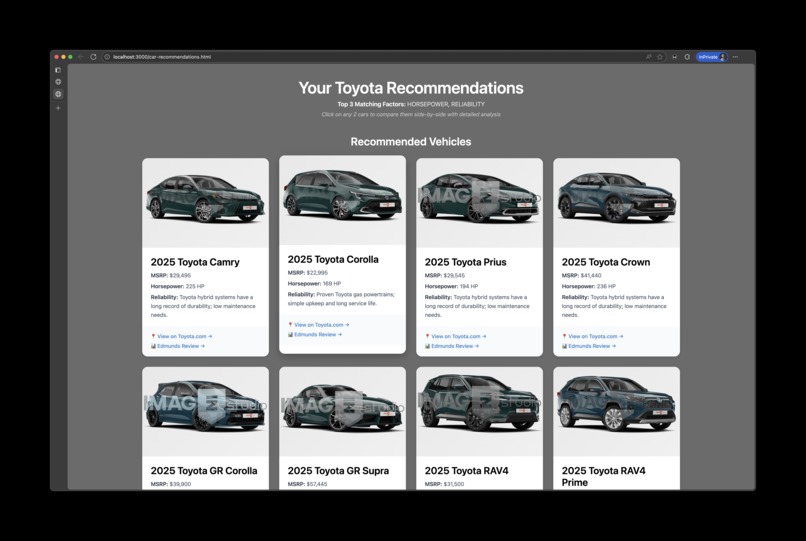
Filter of cars based on voice input
-
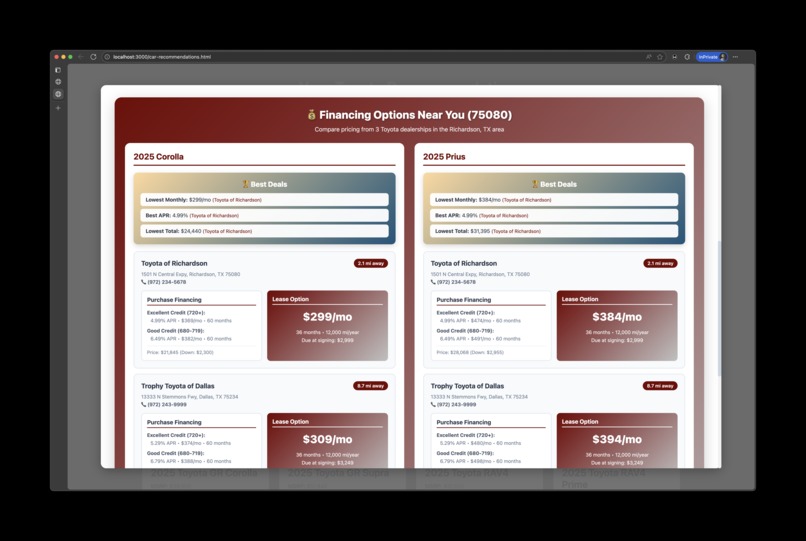
Dealership info based on location and price
-
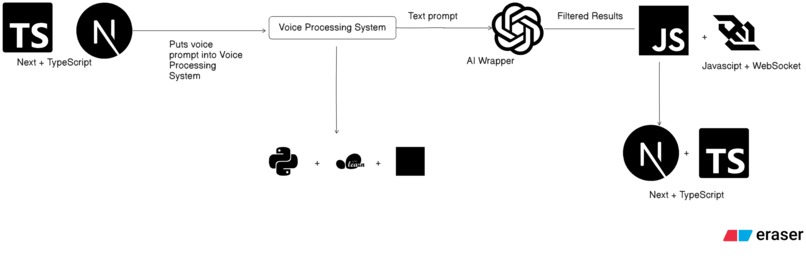
Tech Stack


Inspiration
As I started college, my parents and I began looking for a car for me. We knew it was going to be a bit of a hassle, but I was still excited about my first one. That excitement soon faded when, after months of searching, we still hadn’t found a good deal on a nice, reliable vehicle. We visited multiple dealerships and websites, but nothing worked out. Finally, when we had a car locked in at a dealership, it was sold at the last minute to someone who offered a better price. What seemed like it would take a few weeks stretched into more than a year, and the stress of that experience made me determined to help others avoid the same ordeal. I don’t want anyone, especially someone in a more desperate situation, to struggle as I did just to secure basic transportation, particularly in a sprawling place like Texas, where having a car is a necessity to get through everyday life.
What it does
Our easy-to-access application converts speech to text and allows users to sort through over a hundred different vehicles through a conversation-based model, showing results based on what input they gave the AI, so they get matched with the perfect vehicle of their choice. It also makes sure to highlight keywords that would be used to refine the search for the most optimal results. After being provided a set of options, the user will be given the best choices of financing to allow the best decision to be made by the user, with comfort in mind and no doubt about financial instability. The user's input is also analyzed for satisfaction to let the AI model improve based on customer real-time feedback rather than manual developer tweaks. SmartCompass analyzes customer chatter (Reddit, X/Twitter, reviews, support tickets) and predicts satisfaction as Positive / Neutral / Negative and a 0–1 confidence score
How we built it
For the front, we used HTML, JavaScript, and Next.js to build a fully integrated AI-powered web application. For the backend, we used AI API integrations as well as data set storage in a CSV format to process and analyze the user experience. Development of the frontend took lots of redesigns and a whole script to generate a static webpage for users to find their filtered content. The project has the accessibility of a voice agent that could process users' speech and input for optimal results. Baseline: Logistic Regression + TF-IDF (fast, explainable). Production candidate: XGBoost / LightGBM on rich features for tabular robustness. Evaluation: Stratified holdout; report F1, precision/recall, ROC-AUC; slice by topic, platform, time to catch drift.
Challenges we ran into
We ran into a plethora of challenges, some of which were related to getting the socket connected to the front-end application or an AI agent to work with our requirements. Our data had to be normalized in a standard format for easier processing and dynamic page loading. As well as a secondary connection to a backend server to store our data, the API was misconfigured and did not connect, even with multiple attempts, until we rebuilt the entire system from the bottom up. But as a team, we were able to face any challenge that we came across and built a project that we are proud to show off. API limits & noisy data: Rate caps, deleted posts, spam/bots → built backoff, caching, and bot heuristics
Accomplishments that we're proud of
We are proud that we were able to make an interactive AI voice agent that would take variable user input and provide each user with customized results while fine-tuning to their needs through definable keywords. Our system also interacts through websockets and has a backend system to process user input and analyze their satisfaction throughout the buying process. Live, end-to-end demo: ingest → classify → topic clusters → dashboard in one click.
What we learned
We learned a multitude of different coding skills while making this AI-powered user application. One of the many lessons we learned was that of using the native browser speech kit to process user input and identify keywords by highlighting them. To make this input work with our web application, we had to learn the pivotal skill in our project, which was connecting the backend AI via WebSocket. Task framing matters: Ternary sentiment (Pos/Neu/Neg) + topic-aware slices reflect reality better than binary. ...
What's next for SmartCompass
We would like to have SmartCompass remember past conversation history and store conversation data. We would also like this to be integrated within Toyota's website to help people find their dream car more efficiently and to locate their fiancés faster. As the model becomes more knowledgeable regarding user preferences and satisfaction, it can provide more popular results and filter search criteria based on location, best prices, or even practicality. Having a system that can satisfy users and provide the company with the correct feedback about customer struggles would help refine future goals. Segment intelligence: breakdown by product, geography, campaign, and customer tier; cohort trend reports. Multilingual coverage with language-specific adapters and cross-lingual embeddings.


Log in or sign up for Devpost to join the conversation.