-
-
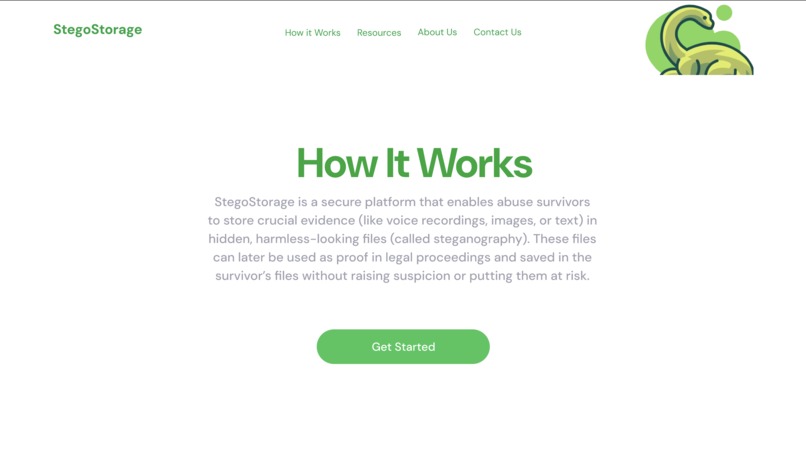
Home Page

Inspiration
“We believe that everyone deserves to be safe in their homes and in their relationships, and that love shouldn’t come at a cost of abuse or control. We can envision a world without violence, and we work every day toward the creation of that world.”
Such is the motto of Project Safe, a nonprofit organization working to end domestic violence through crisis intervention, ongoing supportive services, systems change advocacy, and prevention and education in Agni’s hometown of Athens, GA. They keep their services affordable to everyone through volunteer work and donations, which is how they were able to contribute to their incredible mission statement. Through that experience, we knew we wanted to do more for survivors, which is the start of what inspired our team to create StegoStorage.
What it does
StegoStorage is a website where users can turn messages and files into inconspicuous images, which they can then save. This online application was created for domestic violence survivors, so they can keep records, evidence, and helpful resources without their abusive partners getting suspicious. Domestic violence is a grave issue that affects a larger number than people think. According to the National Domestic Violence Hotline, on average, 24 people per minute are victims of some form of domestic violence in the United States. Research suggests that up to 50% of abusive partners use some form of technology to stalk their partner, and some estimates are as high as 70%. Of domestic violence service providers, 97% report that the survivors they work with experience harassment, monitoring, and threats through technology. StegoStorage provides 3 features. It allows users to encrypt messages into non-suspicious-looking images, it allows users to decrypt images to reveal hidden messages, and it provides resources so survivors know who they can contact and where they can go.
How we built it
We used Figma for designing the user interface and experience, which was then implemented into React for a responsive and dynamic frontend, using Flask for backend connectivity. Furthermore, for the backend, we utilized Pydub and Pillow to work to work with audio and image files respectively. We also used the Gemini API to generate personalized recommendations and resources.
Challenges we ran into
We faced challenges with Flask compatibility and Github integration difficulties with certain file sizes.
Accomplishments that we're proud of
Regardless of the hurdles, we’re incredibly proud of how we came together and applied our newfound knowledge in cybersecurity-related computer science topics to create something meaningful in such a short amount of time!
What we learned
Overall, not only did we learn new technology, such as Flask and Pillow, but also most of us had not worked with cybersecurity before. This project allowed us to expand our understanding of computer science. Most importantly, we also honed our problem-solving skills and improved our ability to collaborate as a team.
What's next for StegoStorage
In the future, we want to fully integrate the frontend and the backend together, as well as develop the capability to encode images. This will allow for greater functionality and support for users.


Log in or sign up for Devpost to join the conversation.