-
-
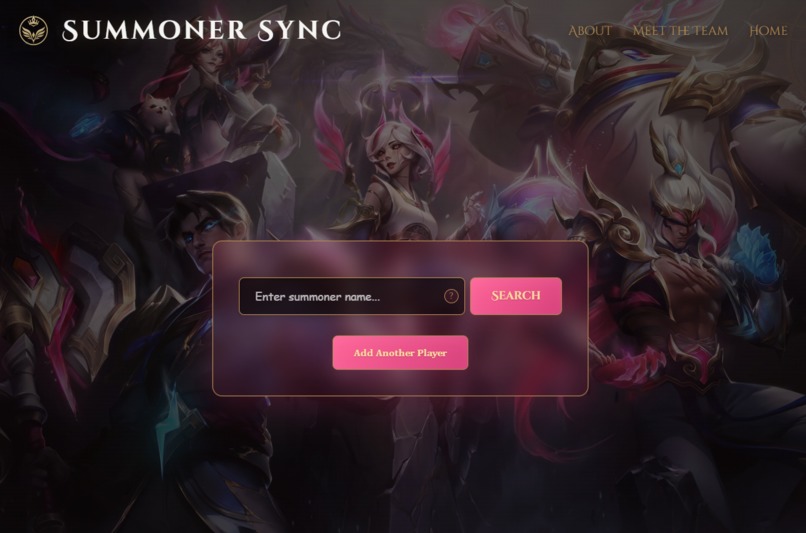
SummSync-Homepage
-
-


About the project -
Inspiration
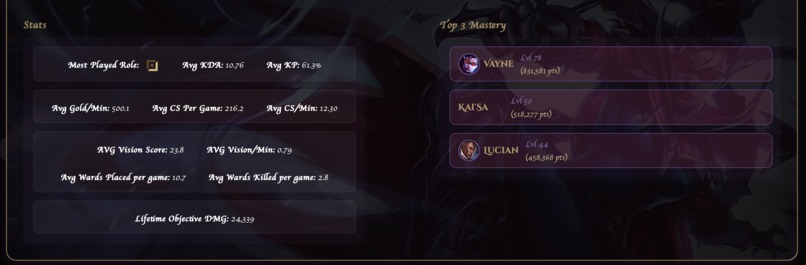
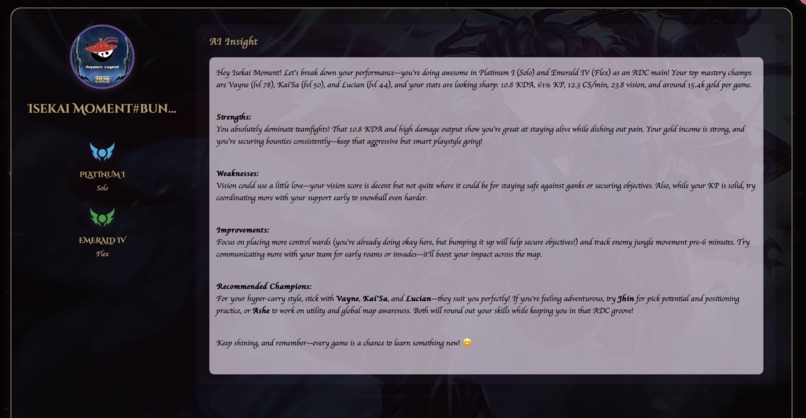
The inspiration for the Summoner Sync comes from wanting to view stats and pair them with your friends, all on one page. This allows for seamless navigation, informed insights into your playstyle, and a clear understanding of your strengths and weaknesses. Seeing raw stats is boring, and every other page has it, so we added an AI coach. Each player will receive a unique stats card with their own AI analysis of their games. Users who enter multiple players will also be able to see team comps for those who want to learn about synergy and team play! So no longer will you have to guess about which champion in your champion pool goes well together and how you should play the composition. As friends who love to play Clash together, this website is something that we find will be useful to others.
What it does
Summoner Sync is a data-driven AI coach for League of Legends that helps players and teams understand their gameplay on a deeper level. Not only does it tell you your stats from your games, it analyzes recent match stats, champion mastery, and play patterns using Riot’s official APIs to deliver clear insights on performance, strengths, and weaknesses. This offers personalized coaching and input to help players learn about their playstyle, matches, and habits, which will be different for each player. Highlight feature includes team analysis. Summoner Sync compares up to five players side by side. It evaluates team comps and synergy, and offers guidance on how to play your draft effectively. It’s your all-in-one tool for learning, improving, and building better team coordination.
How we built it
We built the server using AWS services. The main functionality was built behind a single lambda function handling all incoming client-side API requests, and processing the API requests for both the Riot API calls and AWS-Bedrock AI service calls. We store player data through sessions, managed by sessionId, which is stored in a DynamoDB database temporarily. The front-end is built with a combination of JavaScript, HTML, and CSS. When the site loads, JavaScript sends a request to the backend or API to get data, then updates the page dynamically to display things like player info, stats, or images without needing a reload.
Challenges we ran into
A challenge we ran into was a bug in processing the data when searching for players. We addressed the issue by limiting our analysis to only Summoner’s Rift games and handling edge cases in the Riot API responses.
A second challenge we ran into was finding a sufficient prompt to pass into bedrock that satisfied our vision.
Minimal challenges we ran into during this project were the frontend elements shifting while hiding the scrollbar.
Accomplishments that we’re proud of
The website is functional and taking in multiple players as we planned. We are proud that the website works as intended. The frontend looks great, and the backend does as it is intended.
What we learn
Jeffrey: I learned how to utilize cloud-based systems in server-based development. I really like how AWS resources are linked together, and I learned how to utilize those resources to make development more scalable and modular.
William: I learned a lot when it came to the whole process of a hackathon. Seeing the different roles that people play, how much time and effort were put into it. This was my very first hackathon, and I really did enjoy it a lot and would love to do more in the future. Currently, the role I have is the PM and AI Prompt maker. It was a good intro to everything, and I would want to see what else I can do in the future for my future teams or even doing one on my own!
What’s next for Summoner Sync
Summoner will be given better and more specific data from Riot’s API, such that it can provide more valuable and accurate feedback. The AI bot’s prompt will receive further fine-tuning and structural consistency. Making the request rate and feedback much more consistent is a high priority.




Log in or sign up for Devpost to join the conversation.