-
-
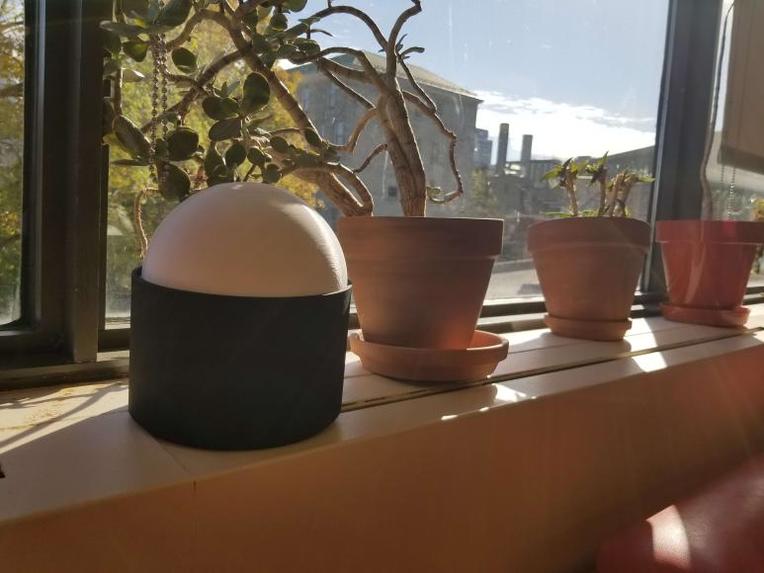
SÜNLÅMP: A lamp that pretends to be the sun. Prototype casing.
-
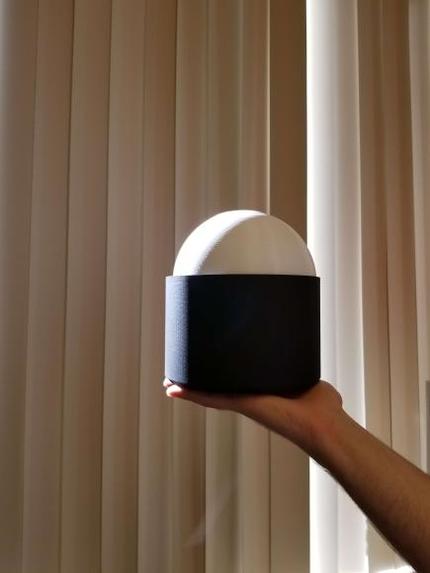
The 3D printed casing was done with PLA fiber. The white dome is about 1 mm thick to allow light through and diffuse it.
-
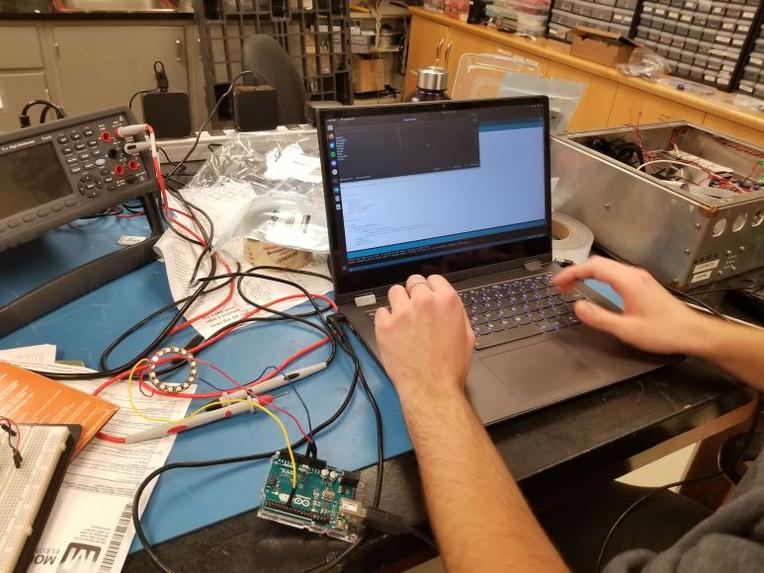
Progress: Getting one LED to light up through the Arduino.
-
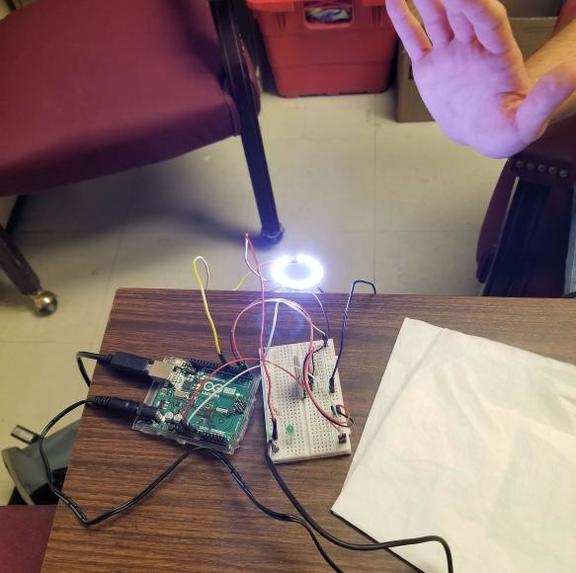
Progress: Heartbeat detected! The first time the LED ring lights up from a Bluetooth command.


Inspiration
There are plenty of sunrise alarm clocks available on the market, but none of them display a scientifically-accurate color of the sunrise or sunset. We were inspired by the shortening days to bring the sun indoors!
The SÜNLÅMP's features include:
- Sunrise and sunset color sequence based on data from F. Zagury (2012)
- Showing the color of a blackbody with a user-inputted temperature.
- Showing the color of the midday sky if our Sun was a different star: Betelgeuse, Polaris, Proxima Centauri, Vega, S Cassiopeiae, Kepler 16, Albireo.
- Showing the color of the sky for a star with a user-inputted temperature.
How it works
The SÜNLÅMP is a bluetooth-controlled LED lamp that is meant to imitate different spectra (blackbodies, Rayleigh-scattered, and measured sky spectra).
The SÜNLÅMP system is composed of:
- A pre-processing pipeline that turns solar spectrum data and blackbody spectra into equivalent colors
- A GUI to control the colors displayed by the lamp via Bluetooth
- Hardware: An Arduino Uno microcontroller, an HC-05 bluetooth module, a NeoPixel LED ring by Adafruit enclosed in a 3D-printed case.
Challenges we ran into
A few selected examples:
Some of our sunrise spectral data was contaminated with a blue sky spectrum, as if the detector caught some of the blue sky during sunrise. We had to investigate the theory behind Rayleigh scattering and ozone absorption.
We ran into many issues with the bluetooth module -- it simply did not work with Ubuntu. Establishing a serial connection with the bluetooth module through Arduino took about 16 hours.
The color theory behind translating a spectrum to an RGB code is much more complicated than it seems. It involves converting the spectrum to a mathematical model of what the cones in your eyes can see, and then to pick a standard system to translate that to a color.
The LEDs are heavily blue-shifted, which we do not have time to gamma-correct.
Accomplishments that we're proud of
This project had a tremendous number of moving parts: data was pulled from a paper and we ensured communication with the author for clarifications, we ordered parts in advance for the hardware, we 3D printed multiple parts during the hackathon, we figured out how to get the bluetooth protocol to communicate with the Arduino Uno board, we learned how to create a GUI to send commands to the lamp, we learned about color theory and how spectra translate to visible colors, we found a spectrometer (then tested it and found out it does not work)... Each team member was doing something completely different!
What's next for SÜNLÅMP
To make a lamp that can compete with current market models, our next step is to incorporate an alarm system, that can begin the sunrise cycle at a user-specified time.
The lamp also has great potential as an educational tool, as a way for students to learn about Rayleigh scattering in a visually engaging way.
External data and code used
We obtained irradiance spectra from F. Zagury (2012) at different time points in a sunrise. The implementation of the color-conversion algorithm from power spectra to RGB color was taken from Scipython user christian. Although ozone absorption simulation was not completed, a table of ozone absorption cross-sections was obtained from Gorshelev (2012) and may be implemented in the future.


Log in or sign up for Devpost to join the conversation.