-
-
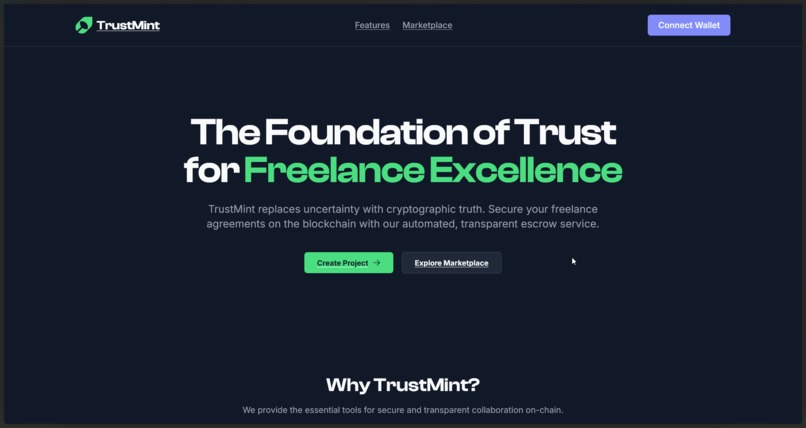
Landing Page
-
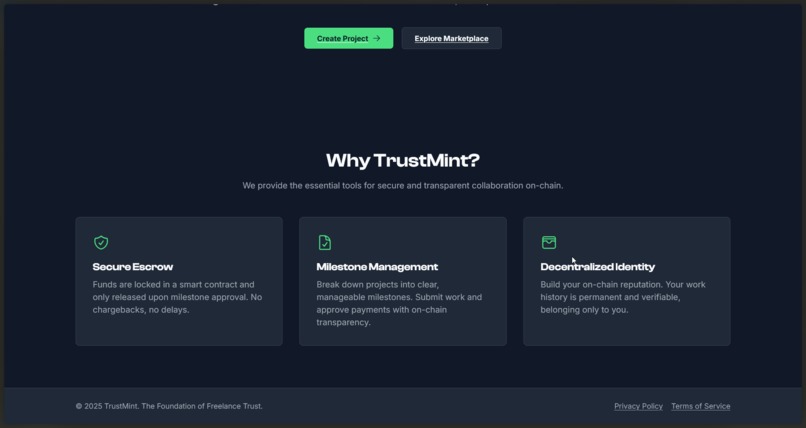
Feature set
-
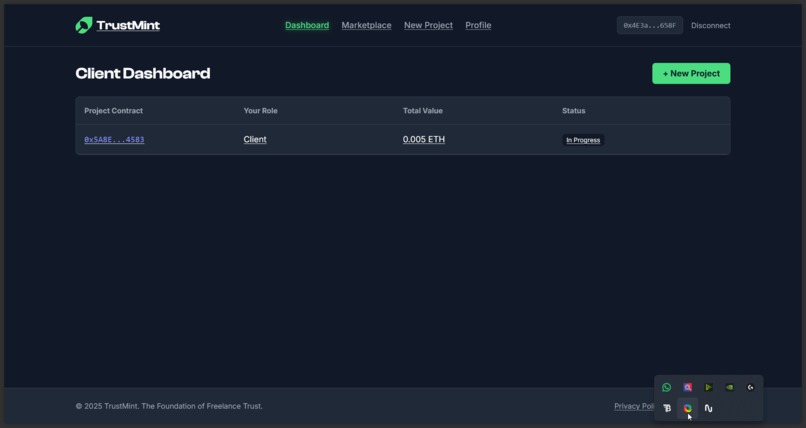
Client - Dashboard
-
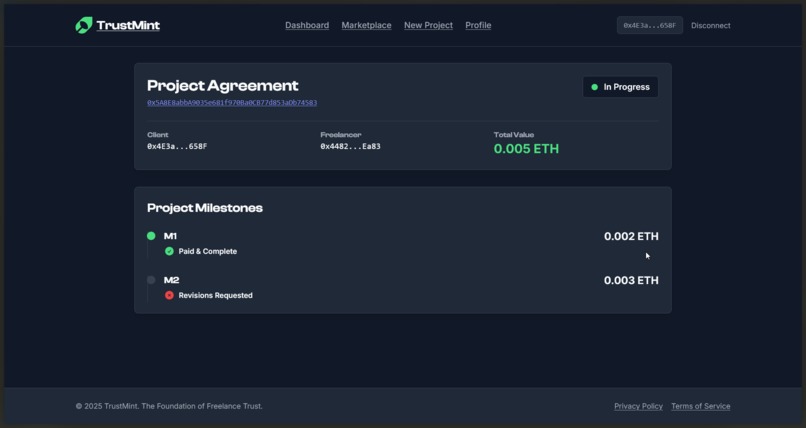
Client - Project Progress
-
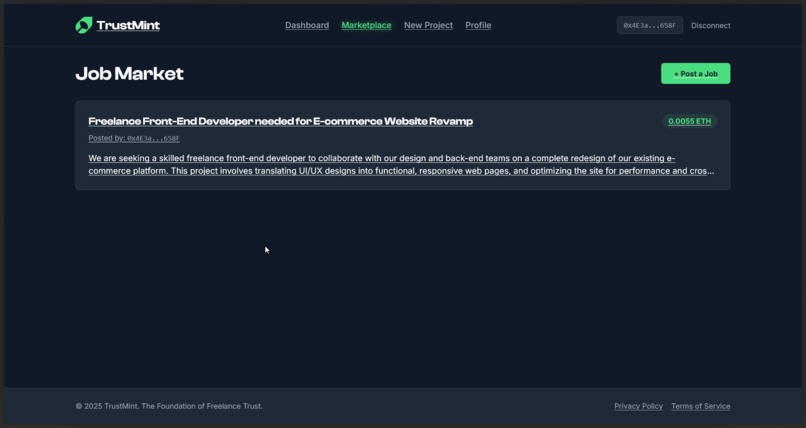
Client - Marketplace
-
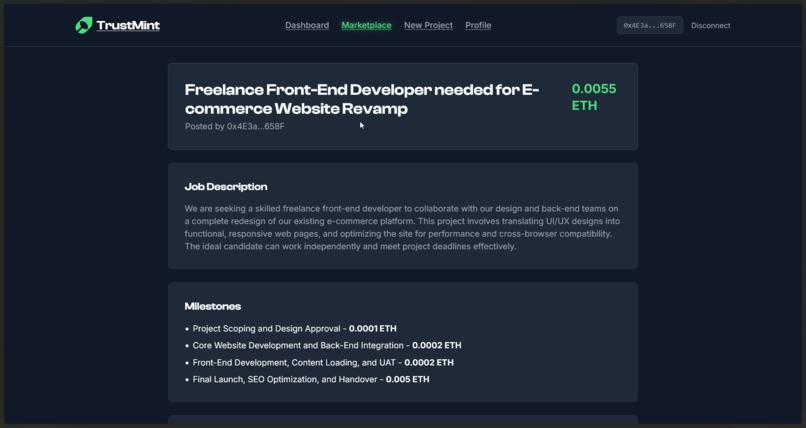
Client - Marketplace Job Description
-
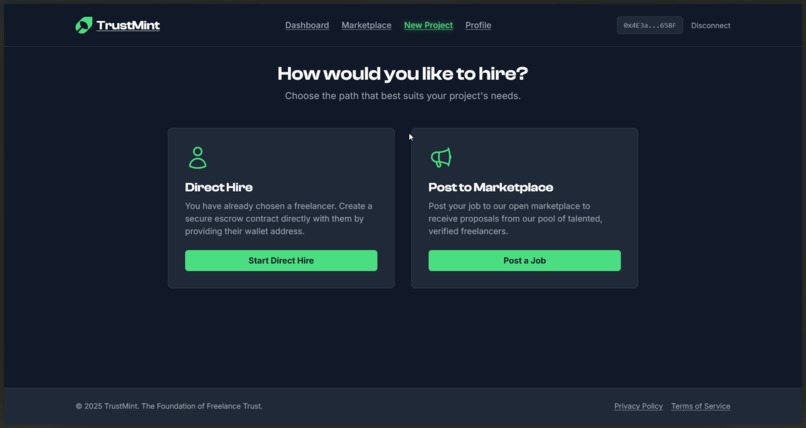
Client - Ways to Post/Assign Project
-
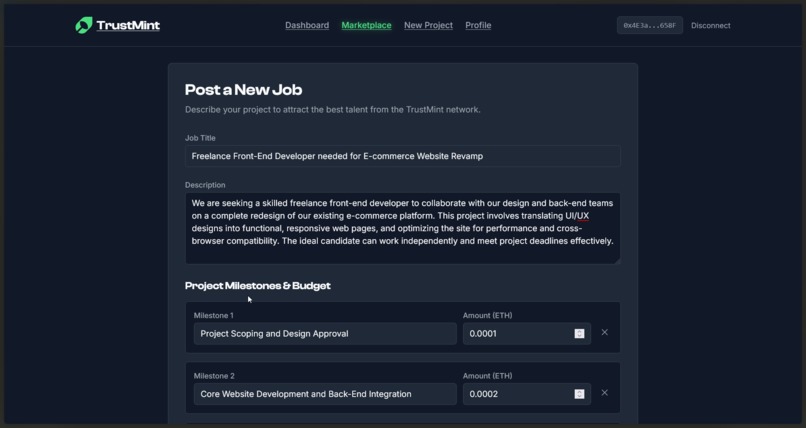
Client - Open Posting a Job in the Marketplace
-
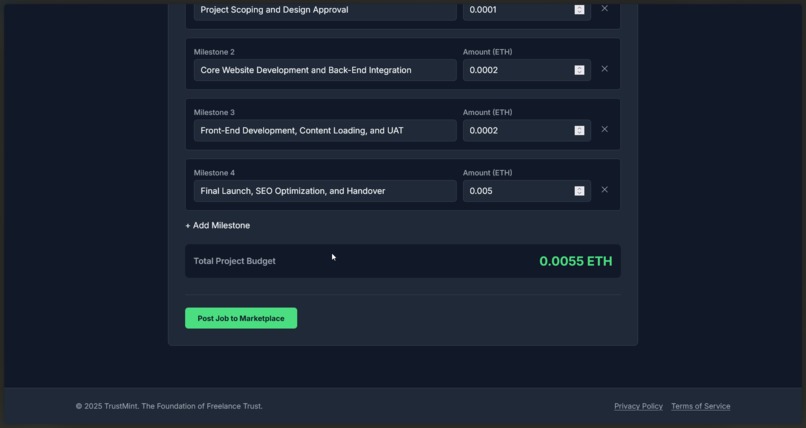
Client - Adding Milestone to Open Job Posting
-
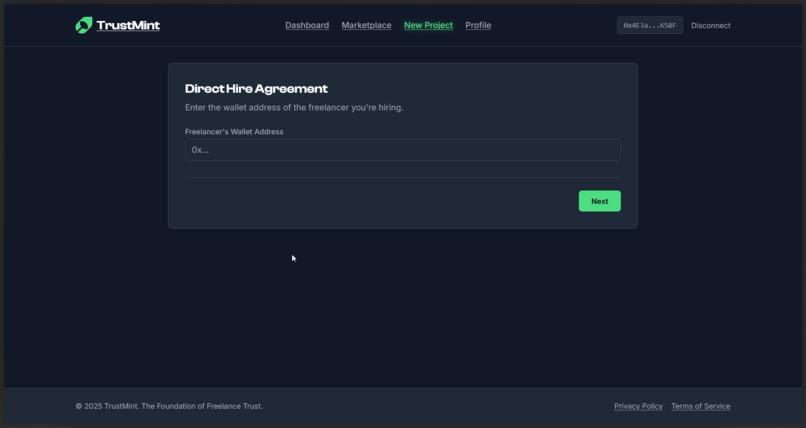
Client - Specified Approch to a Freelancer
-
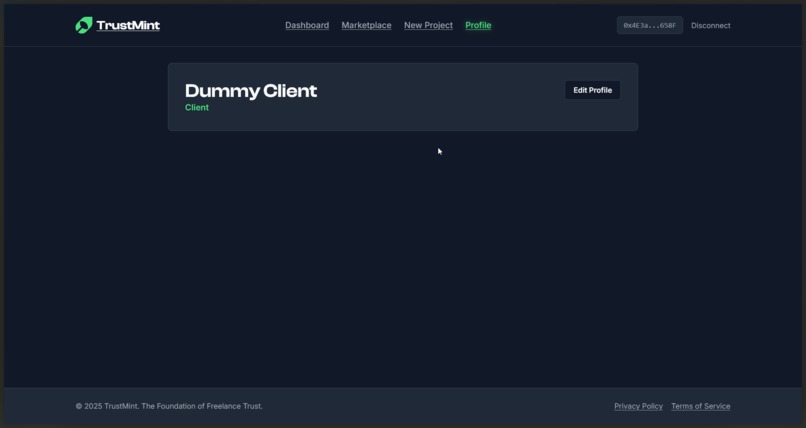
Client - Porfile Page
-
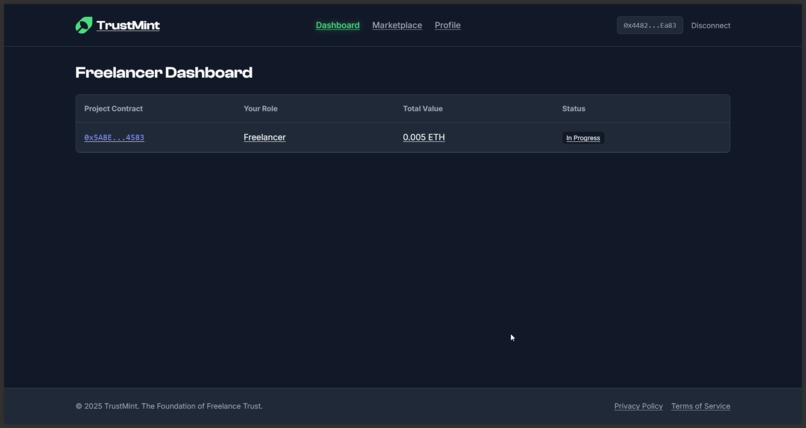
Freelance - Dashboard
-
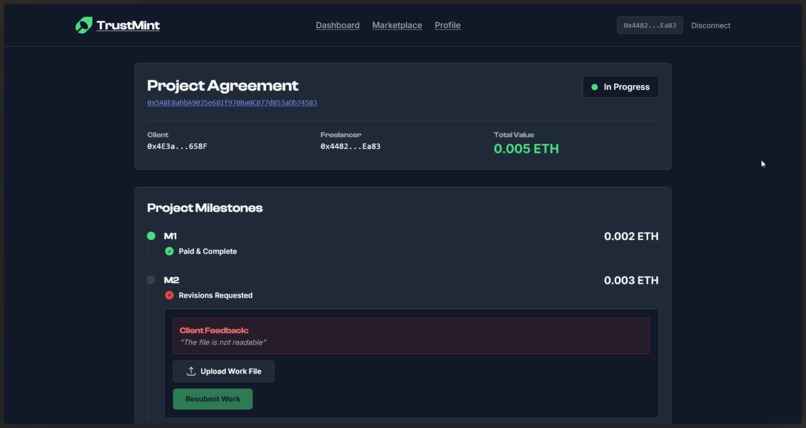
Freelance - In Job Details and Submittion
-
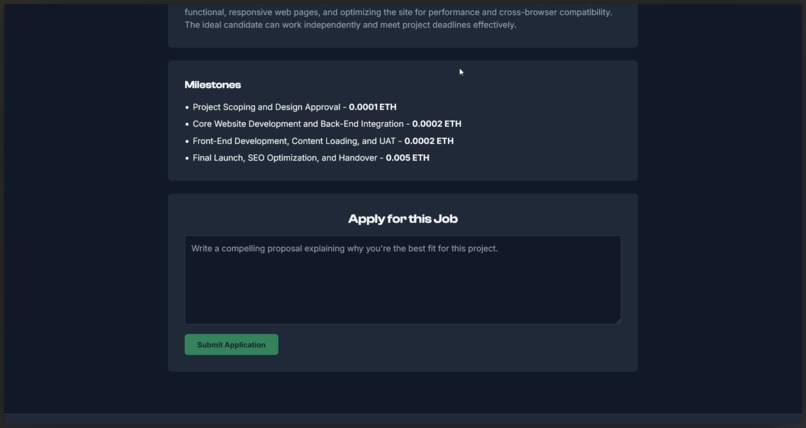
Freelance - Applying for Open Jobs
-
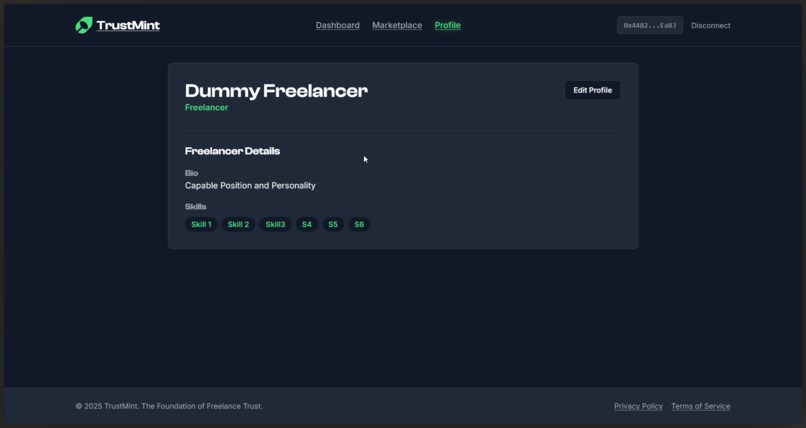
Freelance - Profile


The Forging of TrustMint: A Digital Artisan's Chronicle
Every great project begins not with a line of code, but with a question. For TrustMint, the question was simple, yet profound: "In a world of digital promises, where does true trust reside?"
This is the story of how I answered that question.
The Spark of Inspiration
I've navigated the freelance economy for years, both as a client and as a developer. I've witnessed its brilliance—the global talent pool, the freedom, the innovation. But I've also felt its deep-seated friction. The ambiguity of contracts, the anxiety of payments, the frustration of disputes, and the centralized platforms that hold all the power and extract exorbitant fees.
The system was built on a fragile, human-centric model of trust that often broke down. A client's fear of paying for unfinished work was matched only by a freelancer's fear of not being paid for completed work.
The inspiration for TrustMint was born from a simple conviction: Trust should not be a variable; it should be an axiom. It should be embedded, immutable, and transparent. The only technology capable of delivering this level of certainty is the blockchain. I wasn't inspired to build another freelance platform; I was inspired to build a foundation of trust upon which the future of freelance work could be built.
The Blueprint: Code as Craft
From the outset, the philosophy was "flawless execution." This project was to be a symphony of two distinct but harmonious disciplines:
1. The Backend as Pure Science: The on-chain logic had to be more than just functional; it had to be unimpeachable. Our smart contracts, written in Solidity, were designed to be our constitution.
// A glimpse into the philosophy: clear, purposeful, and secure.
contract Escrow {
    address public client;
    address public freelancer;
    ContractState public currentState;

    // ... logic for milestones, funding, and approvals
}
The architecture was modular by design: a TrustMintFactory to create new agreements, an Escrow contract to govern each project's lifecycle, a UserProfile contract for on-chain identity, and a JobMarket to connect talent. This separation of concerns wasn't just good practice; it was essential for security and scalability.
2. The Frontend as Digital Art: The most powerful backend is useless if the human interface is clumsy or intimidating. The user experience had to be breathtaking. It needed to feel as secure and premium as the logic that powered it.
I chose a stack built for this vision: React and TypeScript for a robust foundation, Vite for blistering speed, and Tailwind CSS for a utility-first design system. But the real magic came from an obsession with the details:
- A dual-font system:
Clash Displayfor bold, impactful headings andInterfor its supreme readability in UI text. - Fluid 60fps animations with
Framer Motionfor everything from page transitions to button clicks, making the application feel alive and responsive. - A "glassmorphism" aesthetic with subtle background gradients and blurred elements to create a sense of depth and modernity.
The Crucible: Challenges Faced & Lessons Learned
No masterpiece is forged without fire. The journey of building TrustMint was fraught with challenges that tested my skills and resolve, ultimately making the final product stronger.
The Unforgiving Nature of the Blockchain
Deploying a smart contract is like setting stone. Once on-chain, it is immutable. A single bug, a single logical flaw, could lead to the permanent loss of user funds. This reality instilled a profound sense of responsibility.
The Challenge: Writing bug-free, gas-efficient, and logically sound Solidity code that could handle every possible edge case.
The Learning: The mantra became "test, test, and test again." I developed a comprehensive suite of unit tests using Hardhat, simulating every user action from funding to disputes. I learned that in the world of Web3, the cost of a mistake is astronomical, and therefore the investment in rigorous testing is non-negotiable.
The Web3 User Experience Chasm
The biggest hurdle for Web3 adoption is its complexity. Wallets, gas fees, and transaction signing can be intimidating for newcomers.
The Challenge: How do you deliver the power of decentralization without burdening the user with its raw mechanics?
The Learning: Abstraction is key. The UI's job is to translate complex on-chain states into simple, human-readable actions. Instead of showing a raw ContractState enum of 3, the UI proudly displays a status of "In Progress." Every button, every notification was designed to guide the user, building their confidence and making the powerful technology in the background feel effortless and magical.
The Moment of Oblivion: A Lost Codex
In a moment of intense focus and carelessness, I realized I had failed to save the latest versions of my smart contracts locally after a session on Remix. The browser tab was gone, and for a heart-stopping moment, I thought weeks of work had vanished.
The Challenge: Recovering the source code when the only remaining artifact was the compiled bytecode on the Sepolia testnet.
The Learning: This was a humbling, terrifying, and ultimately invaluable lesson. I was able to recover the code by retrieving the verified source from Etherscan (a practice I had fortunately followed). This incident forged a new, unbreakable rule: Process is not a constraint; it is the framework that enables flawless execution. From that day forward, every change was committed to Git immediately, and contract verification became a mandatory step in my deployment pipeline.
The Masterpiece: Where We Are Today
TrustMint now stands as a testament to its founding vision. It is a dApp where freelancers and clients can collaborate with absolute certainty. Where the terms are clear, the funds are secure, and the platform itself is just a silent, impartial arbiter of the code.
It is a place where trust is no longer a promise, but a protocol.
And for me, it represents the culmination of countless hours of learning, building, and refining. It is a story written in TypeScript and Solidity, a piece of digital art and science that I am immensely proud to share with the world.


Log in or sign up for Devpost to join the conversation.