-
-
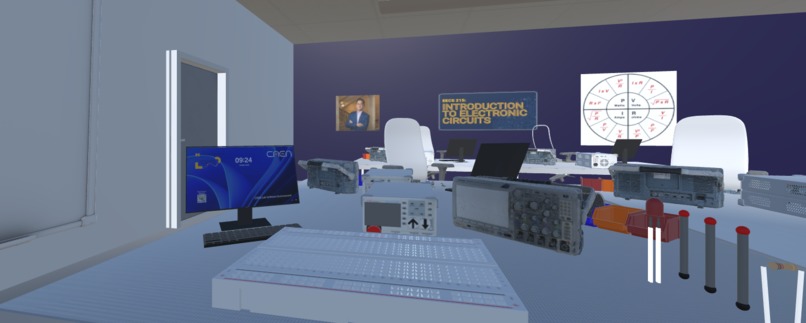
Lab Equipment Setup for the Student
-
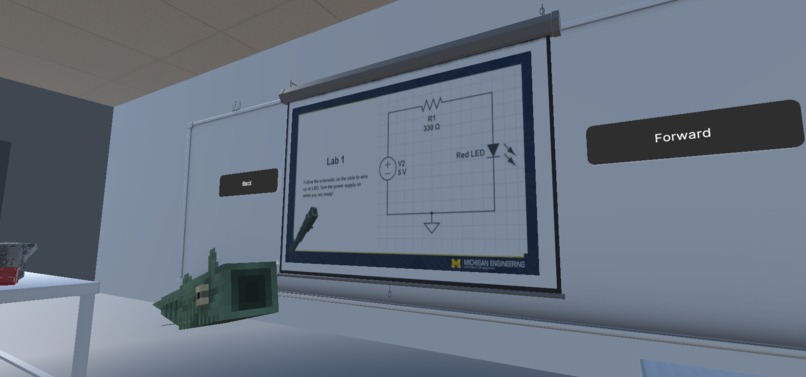
There are lessons to teach the basics of how circuits work.
-
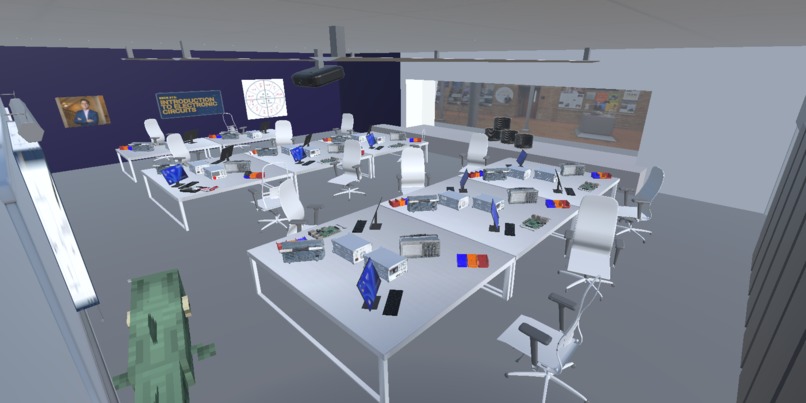
The environment is meant to represent the EECS 215 lab.
-


Inspiration
Software continues to dominate the Engineering job market. After all, CSE + LSA CS took up nearly a third of all graduates in the most recent semester. However, we believe that hardware is just, if not more important than software engineering! Through our experiences volunteering with elementary and middle schoolers, we were able to see an appreciation for hardware learning in youth. Through our experiences with VR, both in a hackathon project last year as well as personal projects, we saw an open area for growth in circuit education. Thus, we created V²/R to provide a more accessible and interactive option to circuitry basics.
What it does
V²/R is an educational VR breadboard simulator that aims to bring the equipment of a hardware lab to the hands of students. Upon exiting the splash screen, the user will be placed in a simulated environment (that resembles EECS building 215/216 lab). The user is provided with three circuit elements: resistors, wires, and LEDs. For connectivity, a sized down breadboard is available for the student. Eely the IA has lab slides for the student on the projector screen, for which the user can toggle through and read about as they figure out how to build the circuit.
The user can place the three elements on nodes of the circuit. Upon completing their circuit, the user can then activate the power supply. The power supply will then simulate the circuit, first ensuring the connections between elements on the circuit and then evaluating the various voltages and currents across each element. This will also evaluate the LED, lighting it up.
How we built it
We utilized Unity, Blender, and Github to complete this project. A Github repository was used as a form of version control between the three members, allowing us to view each others progress as the day went on. Unity formed the backbone of our VR implementation and is stored on the Github repository link below. We also utilized many mesh and .fbx files to simulate the lab environment, as well as recorded audio and imagery for the lab.
For distribution of work, a team member worked on evaluation of the circuit, a team member worked on the interactivity with the circuit board as well as overall integration, and a team member worked on 3d modeling and auxiliary implementations.
Challenges we ran into
Our team encountered some roadblocks through the process of constructing the project. While the learning curve to Unity was far less than Unreal Engine, there still many growing pains throughout implementation. Additionally, due to a rather weak project sharing system on Unity, the team members each had to work on an individual project file. This led to merging issues towards the end of the project that had to be resolved.
Accomplishments that we're proud of
Given the exploratory nature of Virtual Reality, we are exceptionally proud of the product we produced. Most team members had minimal experience working in Unity as well as C#, and we were able to overcome the boundary with many youtube videos, tutorials, and documentation. Highlights of this project include the connectivity between each element and the nodes of the breadboard as well as the circuit analysis program.
What we learned
Through the making of this project, we got to get more hands-on experience with the Unity XR toolkit. Additionally, the project allowed us to brush up on our circuitry and graphing knowledge, and we got to learn about circuit network analysis and apply a linear network analysis on the circuit components. We created an algorithm that would be able to recognize all of the simple closed loops implemented on the circuit and then the algorithm could print out what the current flowing through the component and resistance would be.
What's next for V2/R
The mathematics behind calculating the current and voltage of different circuit components is extremely intricate and complicated. Given the limited timeframe of MHacks, we were forced to leave behind many other core circuit capabilities and strictly limited to DC circuits. In the future, we would like to accommodate AC circuits including elements such as capacitors and inductors as well as op amps. Along with more circuit elements, we would like to have more testing equipment working. This would ideally be an oscilloscope and function generator as well as a voltmeter/ammeter.
Circuitry is a large topic that has many concepts. Through this project, we’ve shown that circuitry simulated in VR is accessible and can be extremely complex. We hope to inspire more hardware learning in K-12 education and we hope to give more power to the students!


Log in or sign up for Devpost to join the conversation.