-
-
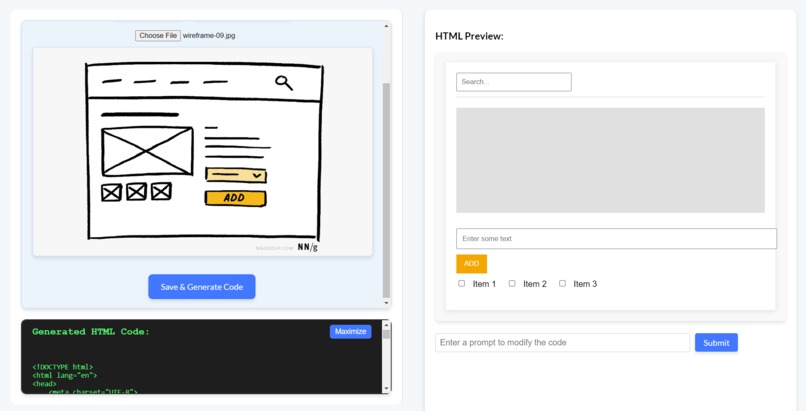
Conversion of 'drawing' to 'webpage' example with code below

Inspiration
The inspiration behind VisiCode comes from a deep desire to make web development accessible to everyone, regardless of their coding skills. We’ve seen so many people with amazing design ideas struggle to bring their visions to life because they lack the technical know-how. By creating VisiCode, we want to empower creative minds to transform their sketches or images into functional websites, bridging the gap between imagination and execution. It’s about turning visual creativity into something tangible—instantly and effortlessly.
What it does
Our web app converts hand-drawn sketches or images into code and gives you a live preview. The app lets users upload or draw an image, which is then analyzed and converted into a corresponding code snippet, offering a real-time preview of the result. You sketch your design, and the app generates the HTML/CSS code for you. Users can create or upload drawings of web layouts, and the app automatically generates the corresponding code (e.g., HTML/CSS) to match the design. It bridges the gap between visual designs and code. This app simplifies the design-to-development workflow by translating visual elements into actual working code, allowing designers and developers to collaborate more efficiently.
How we built it
We built an image-to-code and drawing preview web app using React and the GPT API. It takes user-uploaded images or drawings and generates preview code snippets in real-time. The frontend is built with React, allowing for a dynamic user interface, while GPT handles the code generation logic. The app seamlessly previews the code and visuals, providing a highly interactive experience.
Challenges we ran into
One of the biggest challenges we encountered was the interpretation of hand-drawn sketches into structured code. Unlike an image-based mockup, freehand drawings can be imprecise and messy, making it difficult to translate them into accurate HTML and CSS elements. To overcome this, we had to fine-tune the input processing algorithm and work closely with the GPT model to teach it to recognize common patterns in sketches—things like headers, buttons, and sections. It was a delicate balance between giving users creative freedom while ensuring the app could still produce clean, functional code.
Another major challenge was building the real-time live preview system. Since the generated code could vary in complexity depending on the input, ensuring a seamless, lag-free preview required optimizing the HTML parser and implementing efficient state management in React. The challenge here was maintaining performance while constantly updating the live preview based on both the initial image input and any adjustments made via the Quick Fix feature.
Finally, ensuring that users could make meaningful adjustments in the Quick Fix text box without overwhelming them was a unique challenge. We had to design it in a way that’s powerful enough for technical users but intuitive for non-technical users. Creating a balance between simplicity and flexibility required several iterations of user testing and feedback to refine the interface and feature set.
Accomplishments that we're proud of
Real-Time Code Generation: We successfully integrated GPT API to generate HTML, CSS, and React code in real time from hand-drawn sketches, making coding more accessible to non-developers and creatives. Seamless Design-to-Code Workflow: Visicode can transform rough design concepts into fully functional frontend code, drastically reducing the time it takes to go from an idea to a prototype. User-Friendly Interface: Built using React, the web app provides a clean, intuitive UI, enabling users to quickly visualize and tweak their designs without overwhelming complexity. AI-Powered Refinements: We implemented a ‘Quick Fix’ feature where users can fine-tune their generated code using simple text inputs, leveraging AI for seamless corrections. Rapid Development: We pulled off the entire project—design, build, and testing—in a single all-nighter, fueled by passion, determination, and a lot of coffee! Our project provides an interactive and educational experience by automating the generation of visual content. This makes complex topics easier to understand and more engaging for learners. After countless hours of debugging and fine-tuning, we finally got it running smoothly... and pulled an all-nighter to make it happen! 😄
What we learned
Each tool had its unique learning curve, but combining them to achieve seamless video generation and storage taught us valuable lessons in system integration and communication between components. Throughout the project, we encountered several complex errors related to encoding, API integration, and cloud storage. We learned the importance of robust error handling and how to quickly identify and resolve issues like encoding mismatches, failed API requests, and cloud storage endpoint errors. This experience improved our debugging skills and deepened our understanding of how to create resilient systems.
What's next for Visi Code
This project is designed with scalability in mind. We aim to make this project much bigger than it is right now, perhaps supply this software to companies and even consumers that require visual to code aid. Visi code has only scratched the surface of its potential. Next, we’re focusing on expanding its capabilities to support more complex designs, adding customizable templates, and improving the speed of code generation. We're also exploring integrations with popular frameworks like Next.js and Tailwind to offer users even more flexibility. Ultimately, we envision Visi code becoming a creative hub where developers and designers can collaborate effortlessly. Stay tuned—things are about to get even more exciting!
Built With
- api
- css
- gpt
- html
- javascript
- react
- vscode


Log in or sign up for Devpost to join the conversation.