-
-
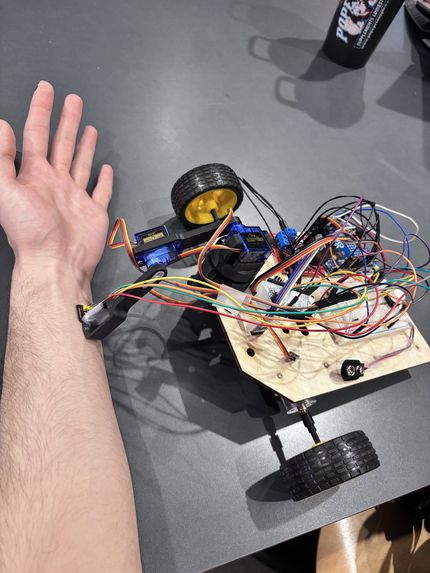
Vital-E In Action
-
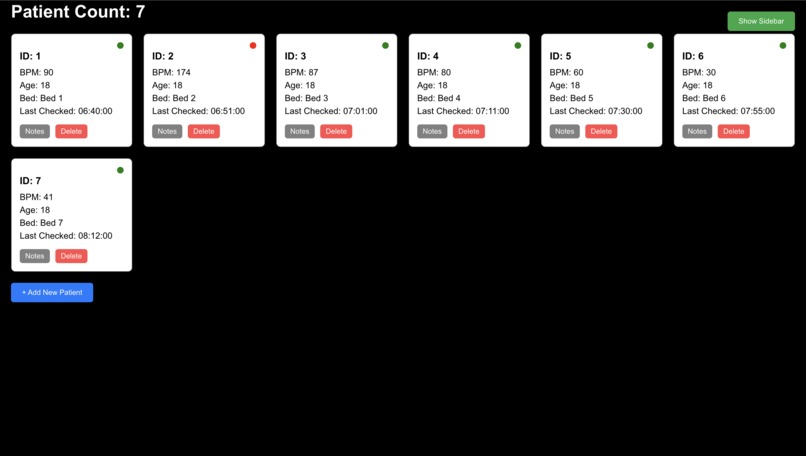
Dashboard Overview


Inspiration 💡
The Global Goals, also known as the Sustainable Development Goals (SDGs), are a set of 17 objectives adopted by the United Nations to create a better and more sustainable future by 2030. Goal #3, "Good Health and Well-Being," focuses on ensuring healthy lives and promoting well-being for people of all ages. This includes reducing maternal and child mortality, combating infectious diseases, ensuring universal access to healthcare, and promoting mental health.
What it does 🤖
Vital-E is an Autonomous Vital Monitoring Robot designed to:
- Navigate hospital settings autonomously using line-following technology
- Read patient vitals, specifically heart rate, using an MH-ET Live heart rate sensor
- Store collected data on a website for real-time access by doctors
- Reduce the workload of healthcare professionals in impoverished countries
- Ensure timely and consistent patient monitoring
How we built it 🔨
We developed Vital-E using the following components and technologies:
- ESP32 microcontrollers for processing and control
- MH-ET Live heart rate sensor for vital sign monitoring
- Color sensor for identifying patient locations
- Proximity sensor to determine the robot's position relative to the patient's hand
- Line-following sensors for autonomous navigation
- Custom algorithms for decision-making and navigation
- Web interface for data storage and access by medical staff
Challenges we ran into 🚧
During the development of Vital-E, we faced several challenges:
- Ensuring accurate vital sign readings in various environmental conditions
- Developing robust autonomous navigation for diverse hospital layouts
- Integrating multiple sensors and actuators into a cohesive system
- Designing a user-friendly interface for medical staff to access patient data
- Balancing the robot's functionality with cost-effectiveness for deployment in resource-limited settings
Accomplishments that we're proud of 🎯
We are proud of several key achievements:
- Creating a functional prototype that successfully navigates and collects vital signs
- Developing a scalable and modular design that can be easily adapted to different healthcare needs
- Addressing a critical global healthcare issue aligned with SDG #3
- Designing a solution that can potentially improve health outcomes and reduce the burden on healthcare workers
- Successfully integrating multiple technologies into a cohesive, autonomous system
What we learned 👺
Throughout this project, our team gained valuable insights and skills:
- Deepened our understanding of the global healthcare challenges and the UN Sustainable Development Goals
- Enhanced our knowledge of robotics, sensor integration, and autonomous systems
- Improved our problem-solving skills in resource-constrained environments
- Learned about the complexities of designing healthcare solutions for diverse settings
- Gained experience in interdisciplinary collaboration, combining healthcare knowledge with engineering skills
What's next for Vital-E 🚀
To be able to navigates hospital environments autonomously utilizing lines on the ground Lowers arm with heart rate sensor attached to the end onto patient’s hand to collect readings Impact and Justification. This robot addresses the global healthcare workforce shortage, especially in low-income countries, where doctor-to-patient ratios are critically low. By automating vital monitoring, it ensures no patient is overlooked, reduces the risk of medical errors due to staff fatigue, and improves response times during emergencies. This solution is scalable, cost-effective, and adaptable to various healthcare settings, making it a powerful tool for advancing SDG #3.
Built With
- arduino
- esp
- http
- javascript
- python
- react




Log in or sign up for Devpost to join the conversation.